
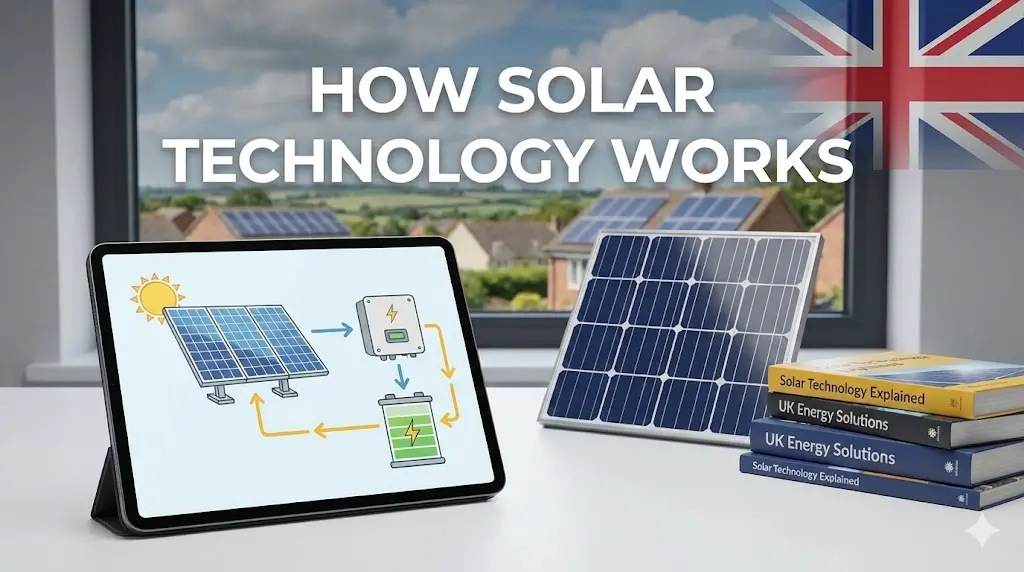
Solar power has moved from a niche eco-conscious choice to a mainstream financial asset. With over 1.7 million installations now active across the UK, understanding the mechanics behind the technology is essential for homeowners looking to maximise their investment [GreenMatch].
Whether you are curious about the physics of the “photovoltaic effect” or deciding between battery configurations, this guide breaks down the science of solar into simple, actionable insights.
1. How Do Solar Panels Work? (Step-by-Step)
Solar Photovoltaic (PV) panels convert sunlight directly into electricity. They do not need heat to work; they need light. In fact, cold, sunny days often produce the best output because heat can actually reduce efficiency [Renewable Energy Hub].
The 4-Step Process:
Absorption (The PV Effect)
Solar panels are made of semi-conducting materials, usually silicon. When sunlight (photons) hits these silicon cells, it knocks electrons loose from their atoms. This movement of electrons creates an electric current [Energy Saving Trust].
DC Generation
The electricity generated within the panels is Direct Current (DC). This is the same type of power found in batteries, but it is not what your home appliances use [MoneySavingExpert].
Conversion (The Inverter)
The DC electricity flows through cables to an inverter. This device is the “brain” of the system, converting DC into Alternating Current (AC), which is the standard voltage (230V) used in UK homes [Spirit Energy].
Distribution
This AC electricity flows into your fuse box (consumer unit). It is automatically used to power your lights and appliances. Any excess energy is either stored in a battery or exported to the National Grid [MoneySavingExpert].
2. Solar Panel Efficiency: What It Means & How to Improve It
Solar panel efficiency refers to the percentage of sunlight hitting the panel that gets converted into usable electricity. In 2026, standard efficiency for premium residential panels ranges between 22% and 25%, a significant leap from the 15% efficiency seen a decade ago [SunSave].
Key Factors That Affect Efficiency:
The market has shifted toward N-Type monocrystalline cells (like TOPCon and Heterojunction). These degrade slower and perform better in low-light conditions compared to older P-type panels [Neexgent].
Solar panels love light but hate heat. As panels get hotter (above 25°C), their efficiency drops. Modern N-Type panels have a better “temperature coefficient,” meaning they lose less power during UK summer heatwaves [NRG Clean Power].
Even a small amount of shade (from a chimney or tree) can impact a whole string of panels. Using micro-inverters or optimisers can mitigate this by allowing each panel to work independently [Renewable Energy Hub].
How to Maximise Output: While you cannot control the weather, you can control the setup. South-facing roofs are optimal, but East/West splits are increasingly popular for matching generation with morning and evening usage [SELCE].
3. Solar Battery Storage Explained
A solar battery is now a critical component for UK homes. Without one, a typical household only uses about 20–30% of the solar energy they generate. Adding a battery can boost this “self-consumption” to 70–80% [Optimum Electrics].
There are two main ways to connect a battery:
AC-Coupled vs. DC-Coupled
DC-Coupled
The battery connects directly to the solar panels before the electricity is converted to AC. This is more efficient because energy is only converted once (DC → DC battery → AC home), reducing energy loss [Aurora Solar].
AC-Coupled
The battery connects to the home’s main AC power supply. This is ideal if you are adding a battery to an existing solar array, as it doesn’t interfere with your current inverter setup [MoneySavingExpert].
Smart Tariffs and Grid Trading
Modern batteries do more than just store solar. Smart tariffs (like Octopus Flux) allow you to charge your battery from the grid during cheap overnight hours (e.g., 2 am–5 am) and sell stored energy back to the grid during peak times (4 pm–7 pm) when prices are highest. This “arbitrage” can significantly reduce the payback period [MoneySavingExpert].
Summary: The Tech Checklist for 2026
- Panels: Look for N-Type Monocrystalline panels with efficiency above 21% [Neexgent].
- Inverter: Ensure your inverter size matches your array. If you have shading issues, ask for optimisers [Renewable Energy Hub].
- Connection: For systems larger than 3.68kW (per phase), your installer must submit a G99 application to the Distribution Network Operator (DNO) to ensure the grid can handle your export [EcoFlow].
Learn More About Solar
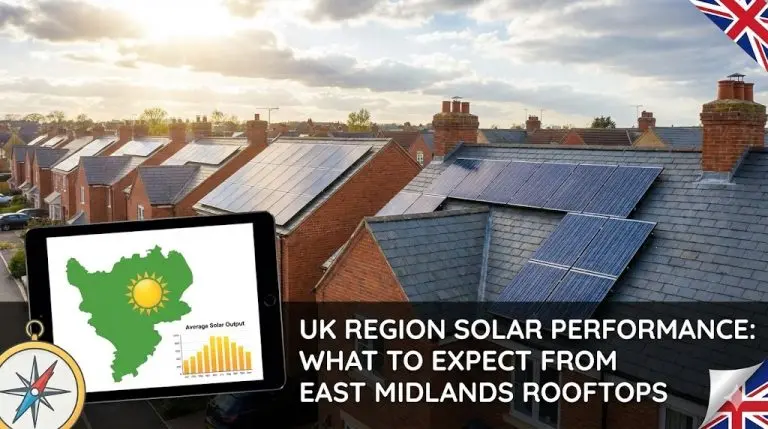

UK region solar performance: What to expect from East Midlands rooftops
UK Region Solar Performance: What to Expect from East Midlands Rooftops While the sunny South…

Solar installer checklist for homeowners in Retford
The Ultimate Solar Installer Checklist for Retford Homeowners (2026 Edition) For homeowners in Retford, the…
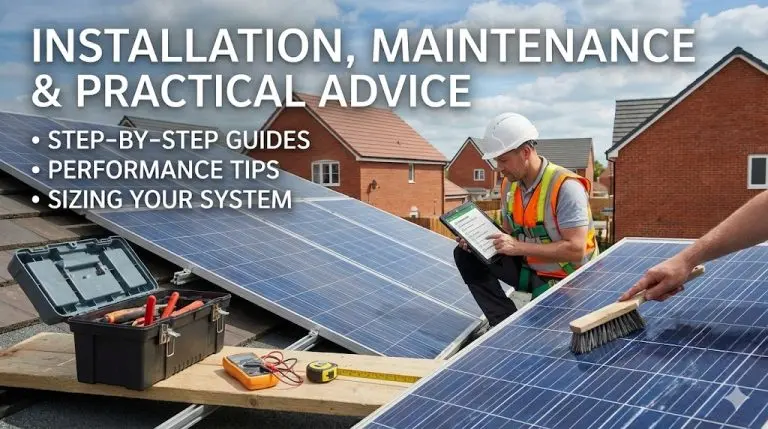
Installation Guides, Practical Advice & Maintenance Tips
The Practical Guide to Solar: Installation, Grid Connections & Maintenance Installing solar panels is a…
