
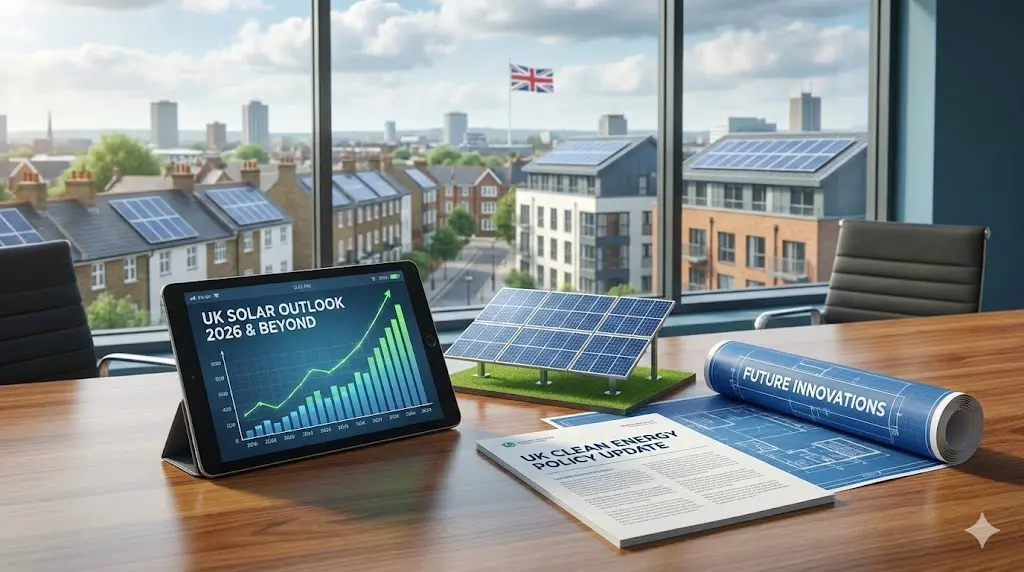
2026 marks a watershed moment for the UK energy sector. With solar generation rising by 26% in late 2025 alone and renewables now accounting for approximately 54.7% of total electricity generation, the transition from fossil fuels is accelerating faster than predicted.
For homeowners, businesses, and investors, the market has shifted from a subsidized “early adopter” phase to a mature, policy-driven ecosystem. From the launch of Great British Energy to critical grid reforms, here is the state of the UK solar market in 2026.
1. Great British Energy (GBE) and the “Clean Power” Mission
The headline development for 2026 is the strategic deployment of Great British Energy (GBE). Headquartered in Aberdeen, this publicly owned energy company has officially entered its operational phase with a mandate to deliver 15 GW of clean energy by 2030.
GBE aims to mobilize £15 billion in private finance to accelerate renewable infrastructure.
A £1 billion “Energy, Engineered in the UK” programme has been launched to domesticate supply chains, reducing reliance on imports for critical grid and solar components.
2. The Solar Roadmap: 47GW by 2030
To support the “Clean Power 2030” mission, the government has published an aggressive Solar Roadmap targeting 47GW of solar capacity by 2030—more than double the current capacity of roughly 18–19GW.
To achieve this, significant planning reforms have been enacted in 2026:
The National Planning Policy Framework now requires local planning authorities to give “significant weight” to the benefits of renewable energy, reducing the likelihood of refusals for well-sited projects.
The threshold for solar projects to be classified as “Nationally Significant Infrastructure Projects” (NSIP) has been raised from 50MW to 100MW. This allows mid-sized commercial solar farms to bypass the slower central examination process and move through local planning faster.
New build mandates are expected to normalize solar installations on the vast majority of new residential properties.
3. Grid Connection Reform: “First Ready, First Connected”
A historic bottleneck for UK solar has been the “grid queue,” where viable projects were stuck behind stalled developments. In 2026, the “First Ready, First Connected” system is fully active.
Projects are now split into Gate 1 (provisional) and Gate 2 (ready to build).
Developers who hoard grid capacity without progressing are now removed from the queue, freeing up capacity for viable residential and commercial connections.
4. Financial Deadlines: The “Clock is Ticking” in 2026
While the market is strong, 2026 represents a critical “closing window” for several high-value financial incentives.
ECO4 Ending
The ECO4 scheme, which provides up to 100% funding for low-income households, is scheduled to end on 31 March 2026.
Business Tax Relief
“Full Expensing,” which allows businesses to write off 100% of solar installation costs against taxable profits in the first year, is currently legislated to end in March 2026.
VAT Relief
The 0% VAT rate on residential solar and battery storage remains active but is set to expire on 31 March 2027.
Feed-in Tariff (FiT) Review
For early adopters on legacy FiT schemes, a government review in 2026 may introduce caps on returns or require upgrades to smart meters and storage to maintain payments.
⚠️ Action Required: If you’re eligible for ECO4 or considering commercial installation with Full Expensing, these incentives expire within months.
5. Emerging Technology: Efficiency and Intelligence
The technology installed in 2026 is markedly different from the panels of the previous decade.
Perovskite Tandem Cells
These advanced cells are entering commercial production, offering efficiencies of 24–28% (compared to the standard 20–23%). While they offer higher output for small roofs, warranties are currently shorter (circa 20 years) compared to standard silicon.
AI Smart Inverters
New inverters utilize AI to predict local weather patterns and optimize battery usage, potentially boosting yields by 5–15%.
Bifacial Mainstreaming
Bifacial panels, which capture light from both the front and back, are becoming standard for flat-roof and ground-mounted commercial systems, boosting output by 5–30%.
6. Regional Policy Variances
Policy is increasingly devolved, creating distinct market conditions across the UK.
Ymestyn Grant
Available for public sector and community enterprises, offering up to 40% capital grants for projects with payback periods longer than 10 years. Applications close February 2026.
Home Energy Scotland Grant
Continues to be the most generous residential scheme, offering up to £7,500 in grant funding plus interest-free loans.
NISEP Grant
While residential grants remain limited, the 0% VAT rule applies, and the NISEP grant can cover up to 20% of costs for businesses.
7. Safety and Sustainability Focus
As the volume of installations hits record highs, industry standards are tightening.
🔥 Fire Safety
The Building Research Establishment (BRE) has formed the PV Fire Intelligence Network (PV-FIN) to gather data and improve safety standards, addressing a lack of historical data on solar fire risks.
♻️ Circular Economy
With waste volumes rising, the industry is moving toward high-value recycling, recovering high-purity silicon, silver, and copper rather than just glass and aluminium frames.
Summary Outlook
The 2026 UK solar market is defined by integration. Solar is no longer treated as a standalone “add-on” but as a critical infrastructure component, integrated with heat pumps, EVs, and smart grids. For consumers and businesses, the immediate priority is capitalizing on the incentives (ECO4, Full Expensing) set to expire this year, while navigating the new planning freedoms to maximize system size and output.
Learn More About Solar

UK region solar performance: What to expect from East Midlands rooftops
UK Region Solar Performance: What to Expect from East Midlands Rooftops While the sunny South…

Solar installer checklist for homeowners in Retford
The Ultimate Solar Installer Checklist for Retford Homeowners (2026 Edition) For homeowners in Retford, the…
Installation Guides, Practical Advice & Maintenance Tips
The Practical Guide to Solar: Installation, Grid Connections & Maintenance Installing solar panels is a…
