
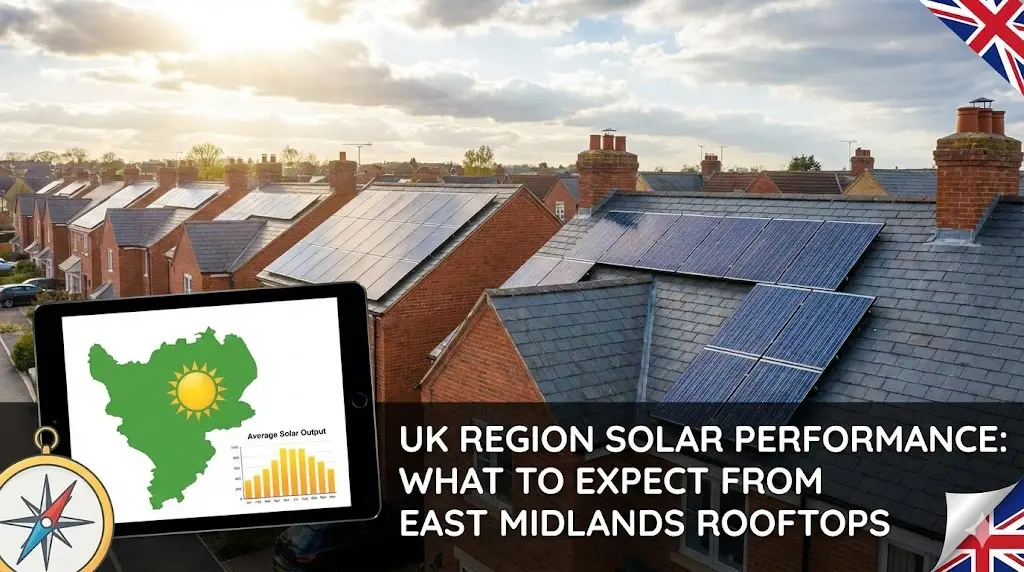
While the sunny South Coast often grabs the headlines for solar potential, the East Midlands has quietly become a powerhouse for renewable energy. As of December 2024, the region has recorded over 133,000 solar installations, proving that you do not need a tropical climate to generate meaningful electricity.
Whether you live in rural Lincolnshire or urban Leicester, here is a realistic breakdown of performance, costs, and savings for East Midlands rooftops in 2026.
1. The “Cloudy Day” Myth: Does the East Midlands Get Enough Sun?
“Solar panels require blazing sunshine to work”
A common misconception is that solar panels require blazing sunshine and high temperatures to work. In reality, modern solar photovoltaics (PV) generate electricity from daylight, not just direct sunlight.
Diffuse Light: Panels function efficiently in “diffuse light”—the light that penetrates through cloud cover. In fact, extreme heat can actually reduce panel efficiency, meaning the temperate climate of the Midlands is often well-suited for consistent generation.
Regional Variance: While southern European countries have an edge in consistent sunshine, the UK—including the Midlands—receives sufficient daylight to power millions of homes annually.
2. Installation Hotspots: Where is the East Midlands Leading?
Solar adoption varies significantly across the region. As of late 2024:
Likely driven by favourable roof orientations and slightly higher coastal light levels
Lower uptake due to higher density of terraced housing or shaded properties
3. Financial Outlook: Costs and Savings
For a standard semi-detached home in the region, the economics of solar have stabilized.
Battery Boost: Adding a battery increases the upfront cost but can reduce the payback period to 7–10 years by allowing you to store energy for evening use.
⚠️ Crucial Deadline: The 0% VAT rate on solar panel and battery installations is currently active but is legislated to end on 31 March 2027. Installing before this date saves you roughly £1,200–£1,600 in tax.
4. Roof Orientation: It Doesn’t Have to Be South-Facing
While a south-facing roof is optimal, East Midlands homeowners with East or West-facing roofs can still achieve excellent results.
South-Facing
Maximum energy generation throughout the day
East/West Split
Generates power in morning and evening when working families are actually home to use it
Lifestyle Match: East/West arrays often suit working families better, generating power when people are home rather than during the middle of the day when the house is empty.
5. Grants and Incentives Available in the Region
While the “free solar” days of the Feed-in Tariff are gone, targeted support remains available for specific households in England.
If your household income is under £31,000 or you receive means-tested benefits, you may qualify for a fully funded installation to improve your EPC rating.
Launched in April 2025, this scheme provides up to £15,000 for energy upgrades (including solar) for low-income households in eligible postcodes or those with an EPC rating between D and G.
Regardless of income, all solar owners can get paid for exported energy. Rates vary wildly; while some suppliers offer a paltry 1p/kWh, others like Octopus Energy and OVO offer rates between 15p and 29p per kWh.
6. The Grid Connection: G98 vs G99
Before installing, your installer must notify your Distribution Network Operator (DNO).
G98: Standard Homes
For systems under 3.68kW, your installer uses the G98 process, which is a simple “install and notify” procedure.
G99: Large Systems/Batteries
If you plan a large array or a high-capacity battery (over 3.68kW), you need G99 approval before installation. This can take 4–8 weeks, so factor this into your project timeline.
Summary Checklist for East Midlands Homeowners
- Check your roof: Ideally pitched between 30° and 40°.
- Verify Accreditation: Ensure your installer is MCS certified; without this, you cannot claim SEG export payments.
- Beat the VAT deadline: Complete your installation before March 2027 to lock in the 0% VAT rate.
- Shop for Tariffs: Don’t settle for a default export rate; compare SEG tariffs to maximize your earnings.
Learn More About Solar


Solar installer checklist for homeowners in Retford
The Ultimate Solar Installer Checklist for Retford Homeowners (2026 Edition) For homeowners in Retford, the…
Installation Guides, Practical Advice & Maintenance Tips
The Practical Guide to Solar: Installation, Grid Connections & Maintenance Installing solar panels is a…
UK Market Trends, Policy & Future Outlook
UK Solar Market Trends, Policy & Future Outlook: The 2026 Landscape 2026 marks a watershed…
