
Solar panels
A system designed around your roof and how your household uses electricity, with a 25-year product warranty and a 30-year performance warranty on the panels.
Solar panels in more detail
 5.0 on Google
If you have solar panels, or are about to get them, a battery lets you use more of what they make. Solar generation is highest during the day, when many homes use the least electricity, and home solar battery storage keeps that electricity for the evening. We fit batteries with new solar panels and add them to existing systems, including ones other companies fitted.
0% depositNothing to pay when you sign
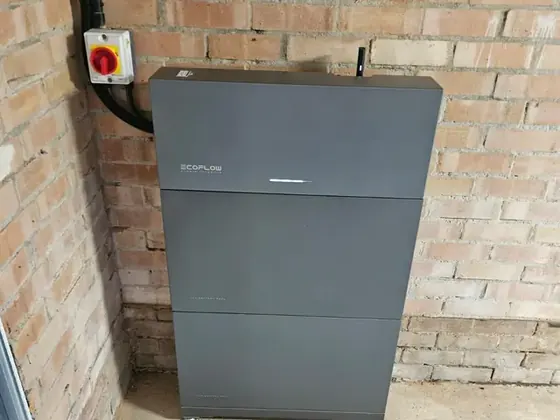
Batteries we've fitted
or call 0333 577 6576Monday to Friday, 9am to 5pm





A home battery storage system sits alongside your solar panels and inverter, often in a garage, a utility room or on an outside wall. Solar panels make direct current (DC) electricity, and batteries store it that way. The inverter converts it to alternating current (AC) for your home.
Solar generation is highest during the day, when many homes use the least electricity.
Electricity your home doesn't use straight away charges the battery, instead of all going to the grid.
When the sun has gone down, your home uses what the battery stored, so you buy less from the grid.
Anything left over still goes to the grid, and you buy from it as usual when the battery runs low.
Without a battery, excess electricity your home doesn't use straight away goes to the grid. With one, the battery can store electricity generated in the day for use later, when the sun has gone down, so you buy less electricity from the grid.
Some energy suppliers offer time of use tariffs, where electricity prices are lower at off-peak hours, usually overnight. The battery can charge then and power your home through the day. Some of our customers do exactly this.
You can see what your panels are making, what's in the battery and what you're using, and we'll show you how before we leave.
Already have solar panels? Adding battery storage is usually possible. Depending on your current inverter, that might mean an AC-coupled battery with its own inverter, or a DC-coupled battery on a new hybrid inverter that runs both the panels and the battery. We ask about your inverter and consumer unit (fuse board) before we quote, and the technical survey checks them once you've signed.
If you're installing solar panels for the first time, we can fit the battery at the same time.
Bigger isn't always better. The right battery depends on how much your panels make and when your household uses electricity.
5 to 15 kWh
what home solar batteries typically hold. They're lithium-ion; kWh means kilowatt hours.
Which?
10 kWh
what a typical home system might be
Energy Saving Trust
8 to 10 kWh
of electricity the average home uses a day
Which?
About 20%
left in the battery: it stops at a set level rather than discharging to zero, so usable capacity is less than the stated storage capacity
Energy Saving Trust
At your consultation we look at your solar generation and your electricity usage pattern, then recommend a size and explain why. If you're planning a heat pump or an electric vehicle, tell us, as either changes how much electricity you use. Batteries we've fitted include EcoFlow systems.
Solar panels can't normally power your home in a power cut. Grid-connected systems have to disconnect when the grid goes down, for the safety of the network.
A battery doesn't provide backup power by default either. The Energy Saving Trust says it normally needs additional equipment and configuration to keep anything running. Some systems can keep essential circuits going when the grid is down; if that matters to you, tell us at your consultation and we'll explain which options do, and for how long.
They disconnect when the grid goes down, for the safety of the network.
Usually off too: backup needs additional equipment and configuration.
Some systems keep essential circuits going. Ask us which, and for how long.
The fire safety standard for home batteries, PAS 63100, says storage batteries should be installed outdoors where practicable.
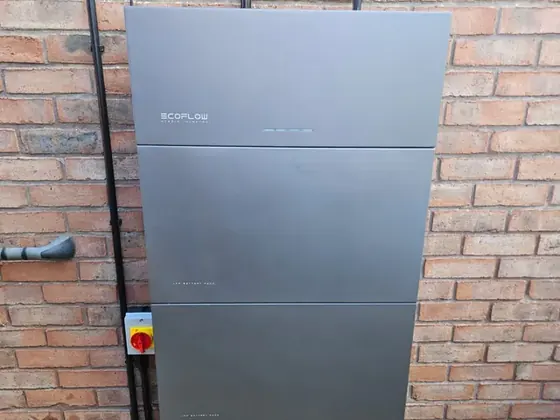
About 100 by 60 by 25 cmBattery units are typically about this size, according to the Energy Saving Trust. We agree the spot with you before anything is fitted.
The size of the battery system, the battery model, whether you need a new inverter and where the battery goes make the difference.
£1,500 to £10,000
for a home battery, from the smallest to the largest
Energy Saving Trust
Around £4,600
for a 5 kWh battery system
Energy Saving Trust
Around £9,000
the average battery installation in 2025
MCS
0% VAT
on batteries fitted to homes until 31 March 2027, including batteries added to existing panels
A battery typically lasts 10 to 12 years, according to the Energy Saving Trust, and warranties are often 10 years.
It depends on when you use electricity. Export rates vary, but the Energy Saving Trust puts export at around 12p a unit, while grid electricity costs more than twice that. So storing your solar power for the evening usually cuts your energy bills by more than exporting it would. Solar batteries work best if you use more electricity in the evening or can charge on a cheap overnight tariff.
The Energy Saving Trust notes that the savings won't always be enough on their own to justify the cost of a battery. If you'd like to compare, we'll price your system with and without one.
Export: Energy Saving Trust. Buying: Ofgem's price cap for October to December 2026.
Rated 5 out of 5 on Trustpilot
If you need a solar system with battery storage then do not hesitate to call Solar Save, i have been totally blown away with the results today.
Rated 5 out of 5 on Trustpilot
I recently had solar panels and a battery installed by Solar Save, and the entire experience was excellent from beginning to end.
Rated 5 out of 5 on Trustpilot
Stephanie coordinated the install and follow ups superbly from head office, ensuring all documents from quotation to handover pack were present and correct.
The Energy Saving Trust says home batteries range from about £1,500 to £10,000, with a 5 kWh system around £4,600. Your price depends on the size and whether you need a new inverter, and comes in a written quote after a free consultation.
It can be, especially if you use most of your electricity in the evening or can charge on a cheap overnight tariff. The Energy Saving Trust notes that the savings alone won't always justify the cost, so we'll price your system with and without a battery if you'd like to compare.
Usually, yes. We ask about your current setup before we quote.
It depends on how much your panels generate and when you use electricity. We work it out from your usage rather than selling a standard size.
Typically 10 to 12 years, according to the Energy Saving Trust, and warranties are often 10 years. Panels last longer, so expect to replace a battery at least once in the life of your solar panel system.
Yes. If you're on a tariff with cheaper overnight electricity, the battery can charge then and power your home during the day.
Some can keep essential circuits running, and some can't. If it matters to you, tell us at your consultation and we'll explain which options do.
Yes. We add batteries to systems fitted by other installers, including companies that have since closed.
Look for an MCS certified installer that belongs to a consumer code such as RECC, the Renewable Energy Consumer Code. We're MCS certified, and members of RECC and NAPIT.
A system designed around your roof and how your household uses electricity, with a 25-year product warranty and a 30-year performance warranty on the panels.
Solar panels in more detailTell us a little about your home and we'll call to arrange a free consultation, by phone or at your home, then send you a written quote. No obligation, and no pressure.
Prefer to talk? Call 0333 577 6576, Monday to Friday, 9am to 5pm.
Get a quote and we'll help calculate how much you could save.
Google
reviews5.0
Rated 5 out of 5
by our customers on Google
We'll only use your details for your quote. Privacy policy