
 5.0 on Google
Solar panel installation cost in 2026 How much do solar panels cost?
The Energy Saving Trust puts the average home solar PV system, about 4.5 kWp and without a battery, at around £7,600 to install. Smaller systems cost less and bigger ones more. Ours start from £7,500 fully installed (10 panels, a Fox ESS battery and scaffolding to one side), or from £4,995 for solar panels on their own, and you get your price in writing after a free consultation. If you're pricing solar before getting quotes, this page shows typical prices by size, what changes a quote and how long panels take to pay back.
0% depositNothing to pay when you sign
or call 0333 577 6576Monday to Friday, 9am to 5pm





Solar panel installation costs: the short answer
Solar panel cost by system size
System size is the biggest thing that moves the price. It's measured in kilowatts peak (kWp), and it depends on how much roof space you have and how much electricity you use. Prices also vary depending on your roof, access and the equipment, so treat these figures as guides.
| System size | Panels (about) | Roof space (about) | Guide price |
|---|---|---|---|
| 3 kWp | 7 | 14 m² | £5,000 to £6,500 |
| 4 kWp | 9 | 18 m² | £6,500 to £8,000 |
| 4.5 kWp | 10 | 20 m² | around £7,600 (national average) |
| 5 kWp | 11 | 22 m² | £8,000 to £10,000 |
Guide prices are from Heatable's 2026 price guide, except 4.5 kWp, which is the Energy Saving Trust's average. Which?'s May 2026 guide prices a 4.6 kWp, ten-panel system at £7,400, using prices from June 2025. Panel counts assume 450 W panels, which are typical in 2026; roof space allows about 2 m² per panel before gaps and edge clearances. These are guides to help you judge a quote, not our prices. The bars show each price on one scale, from £4,000 to £10,000.
How many solar panels you need for your electricity use
Ofgem puts typical household electricity use at 2,500 kWh a year for a medium user. In Which?'s worked example, a 4.6 kWp south-facing system in London generates about 4,200 kWh a year.
So a typical-size system can make more electricity over a year than a medium household uses, and much of it arrives in the middle of the day. Without a battery, that excess electricity goes to the grid.
A three-bedroom semi usually has room for about 8 panels, which puts it between the 3 kWp and 4 kWp rows. A mid-terrace often takes 4, and a large detached house 16. Those rough counts come from the Energy Saving Trust:
-
About 4 panelsMid-terrace
-
About 8 panelsEnd-terrace or semi-detached
-
About 12 panelsSmall detached
-
About 16 panelsLarge detached
Your quote shows how much solar your roof can take. If you plan to add a heat pump or run electric vehicles, your annual electricity use will rise, so tell us. Our guide to how many solar panels you need goes into more detail.
or call 0333 577 6576, Monday to Friday, 9am to 5pm
What you pay for when installing solar panels
A fair quote covers everything needed to get the system working and signed off. Our from prices include:
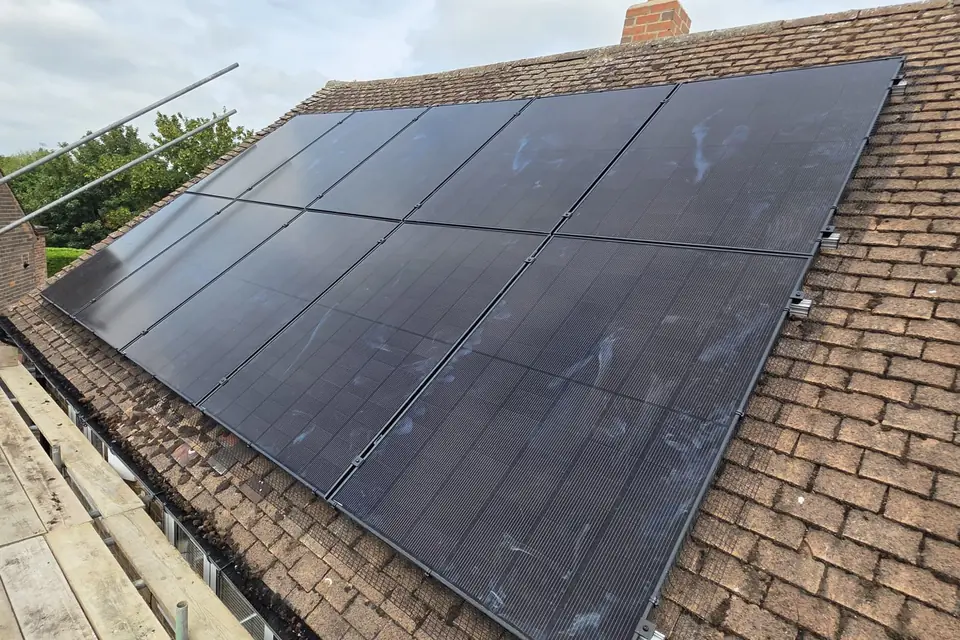
- The solar panels, and the mounting equipment (rails and fixings) that holds them to the roof
- An inverter, which turns the panels' direct current into the alternating current your home uses
- Scaffolding, put up and taken down: one side is included in our from £7,500 solar and battery system, and your quote covers whatever your roof needs
- Cabling, isolator switches and a generation meter, wired into your consumer unit (fuse board)
- Labour: our roofers and electricians, usually for one day
- Notifying your electricity network operator, your MCS certificate and your electrical safety certificate
Where the money goes
Fitting is a smaller share of the bill than most people expect. In Which?'s example, installation labour was about 9% of the total cost. Most of the money goes on the equipment.
The Energy Saving Trust says fitting usually takes one to two days on site; most of our installs take one, once the scaffolding is up.
What changes the cost to install solar panels
If one quote is far cheaper than the rest, check it's for the same solar PV system. These are the things that genuinely change the price:
How much roof you have, its shape and roof type
Hips, dormers, valleys and skylights break a roof into smaller areas, which can mean fewer panels or splitting them across two slopes. The roof type and structure matter too: MCS rules require a competent person to check the roof can carry the panels, and an unusual roof may need a structural engineer.
Which way it faces and what shades it
A south-facing roof gets more energy from each panel. East and west roofs produce about 15 to 20% less, according to the Energy Saving Trust. If part of the roof is shaded, panel optimisers or microinverters can stop one shaded panel dragging down the rest, and they add to the cost.
Roof access
Three-storey houses, conservatories in the way and tight gaps between houses all need more scaffolding. Bungalows are usually the simplest.
The inverter
A hybrid inverter costs more than a basic one, but it lets you add a battery later without a second inverter. Worth asking about if a battery is on your list.
Electrical work and your consumer unit
Older consumer units (fuse boards) sometimes need electrical upgrades before a new circuit can be added. Adding a solar circuit is notifiable electrical work under the Building Regulations, so it has to be certified, and you get a compliance certificate for it. We ask about your consumer unit before we quote, and the technical survey checks it before installation day, so an upgrade is never a surprise on the day.
Extras and additional costs
Some quotes include extras such as bird mesh, in-roof panels or monitoring upgrades. Each one adds to the price, so ask what it's for, and take it out when you compare quotes like for like.
System size and paperwork
Systems with an inverter over 3.68 kW on a normal single-phase supply need the network operator's approval before they're connected (a G99 application). It doesn't usually change the price much, but it can add a few weeks.
Adding battery storage
A battery stores the solar energy your panels make in the day so you can use it in the evening, and it can also charge from the grid on cheaper off-peak electricity. The price depends mostly on battery capacity, measured in kWh.
What a home battery costs
With your panels, or later?
Having a battery installed at the same time as your panels is usually cheaper than adding one later, because our electrician is already on site and one hybrid inverter can run both. In Which?'s survey of supplier prices, one energy company charged:
It still adds to the upfront cost, so whether it pays depends on how much electricity you use in the evening.
VAT, grants and loans
0% VAT until 31 March 2027
Solar panels and batteries supplied and fitted to a home in Great Britain are zero-rated for VAT until 31 March 2027. From 1 April 2027 the rate goes back to 5%, unless the government extends the relief. It only applies when the same company supplies and installs; buy the kit yourself and you pay full VAT on it.
Grants for lower-income households
The Warm Homes: Local Grant, run by councils, can pay for solar PV where:
- The home is owner-occupied or privately rented
- It has an EPC of D to G
- Household income is £36,000 or less, or someone receives a means-tested benefit
If you qualify, you apply through GOV.UK and the council arranges the work.
Low-interest loans
Up to £15,000 for solar panels, and up to £15,000 for batteries
The government's Warm Homes Loan Scheme subsidises these loans, with no income test, through approved lenders. The rules say it opens to homeowners from September 2026; when we checked on 11 October 2026, no lenders had been named. The government grant goes to the lender to cut the interest rate, so expect a low rate rather than a guaranteed 0%.
Both schemes sit under the government's Warm Homes Plan, published in January 2026, which aims to put solar panels on up to 3 million more homes by 2030.
The ECO4 scheme has stopped taking new applications, so it isn't a route to free solar panels any more. Our guide to solar panel grants explains what's still available.
Costs after installation
A solar installation has no moving parts and needs very little looking after.
How long solar panels take to pay back
Your solar panels save money in two ways: electricity you use instead of buying it from the grid, and exported electricity, which an energy supplier pays you for under the Smart Export Guarantee. The Energy Saving Trust puts the payback period for a typical system at 9 to 11 years:
| Location | Home all day | Home half the day | Out all day |
|---|---|---|---|
| London | 9 years | 9 years | 9 years |
| Manchester | 10 years | 10 years | 11 years |
Savings on your electricity bills
£190 to £330 a year
MoneySavingExpert, using Energy Saving Trust figures, puts the bill savings for a 4.5 kWp system at £190 to £330 a year before export payments. The electricity price cap from October to December 2026 is 26.32p per unit, and every unit your panels supply is one you don't buy.
Export tariffs
About 1p to 25p a unit
Export tariff rates range from about 1p to 25p a unit depending on the supplier and tariff. The best rates usually need you to buy your electricity from that supplier, or to have had your system fitted by them.
Your own annual generation estimate
In your quote
These are national estimates. Under MCS rules your quote has to include an estimate of what your own system will generate in a year, so you can work out what solar panels could save in your house. Our guide to whether solar panels are worth it goes through it in detail.
How to compare solar panel quotes
Check the installer is MCS certified.
MCS, the Microgeneration Certification Scheme, is the UK's quality mark for small-scale renewable energy systems. You need an MCS (or equivalent) certified installation to get paid for the electricity you export. You can look installers up on the MCS website.
Compare the system, not just the total.
Look at the size in kWp, the panel make and wattage, the inverter, and the estimated yearly generation. A cheaper quote is often a smaller system.
Check what's included.
Scaffolding, network notification and certificates should all be on the quote, not extras later.
Read the warranties.
Panels usually carry a product warranty and a separate performance warranty; inverters have their own. Ask about the installer's workmanship guarantee too.
Don't pay a big deposit.
The Renewable Energy Consumer Code advises paying no more than 25% of the price when you sign. We take no deposit at all.
Walk away from pressure.
"Today only" discounts are a sales tactic. A fair quote will still be fair next week.
Our prices
Our solar and battery systems start from £7,500 fully installed (10 panels, a Fox ESS battery and scaffolding to one side), or from £4,995 for solar panels on their own. We start with a free consultation, by phone or at your home: we look at your roof and how you use electricity, then send a written quote with the full price and no hidden fees. Once you've signed, an independent technical surveyor checks the roof and your fuse board before anything is fitted. If you'd like to compare panels alone against panels and a battery, we'll price both.
We won't push you to sign on the day. Plenty of our customers got several quotes before choosing us.
Rated 5 out of 5 on Trustpilot
Spoke to about 5 companies all singing from the same hymn sheet. Landed with solar save. Seemed like the only ones that genuinely knew what they were talking about.
Rated 5 out of 5 on Trustpilot and Google
I received quotes from several other companies, but Solar Save really stood out for their honesty, communication, and customer service.
Questions people ask
How much do solar panels cost for a 3-bed house?
A typical three-bedroom semi has room for about 8 panels, around 3.5 kWp with today's 450 W panels. That sits between the 3 kWp guide price (£5,000 to £6,500) and the 4 kWp one (£6,500 to £8,000). Roof shape, access and extras move it either way, so your written quote gives the real figure.
How much will solar panels save on my energy bills?
For a typical 4.5 kWp system, MoneySavingExpert, using Energy Saving Trust figures, puts the bill saving at £190 to £330 a year, before export payments. Your quote includes an estimate of what your own system will generate.
Is it more cost effective to add a battery at the same time?
Usually, yes. Our electrician is already on site, and one hybrid inverter can run the panels and the battery, so you avoid a second visit and a second inverter. You can still add a battery later if you prefer.
Do I need to pay a deposit?
No. We take a 0% deposit, so there's nothing to pay when you sign. If you're comparing installers, the Renewable Energy Consumer Code advises paying no more than 25% as a deposit.
Do I pay VAT on solar panels?
Not until 31 March 2027, if the same company supplies and installs them in your home. From 1 April 2027 the rate is due to go back to 5%. Kit you buy to fit yourself carries full VAT.
Do solar panels cost anything to run?
Very little. There's nothing to service regularly. Allow for an inverter replacement at some point, typically after around 12 years.
Read next
Sources
20 sources, checked 11 October 2026
Figures and rules on this page were checked on 11 October 2026. Schemes, tariffs and prices change, so check the latest before you decide.
- Energy Saving Trust: Solar panels, costs, savings and benefits, updated 1 October 2026
- Energy Saving Trust: Rooftop solar panel installation, updated 1 October 2026
- Which?: How much do solar panels cost?, 3 August 2026
- Which?: Are solar panels worth it?, 15 May 2026
- Heatable: Solar panel costs UK 2026 (installer marketplace guide prices), updated 18 June 2026
- Ofgem: Review of typical domestic consumption values, decision, 27 May 2026
- Energy Saving Trust: Battery storage, updated 6 October 2026
- MCS: Battery storage, updated 8 July 2026
- Which?: Solar panel battery storage, 15 May 2026
- HMRC: VAT on energy-saving materials and heating equipment (Notice 708/6), relief runs to 31 March 2027
- GOV.UK: Apply for the Warm Homes: Local Grant, checked 11 October 2026
- GOV.UK: Warm Homes Loan Scheme rules, September 2026
- GOV.UK: Warm Homes Plan, updated 18 March 2026
- Ofgem: Energy price cap, 1 October to 31 December 2026, 26 August 2026
- Which?: Smart Export Guarantee rates, the best and worst tariffs, 24 April 2026
- MoneySavingExpert: Solar panels, are they worth it?, updated 28 September 2026
- RECC: Advice for consumers, checked 11 October 2026
- MCS: About us, updated 3 August 2026
- MCS: MIS 3002 Solar PV installation standard, issue 1.0, January 2025
- GOV.UK: Approved Document P, electrical safety in dwellings, 2013 edition
Get your own price
Prices on this page are national guides. Yours depends on your roof. Tell us a little about your home and we'll arrange a free consultation, then send a written quote with the full price. No obligation.
Prefer to talk? Call 0333 577 6576, Monday to Friday, 9am to 5pm.
- Step 1
- Step 2
Get My Free Solar Quote
Get a quote and we'll help calculate how much you could save.
Google
reviews5.0
Rated 5 out of 5
by our customers on Google
We'll only use your details for your quote. Privacy policy