
The solar panel installation process What happens on installation day
Most homes are fitted in one day once the scaffolding is up. For systems that don't need the network operator's approval, it usually takes two to three weeks from first call to switch-on. If you're thinking about solar panels and want to know what to expect, here is every step, from first call to paperwork, in the order it happens.
0% depositNothing to pay when you sign
or call 0333 577 6576Monday to Friday, 9am to 5pm
- 4.8 out of 5 36 reviews on Trustpilot
 5.0 out of 5 6 reviews on Google
- MCS certifiedRECC and NAPIT members
- In solar since 2010Family-run, based in Retford
How long it takes to get solar panels installed
Here's how the process runs, stage by stage, and how long each part usually takes. The day on your roof is only a small part of it. The Energy Saving Trust says an installer should take one to two days to fit solar panels, and longer for a more complex system.
| Stage | What happens | Typical timing |
|---|---|---|
| First call | You tell us about your home, how you use electricity and what you want from solar. We book your consultation. | Day 1 |
| Consultation and quote | By phone or at your home. We design the system and send a written quote: the full price, the system design and a performance estimate of how much electricity it should generate in a year. Then we talk you through it. | Within days |
| Technical survey | Once you've signed, an independent technical surveyor checks the roof, where the panels and cables will go, and your fuse board. | After you sign |
| Network approval | Only for systems over 3.68 kW. We apply while your survey is booked, and the network operator sets the pace. | A couple of days to 90, if needed |
| Paperwork | We order the kit, check planning and book your installation date. | Usually days |
| Scaffolding | Goes up around your property, ready for our roofers. | Shortly before installation day |
| Installation | Panels on, inverter and any battery fitted, wired in, tested and switched on. | One day for most homes |
| Handover | We notify the network operator and email your handover pack, including your certificates. | Within 7 working days |
For systems that don't need network approval, the whole thing usually takes two to three weeks. Timings vary depending on the size of the system, kit availability and the paperwork: larger systems wait for the network operator's approval, which can take up to 90 days, and homes that need planning permission or listed building consent take longer too.
Your free consultation and the solar panel survey
The first step is a free consultation, by phone or at your home. We ask when you're home, what your bills look like and whether you're planning an electric car or heat pump, and look at which way your roof faces and what shades it. Then we design your system, send a written quote and talk you through it. There's no pressure to sign.
Once you've signed, an independent technical surveyor visits to check the details before anything is fitted. It isn't a sales visit, and it's included in your price. The survey checks:
- The roof structure. MCS rules require a competent person to check the roof structure can carry the weight of the panels. That means the rafters or trusses, and the tiles or slates, whether concrete, clay or natural slate, and their condition.
- Where the panels go. The exact layout on each slope, around chimneys, vents and roof windows, and the margins MCS rules ask for at the roof edges.
- Cables and your fuse board. Where the cables will run, whether your fuse board can take the new circuit, and where the inverter and any battery will go. Older fuse boards sometimes need upgrading first.
Network approval for bigger systems
A system with an inverter over 3.68 kW on an ordinary single-phase supply needs the network operator's consent before it's connected. We apply while your survey is being booked. It can come back in a couple of days or take up to 90, depending on the network operator and how much grid capacity is free, so nobody can promise a date. Smaller systems, like our 10-panel Fox ESS system, only need a notice after fitting.
Sometimes the network operator approves a bigger system but limits how much it can send back to the grid. On an 8 kW system limited to 3.68 kW, for example, the panels still power your home as normal; you just export less at any one time.
“Excellent communication from quotation to post installation.”
Bryan G.,
How solar panels are attached to the roof
On-roof panels sit on aluminium rails, a few centimetres above your tiles, so they keep a low profile. The rails are held by brackets fixed to the roof timbers underneath. Together, the roof hooks, rails and clamps make up the mounting system.
- Tiles come up. Our roofer lifts a tile or slate at each fixing point.
- Brackets go on the rafters. Each roof hook is screwed into a rafter, not the tiles or battens, so the roof timbers support the weight. Then the tile goes back over it, trimmed if needed so it sits flat and keeps the roof watertight.
- Rails go on the brackets. The rails mount across the roof, held secure by the hooks, and set the line for the panels.
- Panels clamp to the rails. Clamps grip each panel's metal frame at the edges. Nothing is drilled through the panels themselves.
- Cables run neatly to the inverter. From the solar array through the roof space to the inverter, usually in the loft or near your fuse board.
Under planning rules for houses, panels on a pitched roof can stand no more than 0.2 m proud of the roof slope and can't go above the ridge. MCS rules also keep them back from the roof edges unless extra measures are taken, which is why you'll see a margin around the panels. Where the mounting system isn't MCS 012 certified, MCS rules from 18 June 2026 ask for evidence of structural and wind loading calculations, fire performance and weather-tightness.
Flat roofs
On a flat roof, panels usually sit on frames that tilt them towards the sun instead of rails on a slope, and the planning limits are different. Our guide to solar panels on a flat roof covers both.
Installation day, step by step
- Our installation team arrives and we go through the plan with you: where the panels, inverter and any battery are going, and when the power will be off.
- Our roofers fit the brackets, rails and panels. This takes most of the day on a typical house.
- Our electrician works inside. Fitting the inverter, any battery, isolator switches and the generation meter, and running cables to the fuse board.
- Power off, briefly. Your electricity goes off for a short time while our electrician connects to the fuse board. We'll tell you when.
- Testing and switch-on. Every circuit is tested and the system is commissioned before it goes live, usually on the same day as the fitting.
- Handover. We set up the app on your phone, show you what the readings mean, and tidy up before we leave.
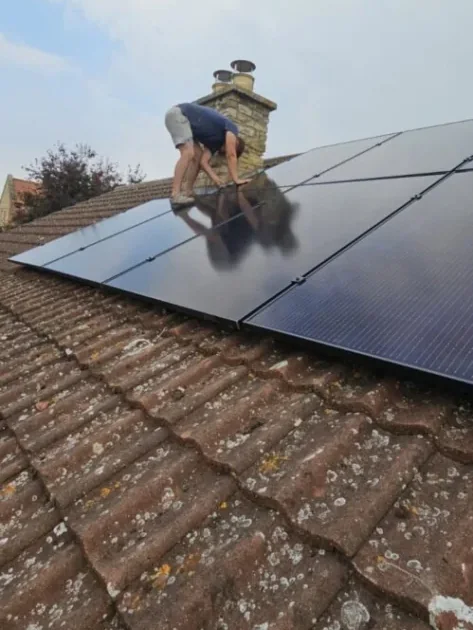
“All fitted and up and running the same day! No fuss or mess and very efficient.”
Ian A., Trustpilot, January 2024
“Paul the electrician showed me everything they were doing and then talked me through the app which is so easy to use.”
Richard H., Trustpilot, May 2026
After installation
Your solar panel system starts to generate electricity as soon as it's switched on. Once installation is complete, there's paperwork, and we handle it:
- Network operator. Most home systems are "fit and notify": under MCS rules, installers must tell your electricity network operator within 28 days of switching on. We do it within 7 working days. Larger systems, over 3.68 kW, are approved before installation.
- MCS certificate. Normally issued within 10 days of commissioning. It shows your system was designed, installed and commissioned to MCS standards, and you need it to be paid for the electricity you export, so keep it safe.
- Electrical safety certificate. Adding a solar circuit is notifiable electrical work. We register it, and you receive a Building Regulations compliance certificate within 30 days.
- Your handover pack. We email it within 7 working days, with your warranties and system details. Certificates issued after that follow by email.
- Export payments. We explain how to apply for a Smart Export Guarantee tariff once your MCS certificate arrives.
The scaffolding comes down once the job's signed off.
Questions people ask
How long does it take to install solar panels?
One day for most homes, once the scaffolding is up. A bigger solar system, two roofs or difficult access can take a second day. Allow two to three weeks from first call to switch-on for a system that doesn't need network approval. Bigger systems wait for the network operator, which can take from a couple of days to 90.
Will my electricity be off?
Only for a short time, while our electrician connects the system to your fuse board. We'll tell you when it's happening.
Do the panels damage the roof?
They shouldn't. The brackets fix to the rafters and the tiles go back over them, so the roof stays watertight. Panels are clamped to rails, not drilled.
How much does a solar panel survey cost?
Nothing extra. Your consultation and written quote are free, and the technical survey, once you've signed, is included in your price.
What if the weather's bad?
Roof work stops in high winds or heavy rain, for safety, so bad weather can affect the date. If the forecast is poor, we'll talk to you and rebook if we need to.
Do I need planning permission?
For most houses in England, no. Listed buildings always need consent, and there are extra rules in conservation areas. See our planning permission guide.
Do solar panels work straight after installation?
Yes, from switch-on. You'll use what the panels make straight away. Export payments start once your MCS certificate is through and you've signed up to an export tariff.
Read next
Sources
Figures and rules on this page were checked on 11 October 2026. Schemes, tariffs and prices change, so check the latest before you decide.
- MCS: MIS 3002 Solar PV installation standard, issue 1.0, January 2025
- MCS: MCS publishes update to MIS 3002, 18 March 2026
- Energy Saving Trust: Rooftop solar panel installation, updated 1 October 2026
- legislation.gov.uk: General Permitted Development Order 2015, Schedule 2, Part 14, up to date to 9 October 2026
- legislation.gov.uk: S.I. 2026/896, solar permitted development changes, in force 27 August 2026
- Energy Networks Association: G98 single premises summary guide, checked 11 October 2026
- MCS: Notifying DNOs, updated 14 July 2026
- MCS: Certificate queries, updated 20 May 2026
- GOV.UK: Approved Document P, electrical safety in dwellings, 2013 edition
- GOV.UK: Smart Export Guarantee, updated 1 October 2026
- Marley: Solar roof systems, checked 11 October 2026
Book your free consultation
The first step is a free consultation, by phone or at your home. Tell us a little about your home and we'll call at a time that suits you.
Prefer to talk? Call 0333 577 6576, Monday to Friday, 9am to 5pm.
- Step 1
- Step 2
Get My Free Solar Quote
Get a quote and we'll help calculate how much you could save.
Google
reviews5.0
Rated 5 out of 5
by our customers on Google
We'll only use your details for your quote. Privacy policy