

The short answer
On a pitched UK roof
Rarely
needs a clean
Check every 12 to 18 months and only clean if you can see dirt, the Energy Saving Trust says.
When it does
A hose and a sponge
used from below
A gentle spray, then a soft sponge on a long pole, on a cool day, with the system off.
Never use
A pressure washer
or stand on the panels
A Kärcher K 2 Start Plus home pressure washer is rated at up to 110 bar. Trina recommends no more than 40 bar and LONGi 7 bar.
Sources checked 16 November 2026, listed at the end of this guide.
Does rain clean solar panels on a roof?
Mostly, yes: most solar panels on a pitched UK roof do not need cleaning very often. Rooftop panels are kept fairly clean by rainfall because of the angle they sit at, the Energy Saving Trust says. Which? says solar PV panels should be self-cleaning on the right incline.
So check them every 12 to 18 months, and only clean them when you can see grime. Clean sooner if:
- Birds roost on your roof, or trees drop leaves or pollen on the panels (Which?).
- You live by the sea or in a city, where salt or a traffic film can build up (Which?).
- Lichen grows on the glass or frame (the Trust).
- Branches hang over the roof. The Trust says keep them trimmed, to cut shade and stop leaves piling up on your solar panels.
- The panels lie nearly flat. Trina wants a tilt of at least 10 degrees so showers can wash dust off. Low-tilt panels on a flat roof need cleaning more often.
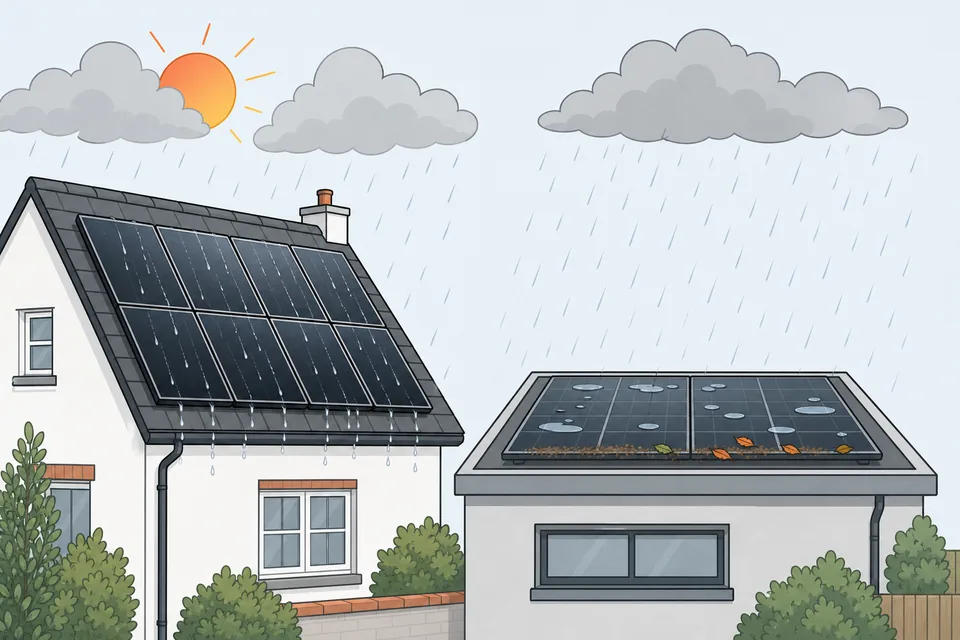
How much does dirt cost? Worldwide, soiling is estimated to cut solar output by 3% to 5% a year, especially in dry, dusty regions, the IEA says. One site in Belgium lost 3% to 4% over five weeks. Soiling studies generally assume rainfall brings the loss back to zero.
Cleaning solar panels on roof tops, step by step
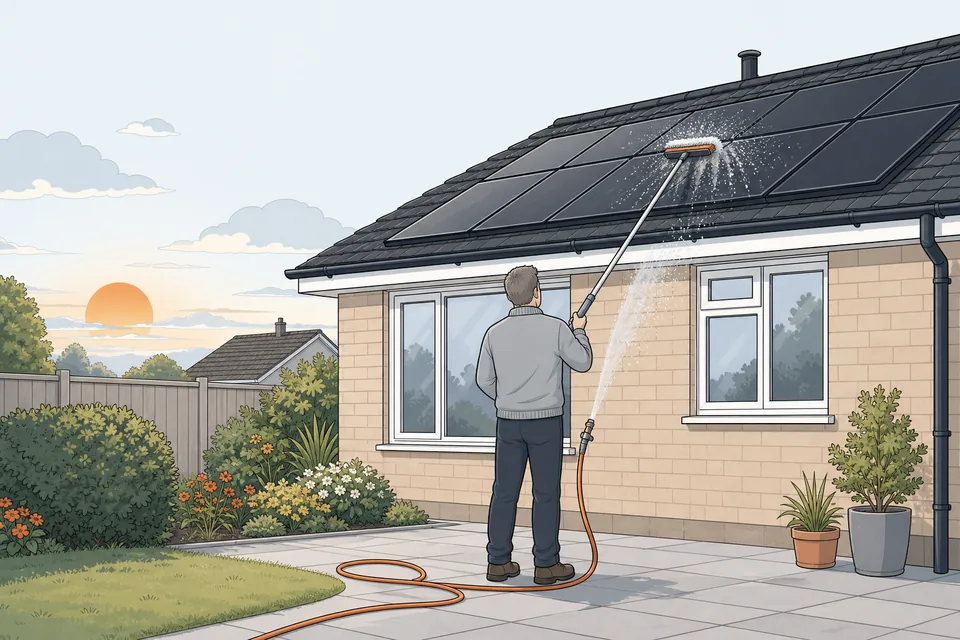
Here's how to clean solar panels safely: from below, on a cool day, with the system off. It follows the Energy Saving Trust's steps and two makers' manuals.
Step 1: Check from the ground first
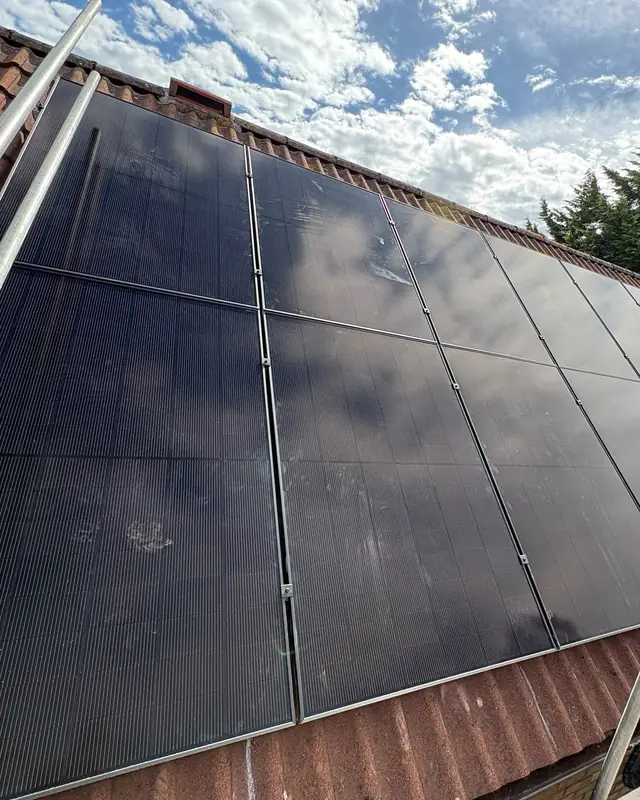
Look from the garden or an upstairs window for grime, droppings or lichen. Compare your generation app with the same month last year. If the panels look clean and output is normal, leave them.
Cracked glass or damaged cables? Stop and call your installer. Damaged cabling is an electric shock hazard, the Trust says.
Step 2: Pick a cool, dull morning or evening
Hot glass dries fast and leaves streaks and patterning. The Trust says a cool, overcast day or early morning is ideal. Trina says avoid the hottest part of the day, downpours, snow and wind above force 4 on the Beaufort scale. LONGi says don't clean below 5°C.
Step 3: Switch the system off
Turn the system off first, the Trust says. Your instruction manual shows how. This stops the inverter, not the panels: Trina says they make electricity whenever light reaches them, connected or not. So never touch the cables or connectors.
Step 4: Rinse with a garden hose
Standing on level paving or grass, give the glass a gentle spray from a garden hose. The Trust says a soft spray should be enough. Rinse off any loose debris, such as leaves, first.
Keep the rinse close to the temperature of the glass. Trina and LONGi both want the two within about 10°C, so on a cold morning even lukewarm water can be too warm.
Step 5: Gentle cleaning with a soft brush on a cleaning pole
If spraying doesn't shift the grime, make sure you use a soft-bristled brush, sponge or cloth on a long, telescopic pole. Use light strokes and never press hard. Which? says a solar cleaning kit with an extendable pole typically costs around £100.
Step 6: Rinse, dry and check your output
Rinse again with the hose and let the glass dry. Switch back on, then compare a few bright days with similar days before. If your solar output is still low, the cause may be something else, such as shade or a fault. See the signs of a panel fault.
Thinking about going solar?
Solar panels need very little upkeep. Free consultation and a written quote, with no pressure to sign.
Or call 0333 577 6576, Monday to Friday, 9am to 5pm. We'll only use your details for your quote. Privacy policy
Is DIY cleaning safe?
DIY cleaning is only safe from the ground. If you can't reach, hire a professional: the Trust says that's safer than working at height without the right training or equipment.
- Falls kill. Falls from a height are the most common kind of fatal accident at work in Great Britain, the HSE says. They average 37 deaths a year over five years.
- Never stand on panels. They aren't built to take a person's weight and could crack, the Trust says. Trina and LONGi forbid it too.
- Solar panels stay live in daylight. They make electricity whenever light hits them, and Trina warns that touching damaged glass can give an electric shock.
For homeowners, a simple safety test: if a telescopic pole can't reach every panel from where you stand, the job needs a professional.
What to use: water, soap-less brushes and sponges
A gentle hose spray and a soft sponge, cloth or non-abrasive brush. The Trust says plain rinsing is best, and Which? agrees.
- Washing-up liquid: best avoided. The Trust prefers plain water to soapy water, because cleaning products can leave a residue that may affect performance.
- A mild detergent: check your manual first. Trina allows household glass cleaner, but no strong acids or alkalis. LONGi says use detergents only when rinsing won't work, then rinse them off.
- Vinegar: neither manual we read mentions it, and LONGi rules out acid cleaners. Stick to rinsing.
- Hard tap supplies: Anglian says its supply is hard to very hard. Yorkshire Water says its east is harder than its west. Severn Trent says most of its supply is soft to moderately hard.
Anglian's "very hard" benchmark is 350 mg/l, under LONGi's 450 mg/l and Trina's 600 mg/l limits. Ask your supplier how hard your own supply is; Severn Trent has a postcode checker. LONGi says minerals can leave deposits that cut the light reaching the cells, so don't let the glass dry in hot sun.
What never to use, and what panel makers allow
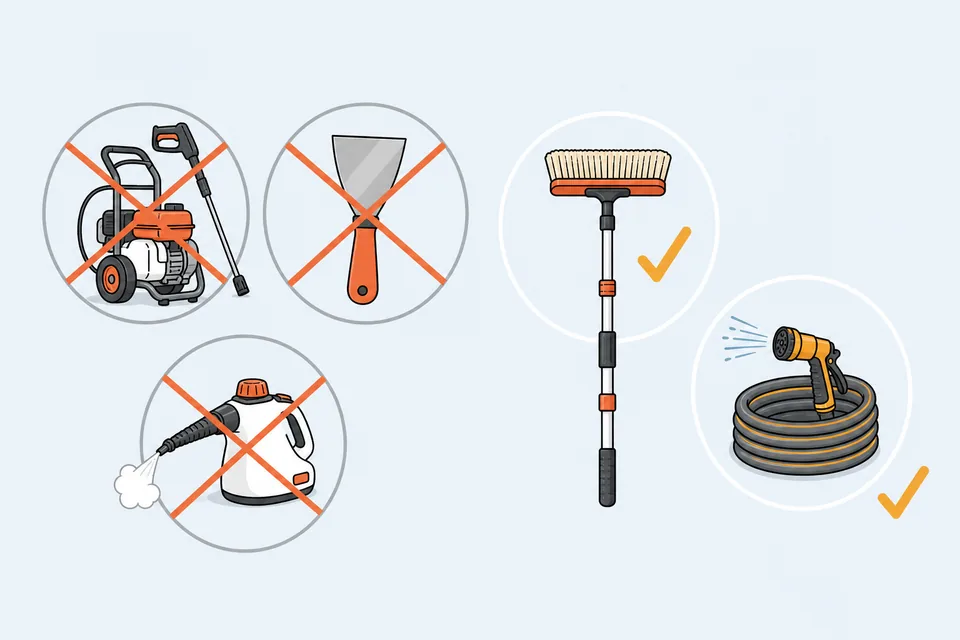
No pressure washer, steam cleaner, scraper or harsh chemicals. The Trust says avoid pressure washers, and the numbers show why:
| What | Pressure | Source |
|---|---|---|
| LONGi's limit on the panel | Up to 7 bar (0.7 MPa) | LONGi maintenance manual, 2024 |
| Trina's recommended maximum | Up to 40 bar (4 MPa) | Trina Vertex manual, 2026 |
| Kärcher K 2 Start Plus pressure washer (pump rating) | Up to 110 bar (11 MPa) | Kärcher technical data |
- Steam cleaners: Trina says don't use them.
- Scrapers and scourers: LONGi rules out tools that could scratch the surface.
- Anything hot: LONGi says never pour hot water on panels, because uneven heat and cold can seriously damage them.
- Strong chemicals: Trina rules out hydrofluoric acid, alkalis and acetone.
| Rule | Trina (August 2026) | LONGi (2024 and current manuals) |
|---|---|---|
| Temperature gap, rinse to glass | -5°C to 10°C | No more than 10°C; not below 5°C air |
| Hardness | Up to 600 mg/l; soft supply preferred | Up to 450 mg/l; mains supply is fine |
| Products | Household glass cleaner allowed | Detergent only if rinsing fails |
| Standing on panels | Forbidden | Forbidden |
| Warranty | Improper cleaning voids it | Not following the manual may void it |
Other makers set their own rules, so read the manual for your panels. Not sure which you have? Check your paperwork. If you spot damage, take photos before anything is moved: LONGi asks for pictures of the problem before a panel is taken down for a warranty claim.
Bird droppings and lichen
Wet droppings and lichen with a gentle spray, then wipe softly. Never scrape.
- Why droppings matter: they shade part of a panel. The IEA says uneven soiling can cause hot spots that permanently damage cells.
- Lichen: a reason to check more often, the Trust says. LONGi rules out rough tools, so leave stubborn growth to a professional.
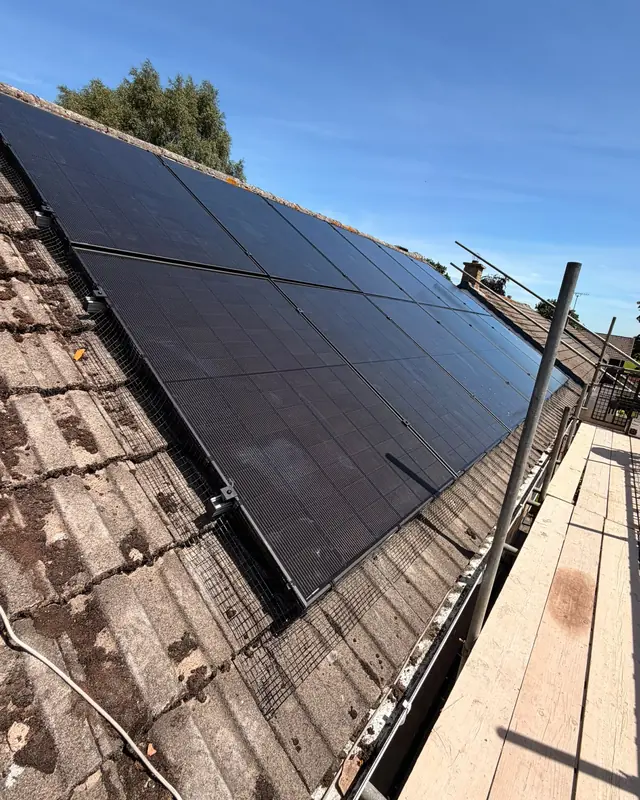
- Bird mesh: deterrents fitted round the edge can stop pigeons nesting under your panels, MoneySavingExpert says. In England it's an offence to intentionally damage or destroy a wild bird's nest while it's in use or being built (GOV.UK), so fit mesh when nothing is nesting. MoneySavingExpert says deterrents are sometimes in the installation price, and sometimes extra.
How often to clean, and what cleaning services cost
Clean when you can see grime or your output drops. The Trust's summary suggests a light clean every 12 to 24 months, and more often near trees, birds or dust. There's no best season: pollen builds up in spring and leaves in autumn.
- A professional panel clean: from around £60 to £100 for a typical home system, the Trust says.
- Per panel: £4 to £15 for solar panel cleaning, Checkatrade's guide says (May 2024 prices). Above one storey costs more: £150 to £300 for 40 panels, against £60 to £100 for one storey.
- Before you book, ask: do they work from below with a pole, keep to your panel maker's pressure and temperature limits, switch the system off, and carry public liability insurance?
A clean isn't a service. The Trust suggests a full professional service every three to five years to check for cracks and inverter faults. Some installers require one within a set period to keep their warranty valid, so check your solar paperwork. See servicing and maintenance costs and the maintenance schedule. Want more from the panels you have? Read about adding a battery.
Questions people ask
Can you pressure wash solar panels?
No. The Energy Saving Trust says avoid high-pressure power washers. A Kärcher K 2 Start Plus is rated at up to 110 bar, while Trina recommends no more than 40 bar and LONGi 7 bar on the panel.
Should you clear snow off the panels?
Never climb up to clear it: the Trust says it's safer not to work at height without the right training or equipment. LONGi says clear it gently with tools that won't damage the glass, such as a mop or blower. It also says never pour hot water on panels, and never try to remove frozen snow or ice.
Can cleaning void your warranty?
Yes, if it causes damage. Trina says damage from improper cleaning voids its warranty, and LONGi says not following its manual may void its warranty. The panels we fit carry a 25-year product and a 30-year performance warranty.
Does cleaning improve efficiency?
Yes, when the panels are dirty: the Trust says dirt cuts how much electricity they generate. In a climate like the UK's the gain is usually small, because rainfall washes most dirt off (Energy Saving Trust).
About this guide
Written by the SolarSave team in Retford: MCS certified installers, led by a founder in solar since 2010. We checked every figure against the Energy Saving Trust, Which?, the HSE, GOV.UK, the IEA, three water companies and the Trina and LONGi panel manuals on 16 November 2026. Makers update their manuals, so check the one for the panels on your roof.
The 15 sources we checked
- Energy Saving Trust: How to clean and maintain solar panels, updated 1 October 2026, checked 16 November 2026
- Which?: How to make the most of your solar panels, 12 August 2026, checked 16 November 2026
- MoneySavingExpert: Solar panels, are they worth it?, updated 28 September 2026, checked 16 November 2026
- Trina Solar: Vertex Series user manual, UM-M-0002 (cleaning, section 7.3), August 2026, checked 16 November 2026
- LONGi: PV module operation and maintenance manual, version 02, January 2024, checked 16 November 2026
- LONGi: PV module user manual (Hi-MO 7 and Hi-MO X10 ranges), checked 16 November 2026
- Kärcher: K 2 Start Plus pressure washer (technical data), checked 16 November 2026
- HSE: Work-related fatal injuries in Great Britain, 2026, 1 July 2026, checked 16 November 2026
- GOV.UK: Wild birds, protection and licences, checked 16 November 2026
- IEA PVPS: Soiling losses, impact on the performance of photovoltaic power plants (key topic page), published January 2023, checked 16 November 2026
- IEA PVPS Task 13: Soiling losses, impact on the performance of photovoltaic power plants (T13-21:2022), December 2022, checked 16 November 2026
- Checkatrade: Solar panel cleaning cost guide, updated 4 July 2025 (prices May 2024), checked 16 November 2026
- Anglian Water: Water quality fact sheet, hard water, checked 16 November 2026
- Yorkshire Water: Let's learn about water hardness, checked 16 November 2026
- Severn Trent: Water hardness, checked 16 November 2026