

| Period | Average solar a day | Miles of driving |
|---|---|---|
| April to June | About 13 kWh | About 47 miles |
| October to December | About 4.5 kWh | About 16 miles |
| One 450 W panel, over a whole year | About 400 kWh | About 1,400 miles |
Can solar panels charge an electric car?
Yes, but not straight from the roof. You can charge your electric car battery with solar power whenever the car is plugged in at the house and your panels are making more than the house is using.
Here's how the electricity gets from your roof to the car:
- The panels make DC electricity. Daylight on the cells makes direct current (DC).
- The inverter converts it. It turns DC into the alternating current (AC) your house runs on.
- The house uses what it needs first. The fridge, the lights and anything else that's on.
- The charger takes the spare. With a solar mode, it sends power that would otherwise go to the grid into the car instead.
- Anything left goes to the grid. You're paid for it if you're signed up for export payments.
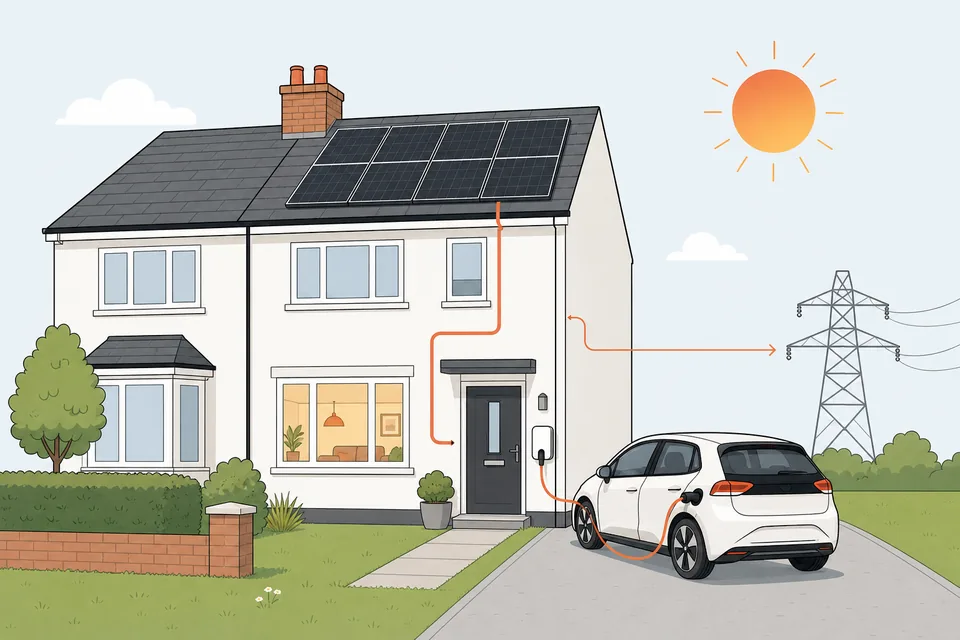
An electric vehicle can't plug into a solar panel directly. Charging always goes through the house's wiring, usually to a wallbox.
Three things decide how much solar ends up in the car:
- Is the car on the drive? If it's parked at work from 8am to 6pm, it misses most of the day's sunshine.
- How much is the house using? A kettle, oven or washing machine takes its share first.
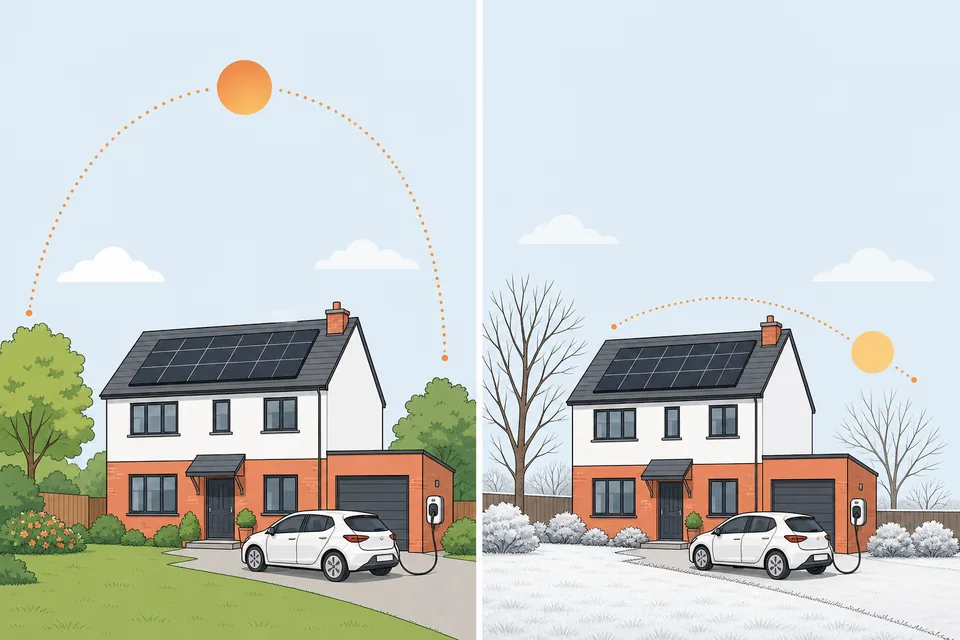
- How sunny is it? An average day from April to June gives about three times what an average day from October to December gives.
So solar panels and an electric car make a good pairing in homes where the car spends daytime on the drive: if you work from home, have a second car, or charge at weekends.
What do you need to charge an EV from solar?
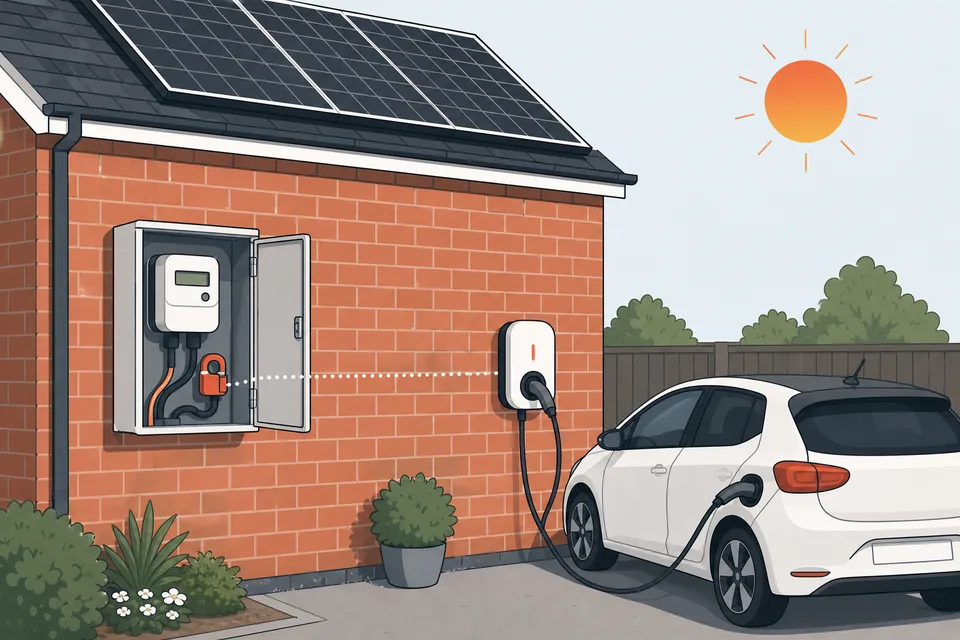
Three things: a solar PV system, a home charger with a solar mode, and a sensor that sees how much power you'd otherwise export. A battery is optional.
- Your rooftop solar panels and inverter. Any size works, but a bigger system has more to spare on more days.
- A solar-compatible EV charger. It speeds up and slows down to match your spare solar. A solar-aware charger lets you use surplus electricity in the car instead of selling it.
- A clamp at the meter. A small sensor clips around your main supply cable and measures power flowing to and from the grid. myenergi says its own unit relies mainly on this clamp to decide how fast to charge.
- A registered installer. The Energy Saving Trust's steps for a home chargepoint are to find a registered chargepoint installer and register the chargepoint with your Distribution Network Operator (DNO), the company that runs your local electricity network.
Does it need a special solar EV charger?
Yes, if you want it to follow the sun. EV chargers range from basic models that charge to a schedule or from an app, to chargers with solar modes. Since 30 June 2022, charge points sold for private use in Great Britain have had to be smart, with pre-set off-peak charging hours you can change. Smart doesn't always mean solar-aware, though.
Which? puts the typical price of buying and installing a charger at £500 to £1,200, and a 7 kW one at around £900 (October 2026).
myenergi gives a car's minimum charging current as 6 amps, which is about 1.4 kW on a normal household supply. On a three-phase supply it's 4.2 kW. Below that, the car won't take your spare solar on its own.
Solar chargers usually offer two kinds of mode:
No-grid modes, such as Hypervolt's Super-Eco
The charger waits until there's enough spare, then follows the surplus solar up and down. Its maker says this mode uses only solar and home battery energy, draws nothing from the grid, and needs about 1.4 kW spare to start. Because it can draw on a home battery, the same maker's Battery-Safe mode pauses charging if your house battery starts to empty into the car.
Solar-plus-grid modes, such as zappi's Eco
The charger keeps charging at the minimum rate and adds any spare solar on top, with the grid making up the difference. In this mode the car always charges, but some of the power comes from the grid. myenergi gives the top rate as 32 amps, about 7.4 kW.
How many miles a day can the sun add?
About 47 miles on an average April to June day, and about 16 from October to December, from a 4 kW system. That's if every unit went into the car. In real life the house takes its share first, so the car gets less.
| Months | Share of full power | Solar a day | Miles of driving |
|---|---|---|---|
| April to June 2024 | 13.6% | About 13 kWh | About 47 miles |
| October to December 2024 | 4.7% | About 4.5 kWh | About 16 miles |
How we worked it out:
- The government's Feed-in Tariff figures for 2024/25, covering 282,047 solar systems, show they ran at 13.6% of their full power on average from April to June 2024, and 4.7% from October to December 2024.
- A 4 kW system at 13.6% makes about 13 kWh a day (4 kW for 24 hours, times 13.6%).
- HMRC's advisory rates assume an electric car does 3.59 miles per kWh. So 13 kWh is about 47 miles.
A 4 kW system is about ten 400 W panels. The report says both quarters were the lowest for their time of year in its records, so a sunnier year gives more.
Does solar charging work in winter?
A little, on bright days. From October to December, a 4 kW system averaged about 4.5 kWh a day. That's the same as running at 1.4 kW for just over three hours, before the house takes its share.
So plan on overnight charging from the grid through the darker months. Our guide to how much solar panels make in winter has the full picture.
How big a solar panel system does an electric car need?
About one 450 W panel for every 1,400 miles you drive in a year, on top of what your house uses. One of today's 450 W panels makes about 400 kWh a year in the UK, and 400 kWh is about 1,400 miles at HMRC's figure.
That 400 kWh comes from the government's load factors: UK solar ran at 9.2% of full power across 2024 and 11.1% across 2025, which is about 360 to 440 kWh a year for a 450 W panel.
| Miles a year | Electricity the car needs | Extra panels |
|---|---|---|
| 5,000 | About 1,390 kWh | About 3 to 4 |
| 7,000 | About 1,950 kWh | About 5 |
| 10,000 | About 2,790 kWh | About 7 |
| 12,000 | About 3,340 kWh | About 8 to 9 |
There are two catches:
- The car has to be parked at the house in daylight to use the extra output. Otherwise the panels mostly export it.
- Your roof has to fit them. Our guide to how many solar panels you need explains how to size a system for your use and your roof.
How long does a car take to charge from solar?
Spare solar sets the speed, not the charger. At HMRC's figure, every kW of charging adds about 3.6 miles of range an hour.
- At the 1.4 kW minimum, the car gains about 5 miles an hour.
- At 3.7 kW, about 13 miles an hour. Our entry-level system runs 10 panels on a 3.7 kW inverter, so it can never give the car more than that, less what the house is using.
- At 7 kW, about 25 miles an hour. That's about the most a wallbox can manage on a normal household supply, so it's also the top charging speed from the grid.
So three hours of spare solar at 1.4 to 3.7 kW adds about 15 to 40 miles. The Energy Saving Trust says a full charge on a 3.7 to 8 kW wallbox takes five and a half to 11 hours.
Inverters bigger than 3.68 kW on a normal supply need the network operator's agreement before they're connected (G98 vs G99). We apply for that for you when a system needs it.
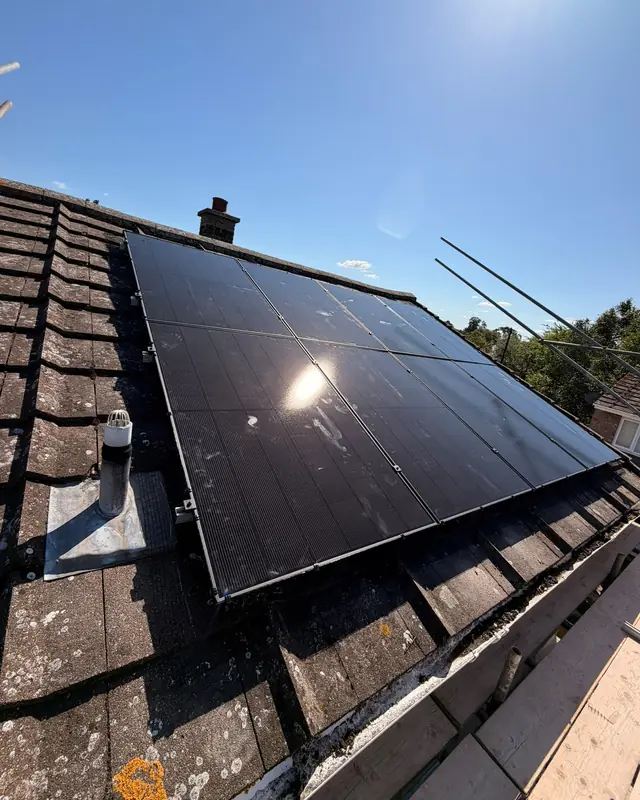
Want your roof sized around your car?
Tell us how many miles you drive and when the car is at home, and we'll design your panels and battery with that in mind. Our solar and battery systems are fully installed from £7,500 (10 panels, a Fox ESS battery and scaffolding to one side), including VAT.
Or call 0333 577 6576, Monday to Friday, 9am to 5pm. We'll only use your details for your quote. Privacy policy
Which costs less: solar or overnight charging?
It depends on two numbers: what you're paid to export, and what you pay to charge overnight. Every unit of solar that goes into the car is a unit you don't sell. If your export rate is higher than your overnight rate, it's cheaper to export by day and charge at night.
| Where it comes from | Cost per unit (kWh) | Cost per mile |
|---|---|---|
| The grid, at the average price cap rate | 26.32p | About 7.3p |
| The grid, overnight on Intelligent Octopus Go | 9.9p | About 2.8p |
| Your own solar, if you could export it at 13p | 13p you don't earn | About 3.6p |
| Your own solar, if you could export it at 4.1p | 4.1p you don't earn | About 1.1p |
Where the rates come from:
- Ofgem's price cap puts the average unit rate at 26.32p from 1 October to 31 December 2026.
- Octopus's rate list for Intelligent Octopus Go, valid from 4 November 2026, gives 9.9p a unit from 11:30pm to 5:30am in the East Midlands and Yorkshire. Its product page advertises smart charging from 6.5p, so check the rate you're offered.
- 13p is the best export rate open to anyone in our monthly check of export rates (Fuse Energy, 3 November 2026). 4.1p is Octopus's export rate for people who buy their electricity from another supplier.
- Intelligent Octopus Go customers with solar can add Outgoing Octopus, which pays its own customers 12p a unit. Octopus says the two are compatible.
Put together, exporting at 13p and charging at 9.9p comes out about 3p a unit ahead of charging from solar. On Intelligent Octopus Go with Outgoing Octopus at 12p, exporting is about 2p a unit ahead. With a 4.1p export rate, charging from the sun is about 6p a unit cheaper than charging overnight at 9.9p. With no EV rate at all, each unit of solar in the car saves you the full 26.32p, less what you'd have earned exporting it.
Your charging costs, and your savings, depend on your rates and on when the car is parked at the house.
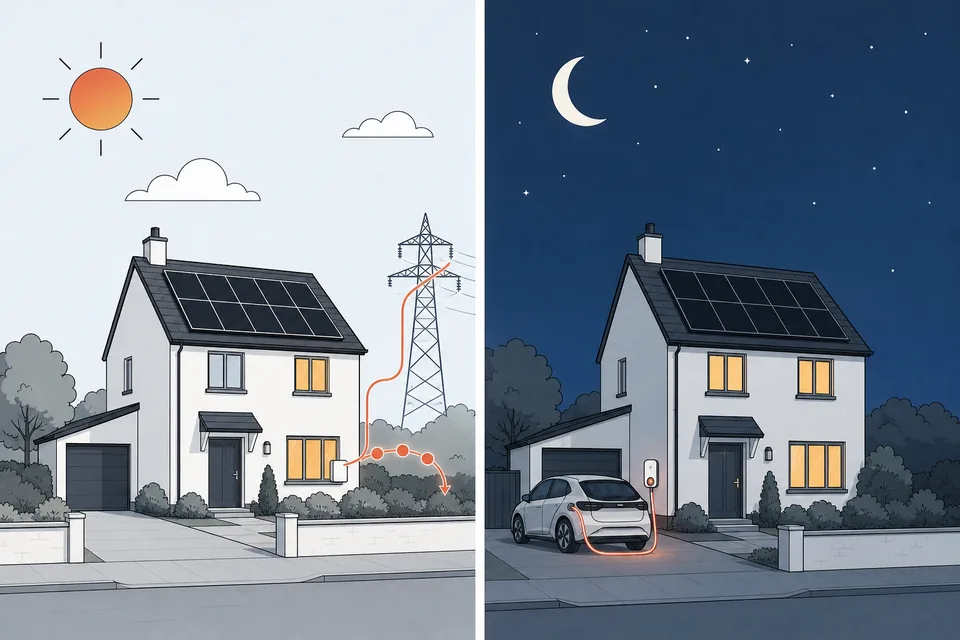
Where do the biggest savings come from?
The car is on the drive in the daytime
If you work from home, are retired or have a second car, the car is there while the panels produce. That's when a solar charger earns its place.
You can't get a cheap overnight rate
Smart EV rates like Intelligent Octopus Go only work with compatible cars and chargers, and Octopus says it can't guarantee yours will work. Without one, the sun easily beats the standard rate.
Your export rate is low
Export rates open to anyone run from 2p to 13p in our monthly check. On 2p to 6p, the car is the better place for your spare solar.
Your export is capped
Network operators sometimes limit how much a bigger system can send to the grid. In our worst case, a network operator agreed an 8 kW system but let it export only 3.7 kW at a time. Export limiting schemes work by cutting what the panels produce or by using more electricity on site, so a charger can soak up solar-generated electricity that the cap would otherwise hold back.
Do you need a battery to charge the car?
No. A solar-aware charger works without one, and a home battery is far smaller than a car's. The Energy Saving Trust gives car battery sizes of about 25 to 100 kWh. Home battery storage is sized for the house: our guide to what size battery suits a home with an electric car works through a 30-mile day.
- Keep the battery for the house. If it empties into the car in the afternoon, the house has to buy from the grid in the evening instead.
- Stop it emptying into the car overnight. A battery set to cover the house can also feed the charger when the car plugs in. Ask your installer to set it up so it doesn't, or choose a charger with a mode that pauses charging when the battery starts to discharge.
- Fill the battery cheaply too. On a cheap overnight rate, the battery can charge at night and run the house in the day. One of our customers wrote that "we are now (hopefully) getting the full benefit of overnight cheap rate electricity powering batteries and day time the batteries powering the house" (Peter W., Google, November 2025).
By day, the battery and the car compete for the same spare solar, so tell your installer which matters more to you.
Grants, VAT and planning for EV charging
There's no grant for homeowners with a driveway, and the 0% VAT on solar doesn't cover chargers. Here's what applies in England in November 2026.
Grants and VAT
Is there a grant for a home chargepoint?
Only for some households. The government's chargepoint grants, open until 31 March 2027, give up to £500 to:
- flat owners and renters with private off-street parking
- households with only on-street parking who fit a cross-pavement channel for the cable
Homeowners with a driveway aren't on the list. Landlords and workplaces have their own schemes.
Does the 0% VAT apply?
To the solar panels and battery storage, not the charger. HMRC's zero rate for energy-saving materials runs to 31 March 2027. EV chargers are not on its list. If your own position is unusual, check with HMRC or your accountant.
Planning and installation
A charger on a house in England is usually permitted development, within limits. The Planning Portal's rules, in force from 21 October 2026, say:
- One wall-mounted outlet per house, no bigger than 0.2 cubic metres and no higher than 1.6 metres off the ground.
- A charger on a post can be up to 1.6 metres high.
- In a business car park, a charger on a post can be up to 2.7 metres high.
- Not in a conservation area or at a listed building.
- Next to a road, it can't stick out more than 0.2 metres or sit within 1.5 metres of the carriageway.
Use a registered installer. GOV.UK has a postcode search for installers approved by the Office for Zero Emission Vehicles.
The bottom line
Charging from the sun pays when the car is home in daylight and your export rate is below your overnight rate.
Questions people ask
Can I plug my car straight into my panels?
No. Panels make direct current (DC), which has to go through an inverter and the house wiring before it reaches the car, usually through a wallbox.
Can a plug-in solar kit charge an electric car?
Not on its own. The law limits a plug-in kit to 800 W of output, and most cars won't start charging below about 1.4 kW. A kit's output can still help a charger that's already running from the grid. Our guide to plug-in solar panels covers the rules.
Can you charge a Tesla from solar?
Yes. A Tesla charges at home like any other electric car. For charging from the sun, what matters is the charger's solar mode, not the make of car.
Will it work with panels I already have?
Often, yes. myenergi says its unit works mainly from a clamp at your meter, so it reads your spare solar there, not from your inverter. You can also add a battery to panels you already have.
What does it cost to charge an electric car?
At the average price cap rate of 26.32p a unit, about 7.3p a mile. HMRC's advisory rate for charging at home is 7p a mile. On Intelligent Octopus Go's overnight rate of 9.9p, it's about 2.8p a mile, and spare solar is worth only the export payment you give up.
Can an electric vehicle power my house?
Generally not yet. The Energy Saving Trust says two-way (bidirectional) charging, which lets an electric vehicle draw power from, or supply power to, a home or the grid, is being trialled in some places but isn't widely available.
About this guide
Written by the SolarSave team in Retford: MCS certified installers, led by a founder in solar since 2010. We checked these figures on 16 November 2026; export rates come from our monthly check of 3 November 2026. Rates change, so we update this page when the price cap or export rates move.
The 24 sources we checked
- HMRC: Advisory fuel rates (advisory electric rate and miles per kWh), rates from 1 September 2026, checked 16 November 2026
- DESNZ: Feed-in Tariff load factor analysis 2024/25, 18 December 2025, checked 16 November 2026
- DESNZ: Digest of UK Energy Statistics 2026, chapter 6 (solar load factors), 2026
- Ofgem: Energy price cap, 1 October to 31 December 2026, 26 August 2026, checked 16 November 2026
- Octopus Energy: Intelligent Octopus Go, checked 16 November 2026
- Octopus Energy: Intelligent Octopus Go night rate, East Midlands (rate list), valid from 4 November 2026, checked 16 November 2026
- Octopus Energy: Outgoing Octopus (export tariff, 12p), checked 16 November 2026
- Octopus Energy: Can I still export my energy if I'm on an EV tariff? (help article), checked 16 November 2026
- Octopus Energy: Smart Export Guarantee (4.1p, for people who buy electricity elsewhere), checked 16 November 2026
- SolarSave: Best SEG tariffs, every export rate checked on the supplier's own site, checked 3 November 2026
- Which?: Electric car charging at home (charger costs), 20 October 2026, checked 16 November 2026
- Energy Saving Trust: Charging electric vehicles, checked 16 November 2026
- Energy Saving Trust: Battery storage, updated 6 October 2026, checked 16 November 2026
- myenergi: What are the zappi charging modes?, checked 16 November 2026
- myenergi: Is a solar CT clamp necessary for using surplus solar energy?, checked 16 November 2026
- Hypervolt: Charging modes, checked 16 November 2026
- GOV.UK: Regulations, electric vehicle smart charge points, updated 23 April 2024, checked 16 November 2026
- GOV.UK: Government grants for low-emission vehicles (chargepoint grants), updated 1 April 2026, checked 16 November 2026
- GOV.UK: Find an electric vehicle (EV) chargepoint installer, checked 16 November 2026
- HMRC: VAT on energy-saving materials and heating equipment (Notice 708/6), zero rate to 31 March 2027, checked 16 November 2026
- Planning Portal: Electric vehicle charging, permitted development, rules in force 21 October 2026, checked 16 November 2026
- National Grid Electricity Distribution (as WPD): ST:SD1E/4, technical requirements for customer export limiting schemes, October 2018, checked 16 November 2026
- Electricity North West: G98 micro-generation connections (3.68 kW single phase), checked 16 November 2026
- legislation.gov.uk: S.I. 2026/848, plug-in microgenerators, in force 27 August 2026, checked 16 November 2026