

In short
- Add up every unit in the home that can generate, including any older system.
- Within the limit: fit, then notify. Over it: apply first.
- Small systems over the limit can use a fast track: a reply within 10 working days.
- Your installer sends the paperwork.
| G98 | G99 | |
|---|---|---|
| What it covers | Everything that generates in the home, up to 16 amps per phase in total | Anything bigger |
| Normal home supply | Up to about 3.68 kW | Over 3.68 kW |
| Three-phase supply | Up to about 11.04 kW, spread across all three phases | Over 11.04 kW |
| When the network hears | Within 28 days of switch-on | Before connection |
| Approval | Not needed, unless your installer is fitting several homes nearby | Needed, sometimes with conditions |
| Time it adds | None | 10 working days on the fast track; otherwise 2 to 90 days in our experience |
What's the difference between G98 and G99?
G98 is a notice sent after the job. G99 is an application made before it. That timing of approval is what sets them apart.
Each is an engineering recommendation that every local power network in Great Britain follows. Yours is run by your distribution network operator, or DNO, not by your energy supplier.
- G98 covers small micro-generation devices, such as solar PV and storage, up to the 16 amp limit in total.
- G99 covers everything bigger, up to solar farms.
Both set the rules for a safe grid connection, renewable or not. They replaced G83 and G59 for systems connected from 27 April 2019, and both are now on their second issue.
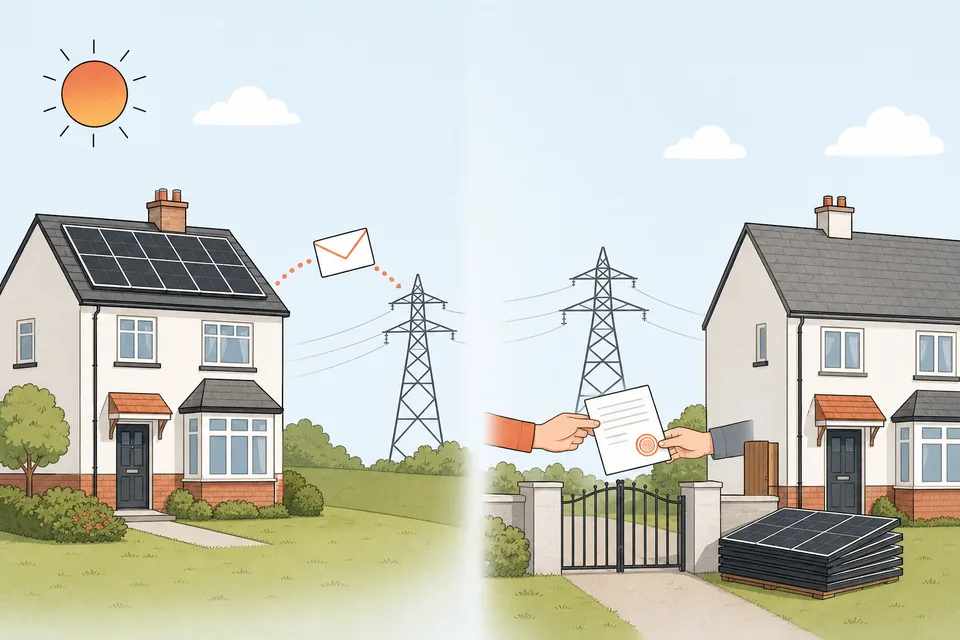
The 16 amp line is also in the Electricity Safety, Quality and Continuity Regulations 2002. A source within 16 amps a phase needs no separate agreement with its network. To qualify, it must also shut down in a power cut, and the network must be told.
G98 vs G99: which does your system need?
Add up the ratings of every unit in the home that can generate. Within the limit, it's fit and notify; above it, apply first.
- Check your supply. A single-phase supply has a limit of about 3.68 kW. Three-phase allows about 11.04 kW, at most 16 amps on each of its three phases.
- Use the inverter rating. The inverter turns solar power into the power your home uses. Its output decides the route, not the number of panels.
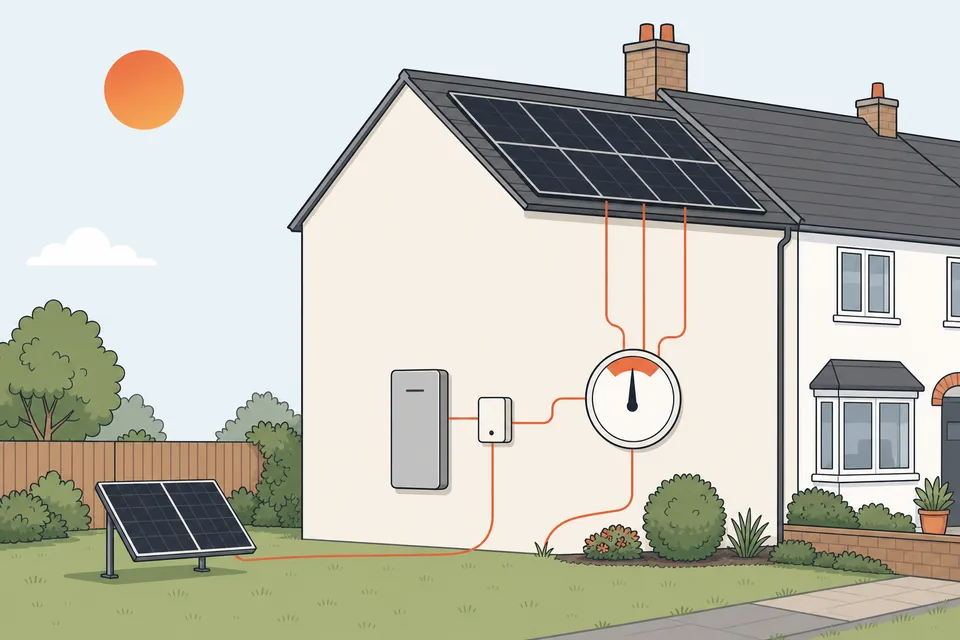
- Add everything else. A battery with its own unit, an older system and a plug-in kit all count.
- Ask about nearby jobs. Check whether your installer is fitting other homes nearby within 28 days.
| Set-up | Route |
|---|---|
| Solar and storage on one 3.68 kW hybrid unit | Fit, then notify |
| A 5 kW unit on a normal home supply | Apply first |
| 3.68 kW of solar plus a battery with its own 3.68 kW unit | Apply first: fast track, with a cap on what goes back |
| A 3.68 kW system plus an 800 W plug-in kit | Apply first |
| One installer fitting several nearby homes within 28 days | Apply first |
Want a system that skips the wait?
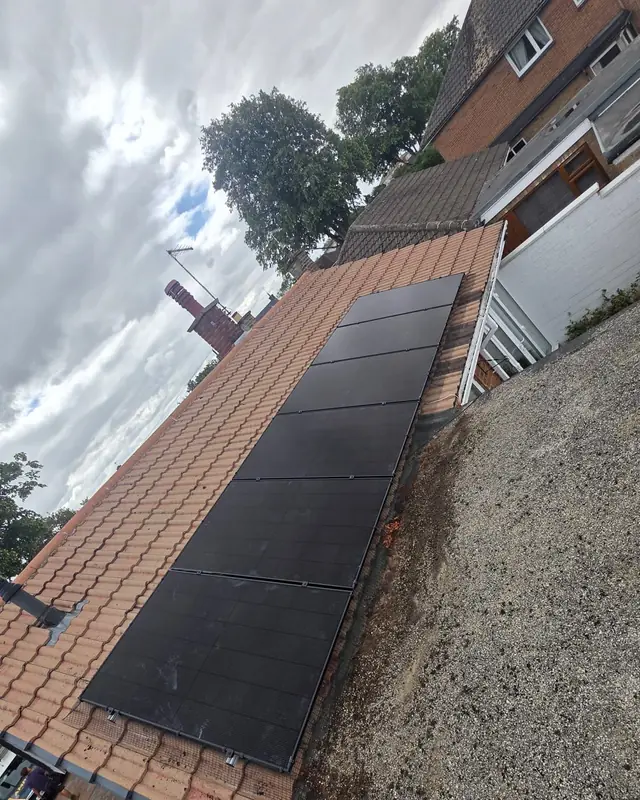
In a home where nothing else generates, our entry system needs only a G98 notice. It's fully installed from £7,500 (10 panels, a Fox ESS battery and scaffolding to one side), including VAT, with no pressure to sign.
Or call 0333 577 6576, Monday to Friday, 9am to 5pm. We'll only use your details for your quote. Privacy policy
Does a home battery count as generation?
Yes. The rules count storage as generation. What matters is whether it shares the solar unit or has its own.
- One hybrid inverter for both. Storage charges through the same unit as the solar, so the total stays at that unit's rating.
- A separate unit. Its rating adds to the solar one, so the total is likely to go over 16 amps.
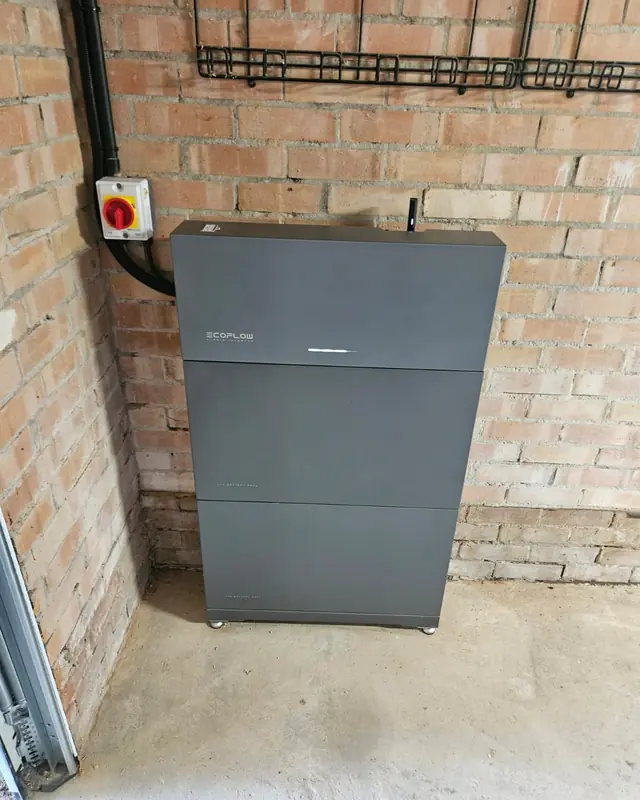
MCS says storage that takes a home over 3.68 kW must be applied for before installation, often on the fast track. See adding a battery to existing solar.
Why 3.68 kW is the size threshold
16 amps at 230 volts is 3,680 watts, or 3.68 kW. A unit sold as "3.7 kW" can be built to that figure. Fox ESS, for example, rates its H1-3.7 hybrid at 3,680 W, set to that limit.
The array on the roof can be bigger than the unit's rating. See how many solar panels you need.
Our entry system runs on a 3.7 kW inverter, so it connects under G98 if nothing else in your home already generates. More on our solar and battery systems.
How a G99 application works
The connection process starts before anything is fitted. Your installer applies and the DNO checks the local network, then says yes, yes with conditions, or that upgrades are needed first.
A G99 application brings more paperwork complexity than a notice. The DNO process:
- Design the system. Add up everything that will generate, including older kit.
- Send the DNO application. Usually Form A1-1, or Form A1-2 on the fast track, with location and site plans and the equipment datasheets.
- Get the answer. Approval can come with a cap on what you send back.
- Install and commission. Tests may be witnessed. If not, your installer confirms commissioning within 28 days.
The system can't be connected until approval comes through. We apply while your survey is being booked. See what happens on installation day.
How long approval takes
On the fast track, you get a reply within 10 working days. Other applications take 2 to 90 days in our experience. It depends on the DNO and how much spare capacity the local network has.
Within the G98 limit there's no wait: it's a simpler process.
Is there a fast track for smaller systems?
Yes. Since 9 November 2022, small home systems built from fully type-tested kit can use a quicker route, with a reply within 10 working days.
| Group | What fits | What happens |
|---|---|---|
| SGI-1 | All devices together up to 16 amps | Notify only |
| SGI-2 | Each up to 16 amps, 32 amps in total, grid output capped at 16 amps | Apply, then notify within 28 days |
| SGI-3 | Each up to 32 amps, 60 amps in total, grid output capped at 32 amps | Apply, then notify within 28 days |
The home must already exist. The kit mustn't keep running in a power cut, so a battery set up for backup power can't use the fast track. A 3.68 kW solar system plus a battery with its own 3.68 kW unit adds up to 32 amps. That fits SGI-2 if the DNO's network check passes.
Can an export limit avoid approval?
No. The G98 limit is on the combined rating of everything that generates, not on what leaves the house. An export limit can let a bigger system use the fast track instead.
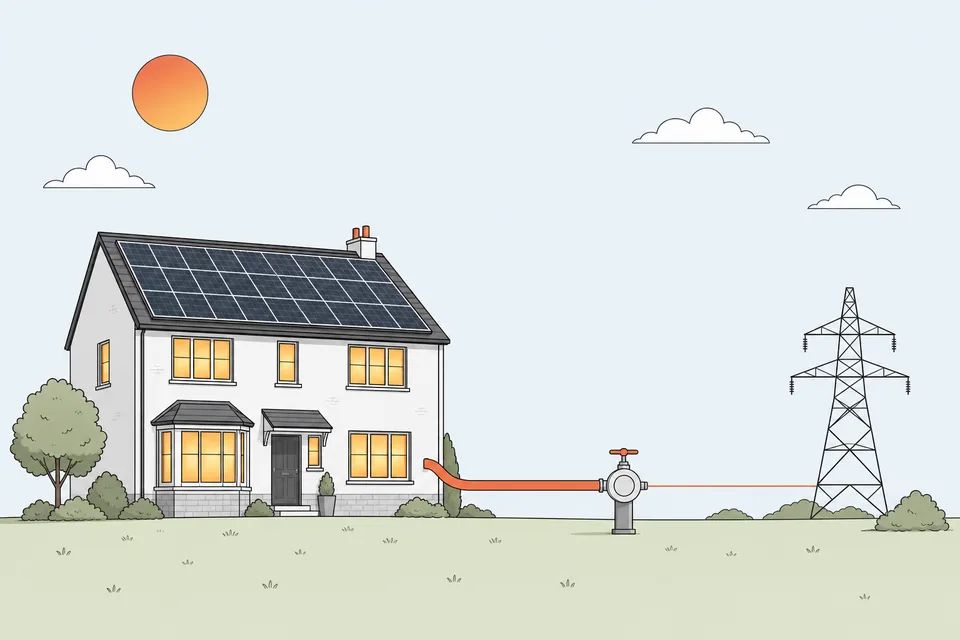
The cap comes from a limitation scheme built to another industry rule, G100. A DNO can also approve a bigger system with a cap on what goes back. Your home can still use the system's full output. Only what goes back is capped, so you may be paid for less under the Smart Export Guarantee.
What is a G98 certificate?
People mean one of two documents: proof that a unit's model meets the rules, or the notice your installer sends after switch-on.
- The maker's test report (Form C). It's the model's proof of grid compliance. Makers also declare compliant models on the industry's register of low-carbon products; the older ENA Type Test Register closed in April 2024.
- The installation document (Form B). Your installer sends it to your DNO within 28 days of commissioning.
Every system on this route needs built-in electrical protection that shuts it down in a power cut. Keep copies of your forms with your MCS certificate.
Does it cost anything to connect?
National Grid lists no fee for a G98 notice. A G99 application can carry assessment and design fees, which the DNO can charge whether or not you accept its offer. Where the local network needs upgrading, the offer sets out your share of that cost before you agree. Ask whether your quote includes making the application.
Who is your DNO?
Across our area it's mostly one of two companies.
| Company | Towns we cover |
|---|---|
| National Grid Electricity Distribution | Worksop, Chesterfield, Nottingham, Derby, Leicester, Stoke-on-Trent, Coventry, Birmingham |
| Northern Powergrid | Doncaster, Sheffield, Wakefield, Hull, Leeds, York, Bradford, Sunderland |
| Electricity North West | Manchester, Preston, Lancaster |
Derbyshire and Lincolnshire are split between companies, so check your postcode.
What if your installer is fitting several homes nearby?
If one installer fits several homes close together within 28 days, it must apply first, on G98's multiple premises form (Form A).
Industry guidance treats homes within about 500 metres of each other, or sharing a postcode up to its last two letters, as close together.
Does plug-in solar count towards the limit?
Yes. A plug-in kit of up to 800 W counts towards the same 16 amps, so adding one to a full 3.68 kW system takes the home over the limit.
Ofgem approved the rules in August 2026: one plug-in device per home, a simple way for owners to tell their network, and one shared limit. Read about plug-in solar panels.
The bottom line
Add up everything in the home that can generate. Within the 16 amp limit, it's a G98 notice afterwards. Over it, it's a G99 application first.
Questions people ask
Do I need G99 for a 4 kW solar system?
Only if the unit is over 3.68 kW. A 4 kW array on a 3.68 kW unit just needs a notice. A 4 kW unit is over 16 amps, so it needs approval first.
Can a G99 system be fitted before approval?
No. Under G99 the system can't be connected until the DNO gives permission, and MCS says the application must go in before installation.
Does adding storage later need approval?
Usually. A battery with its own unit adds to the solar rating, so the total is likely to go over 16 amps. Many add-ons can use the fast track.
Who deals with the network paperwork?
Your installer. MCS requires it to tell the network about every system, and to apply first where the rules say so.
How long does an installer have to send the notice?
28 days from commissioning. We aim to send ours within 7 working days.
What if the network was never told?
Telling your network is a legal requirement. Ask your installer for a copy of the notice. If that doesn't sort it, MCS handles complaints about its certified installers.
Do you need the paperwork for export payments?
You need an export MPAN, the number that identifies your export point. Your export supplier can arrange it.
About this guide
Written by the SolarSave team in Retford: MCS certified installers, led by a founder in solar since 2010. We checked these rules against the Energy Networks Association's guide, National Grid Electricity Distribution, Electricity North West, SP Energy Networks, MCS, Ofgem, legislation.gov.uk and the Fox ESS datasheet on 16 November 2026. The rules are amended from time to time, so we recheck this page when they change.
The 19 sources we checked
- Energy Networks Association: Distributed Generation Connection Guide, G98 and G99 (v2.0), March 2025, checked 16 November 2026
- Energy Networks Association: Connecting generation to the electricity networks, checked 16 November 2026
- Distribution Code: Engineering documents (G98 and G99, Issue 2), checked 16 November 2026
- legislation.gov.uk: Electricity Safety, Quality and Continuity Regulations 2002, regulation 22, checked 16 November 2026
- National Grid Electricity Distribution: Micro generation (G98), checked 16 November 2026
- National Grid Electricity Distribution: Generation (G99), checked 16 November 2026
- National Grid Electricity Distribution: Fast track (G99), checked 16 November 2026
- Electricity North West: G98 and G99 application guidance, December 2021, checked 16 November 2026
- Ofgem: Decision on DCRP/21/08, the G99 fast track, 9 September 2022, checked 16 November 2026
- Ofgem: Decision on DCRP/MP/26/02, plug-in microgeneration, 11 August 2026, checked 16 November 2026
- Ofgem: Smart Export Guarantee, guidance for generators, December 2019, checked 16 November 2026
- MCS: Notifying DNOs, updated 14 July 2026, checked 16 November 2026
- SP Energy Networks: Export limitation, checked 16 November 2026
- National Grid Electricity Distribution: Customer export limitation schemes, checked 16 November 2026
- Electricity North West: G98 form summary, checked 16 November 2026
- Fox ESS: H1 G2 hybrid inverter datasheet (v2.2), 9 June 2026, checked 16 November 2026
- Energy Networks Association: Find my network operator, checked 11 October 2026
- Northern Powergrid: About us, checked 11 October 2026
- MCS: What to do if things go wrong, updated 7 September 2026