

In short
- Typical new panels: 21.7% to 24.1% efficient in standard tests, depending on the type of cell.
- UK output: about 805 to 970 kWh a year for each kWp of panels, averaged across all UK solar (DESNZ, 2024 and 2025).
- Does it matter? On a small roof, yes. On a big roof with room to spare, direction, shade and warranty matter more.
| Figure | Typical value | What it tells you |
|---|---|---|
| Record for a silicon-perovskite tandem cell | 35.5% (LONGi, July 2026) | What labs can do. Not a panel for your roof. |
| Typical datasheet rating for a panel | 21.7% to 24.1% (2026) | How much power fits on each square metre of roof. |
| Average output of UK solar | About 805 to 970 kWh per kWp a year | What UK systems actually made, all sites together. |
How efficient are solar panels in 2026?
Most solar panels sold in 2026 are 21.7% to 24.1% efficient. The figure depends mainly on the type of cell inside the panel. The solar manufacturing industry's 2026 roadmap (ITRPV) gives the typical efficiency for each type:
| Cell type | Efficiency | Good to know |
|---|---|---|
| PERC | 21.7% | The traditional type. TOPCon passed it in market share in 2024. |
| TOPCon | 23.5% | Level with heterojunction on efficiency. |
| Heterojunction (HJT) | 23.5% | Matches TOPCon. |
| Back-contact | 24.1% | The most efficient type. The connections sit on the back of the cells. |
The best panels for homes now reach about 24% to 25%. TCL SunPower's back-contact panel for homes, launched in June 2026, is rated 23.8% to 24.7%. AIKO's Neostar 2P54 reaches up to 24.3%, and Trina's Vertex S+ up to 23.8%. Our guide to the best solar panels in the UK compares named panels.
Which? says monocrystalline panels are the most popular and most efficient option. Most polycrystalline panels are less efficient but cheaper, and thin-film panels are less efficient than both.
Figures online disagree because some quote lab records, some quote single cells and some are out of date. Compare the module efficiency on each datasheet: that's the figure for the whole panel.
What does solar panel efficiency mean?
A solar panel's efficiency is the ratio between the electricity it makes and the solar energy falling on it. If a panel successfully converts 22.5% of the light hitting it into electricity, it's 22.5% efficient. The rest is reflected or warms the panel.
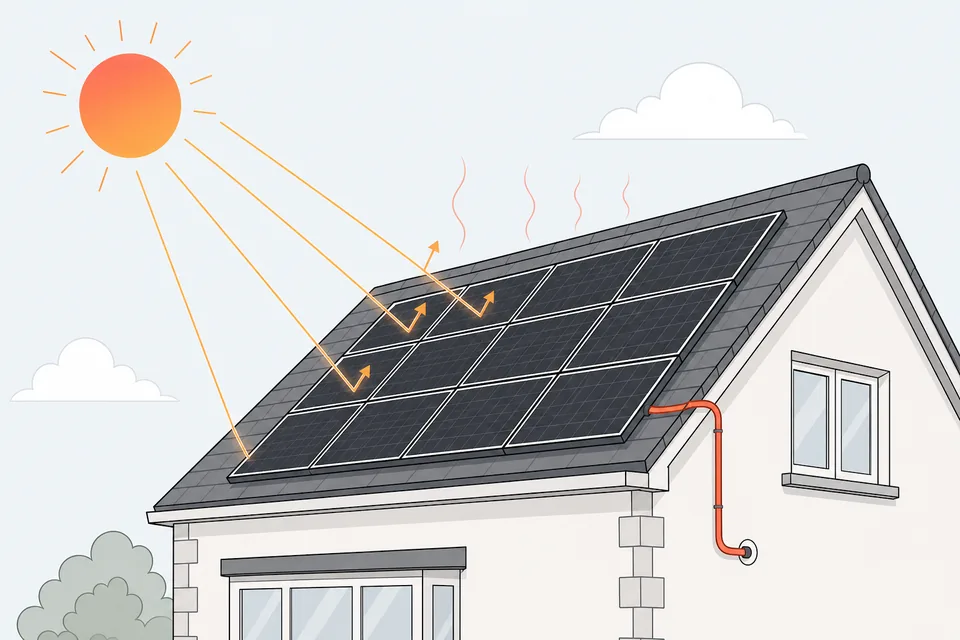
Every photovoltaic (PV) panel is tested the same way, under standard test conditions (STC): light of 1,000 watts per square metre, cells at 25°C, and a light spectrum called air mass 1.5.
You can check a panel's efficiency yourself: divide its power by the test light falling on it.
- Trina's 450 W Vertex S+ panel measures 1.762 m by 1.134 m, which is about 2.0 square metres.
- In the test, 2.0 square metres receives about 2,000 watts of light.
- 450 W out of 2,000 W is 22.5%, the share of test sunlight the panel converts. That matches Trina's datasheet.
Watts or percentage: what's the difference?
Wattage (W) is how much power one panel makes in the test; efficiency is how much it makes for its size. A big panel can have more watts but lower efficiency. All your panels' watts added up give the system size in kilowatts peak (kWp).
Cell figures vs panel figures
A panel is many cells plus a frame and the gaps between them, so a whole panel scores lower than its best single cell. LONGi's record silicon-perovskite tandem cell, which adds a thin layer of a light-absorbing material called perovskite, reached 35.5% in 2026. Its tandem modules reached 31.4% and 29.4%.
How much electricity you get in UK weather
A panel's rating is the same in Doncaster as anywhere else, because it's measured in a lab. What changes is the amount of light that reaches it. Across the UK, each kWp of solar panels made about 805 kWh in 2024 and about 970 kWh in 2025. These are averages for all UK solar PV, not one roof.
Those figures come from the solar load factors in the government's renewable energy statistics: 9.2% in 2024 and 11.1% in 2025 (DESNZ). A load factor is the electricity panels actually made, as a share of what they'd make running at full power all year.
2025 was the sunniest year in DESNZ's records, which start in 2001.
A load factor isn't efficiency. It counts every hour of the year, including nights and cloudy days, so it's far lower than the panel's rating.
So a 4 kWp system would make about 3,220 kWh in a year like 2024 and about 3,880 kWh in a year like 2025, whether you use it or export it to the grid. To size a system from your own electricity use, see how many solar panels do I need?
Cloud, cold and winter
Panels run on daylight, so they keep generating under cloud at lower output: Trina's datasheet shows its panel working at a fifth of test light. Cold helps, because heat cuts output. Short days and a low sun are what cut winter output: more in do solar panels work in winter?
When does efficiency matter on a UK roof?
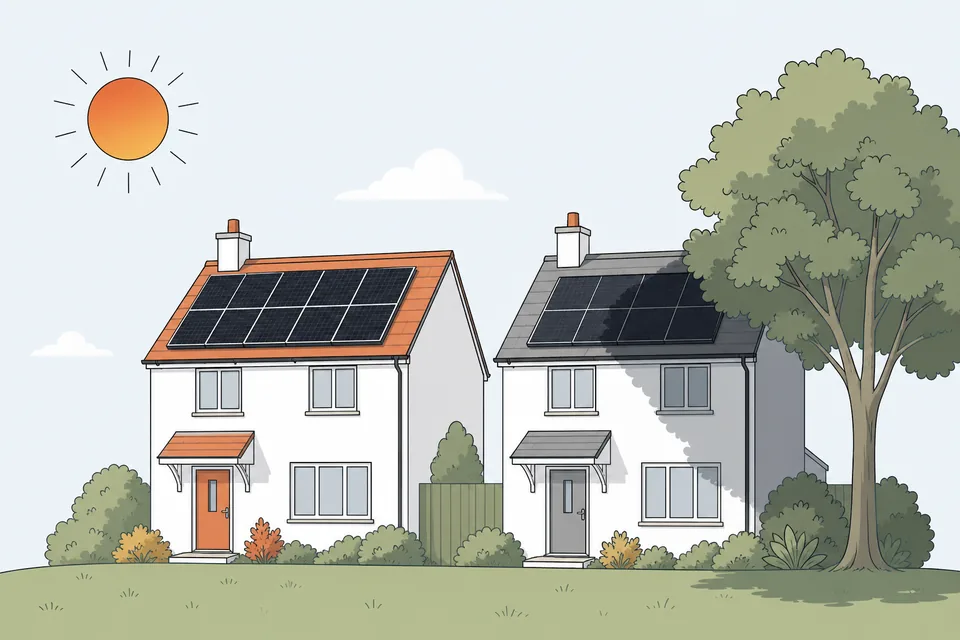
Efficiency matters on a UK roof when roof space limits how many panels you can fit. A higher rating puts more kWp on the same roof. On a big roof with room to spare, direction, shade and warranty make a bigger difference.
A worked example: 16 square metres of usable roof, room for eight panels of about 2 square metres each, with the efficiencies above and UK-average output in 2024 and 2025:
| Panel type | Efficiency | System size | Output a year |
|---|---|---|---|
| PERC | 21.7% | About 3.5 kWp | About 2,800 to 3,370 kWh |
| TOPCon or heterojunction | 23.5% | About 3.8 kWp | About 3,030 to 3,650 kWh |
| Back-contact | 24.1% | About 3.9 kWp | About 3,100 to 3,740 kWh |
Our sum: roof area x efficiency = system size (16 x 0.241 = 3.86 kWp), and system size x 805 to 970 kWh = output a year.
So back-contact panels make about 11% more than PERC panels on the same roof. Now compare direction. Which? says an east- or west-facing roof makes 15% less than a south-facing one, and a north-facing roof around 30% less. Turning from south to east costs more than the best panels add.
When is efficiency worth paying for?
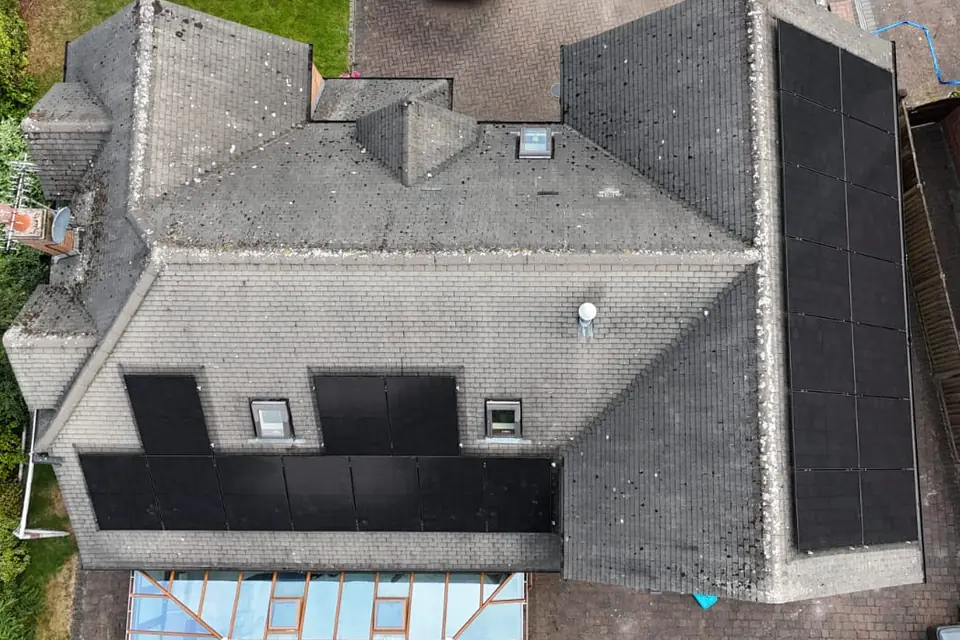
- Small or broken-up roof: terraces, dormers, roof windows and hips leave little space. Back-contact or TOPCon panels fit more power into it.
- Big, clear south-facing roof: you can fit enough panels anyway, so a well-warranted panel at a sensible price is usually the better buy.
- Shaded roof: deal with the shade first (see shade below).
Want to know what your roof could make?
We design each system around your roof and how you use electricity. Free consultation, a written quote, no pressure to sign.
Or call 0333 577 6576, Monday to Friday, 9am to 5pm. We'll only use your details for your quote. Privacy policy
What your quote's output estimate is based on
Efficiency shows up on an MCS quote as system size (kWp). MCS installers estimate your yearly output with a set formula, and panel efficiency isn't in it. The MCS 032 standard puts it like this:
- Output a year (kWh) = kWp x Kk x SF.
- kWp is the total of the power ratings on the panels' data plates, measured under standard test conditions.
- Kk is the kWh each kWp should make a year in your postcode zone, for your roof's pitch and direction. MCS takes it from the EU's PVGIS solar data and multiplies it by 0.8.
- SF is a shading factor: 1 with no shade, lower with more.
So a higher rating only raises the estimate if it lets more kWp onto your roof. In MCS's own worked example, a roof in postcode zone 1 with a 30° pitch, turned 45° from south, gets 925 kWh per kWp. MCS says the estimate "should not be considered as a guarantee of performance".
What to check on a solar quote
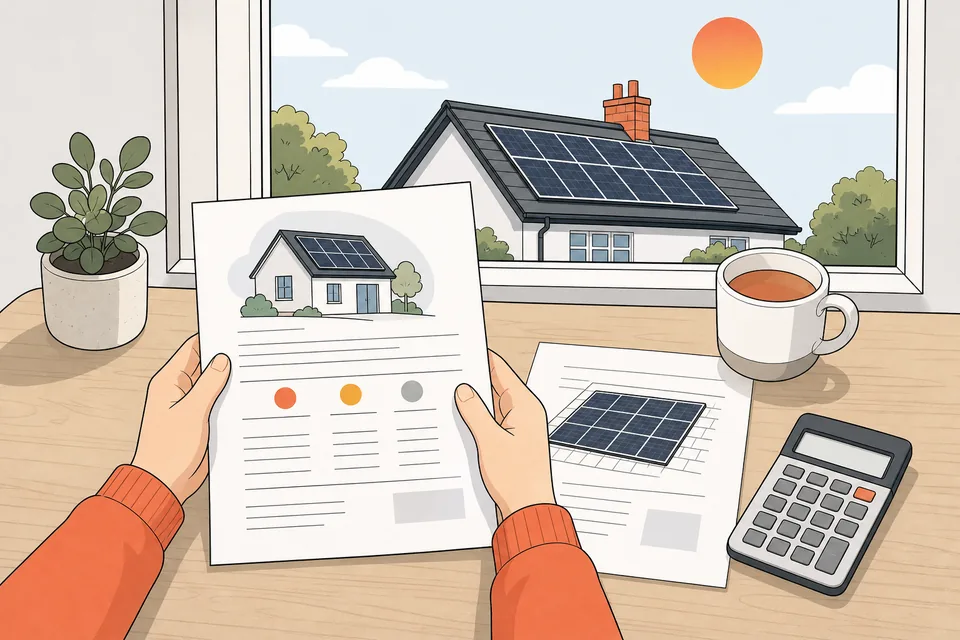
- The panel's make and model. Look up its datasheet.
- Watts and module efficiency. Check both against the datasheet.
- Temperature coefficient. Closer to zero is better (Trina's Vertex S+ is -0.29% per °C, AIKO's Neostar 2P54 -0.26%).
- Yearly power loss. The first-year and yearly limits in the warranty.
- Warranties. The product warranty covers faults. The performance warranty covers output.
- System size and estimate. The total kWp, and the MCS estimate in kWh a year.
Which? tests panels against their labels and says "not all panels live up to these claims", so check independent tests too.
The panels we fit carry a 25-year product warranty and a 30-year performance warranty. To see what your roof could make, ask us for a free quote.
What cuts output on a real roof?
Output on a real roof drops with anything that changes how much sunlight reaches the cells, or how hot they get. On UK roofs, direction and shade usually cost the most.
Heat
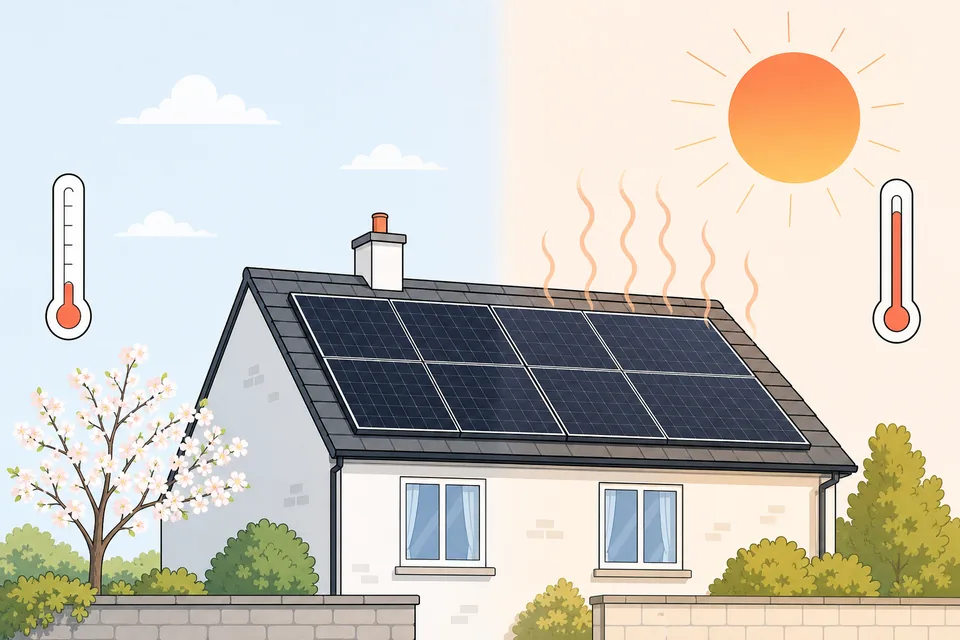
Heat cuts energy output. The datasheet's temperature coefficient says by how much: Trina's Vertex S+ loses 0.29% of its power for each degree its cells rise above 25°C.
- In Trina's normal operating test (800 W/m² of light, 20°C air, a 1 m/s breeze), its cells run at about 43°C. That's 18°C above the test level, so about 5% less power than the same light would give at 25°C.
- Every extra 10°C on the cells costs about another 2.9%.
- On a cold, bright day the cells can sit below 25°C. The same coefficient then works the other way and nudges output up slightly.
Light and direction
Facing east or west costs about 15%, and north about 30% (Which?, as above). Panels still produce power in dull light.
Shade
Shade cuts output. Which? says a roof with 20% shading or less is best, and one more than 80% shaded can lose as much as 50% of its output. If part of your roof is shaded, read do you need optimisers or microinverters?
Dirt
Dirt on the glass blocks light, but the Energy Saving Trust says rain washes most of it away in many cases.
How much power does a panel lose with age?
Solar panels lose only a little power each year. Two current panels, Trina's Vertex S+ and AIKO's Neostar 2P54, are guaranteed to lose no more than 1% in the first year, then 0.4% and 0.35% a year. NREL's review of field data found a median of 0.5% to 0.6% a year. This slow loss is called degradation.
For a 22.5% efficient Trina Vertex S+ panel, the warranty guarantees at least:
- After 1 year: 99% of its power, like an efficiency of about 22.3%.
- After 10 years: 95.4%, like about 21.5%.
- After 25 years: 89.4%, like about 20.1%.
- After 30 years: 87.4%, like about 19.7%.
These are guaranteed minimums. In NREL's review, hotter climates appeared to show faster loss, though the effect wasn't statistically significant overall.
The panels we fit have a 30-year performance warranty. More in how long do solar panels last?
Solar efficiency records: the most efficient panels and cells
For homes, back-contact panels lead, at about 24% to 25%. Lab cells go further, but they're research cells, not roof panels.
- Tandem record: 35.5% for a silicon-perovskite tandem cell from LONGi, certified by the European Solar Test Installation (ESTI) in July 2026.
- Highest of all: 47.6% for a four-junction cell under light concentrated 665 times, a design meant for concentrator systems (Fraunhofer ISE, 2022).
- Efficiency limits: a single-junction cell (one light-absorbing layer) can't pass about 33.7% in ordinary sunlight, known as the Shockley-Queisser limit. Tandem cells get past it by stacking layers.
Will higher-efficiency panels come along soon?
Panels will keep getting more efficient, but slowly. The ITRPV roadmap expects single-junction panels to reach about 26.3% by 2035, about two points above today's typical back-contact panels. It expects tandem panels to enter mass production around 2027, at about 27.4% by 2028.
Worth waiting? A 2035 single-junction panel might fit about 9% more power onto the same roof than a typical back-contact panel today, but waiting means years without solar power.
How to keep your system working well
You can't improve solar panel efficiency once panels are fitted, because the rating is fixed. You can keep the system producing what it should.
- Check your generation readings. Compare each month with the same month last year, because output swings with the seasons.
- Compare the year with your estimate. A year well below your MCS estimate is worth a call to your installer. The estimate isn't a guarantee, and a dull year makes less.
- Trim back trees. Growing branches can shade panels that were once clear.
- Clean them if you see dirt. The Energy Saving Trust suggests checking panels every 12 to 18 months and cleaning them if there's visible dirt. It warns against standing on panels, which can crack, or working at height untrained, and says professional cleaning typically starts at around £60 to £100 for a standard system.
- Book a check-up. The Trust suggests an inspection every one to two years, and a full professional service every three to five years.
The short version: efficiency decides how much power fits on your roof. Direction, shade and warranty decide most of the rest.
Questions people ask
What is a good efficiency for a solar panel?
For a new panel in 2026, about 23.5% is typical for TOPCon and heterojunction panels, and 24.1% for back-contact panels. Older-style PERC panels are about 21.7%.
Is a more efficient panel worth paying extra for?
It can be if your roof is small, because you fit more power in the same space. In our worked example, back-contact panels made about 11% more than PERC panels on the same roof.
Is a panel less efficient in winter?
Not because of the cold. Two current panels, Trina's Vertex S+ and AIKO's Neostar 2P54, lose 0.29% and 0.26% of their power for every degree they warm above 25°C, so cold helps. Winter output is lower mainly because the days are short and the sun is low.
How efficient is a 20-year-old panel?
It keeps most of its power. At the median loss of 0.5% to 0.6% a year that NREL researchers found, a panel would still make about 88% to 90% of its original output after 20 years.
Can a solar cell ever be 100% efficient?
No. A single-junction cell (one light-absorbing layer) can't pass about 33.7% in ordinary sunlight. Stacking layers raises the ceiling: the best so far is 47.6%, for a four-junction cell under concentrated light (Fraunhofer ISE, 2022).
About this guide
Written by the SolarSave team in Retford: MCS certified installers, led by a founder in solar since 2010. We checked every figure against its source, listed below, on 16 November 2026. Panel efficiency improves every year, so check the datasheet for the exact panel in your quote.
The 12 sources we checked
- PV Tech: ITRPV 2026 roadmap, module efficiency by cell type, 25 June 2026, checked 16 November 2026
- Trina Solar: Vertex S+ NEG9R.28 datasheet (2026), checked 16 November 2026
- AIKO: Neostar 2P54 Mono-Glass, 450 to 485 W, checked 16 November 2026
- LONGi: 35.5% crystalline silicon-perovskite tandem cell, 15 July 2026, checked 16 November 2026
- DESNZ: Digest of UK Energy Statistics 2026, chapter 6 (solar load factors), checked 16 November 2026
- MCS 032: Solar PV and battery pre-sale information and system performance estimate standard, issue 1.0, 1 January 2025, checked 16 November 2026
- Which?: Buying advice for solar panels, 12 August 2026, checked 16 November 2026
- Which?: How we test solar panels, 12 August 2026, checked 16 November 2026
- Energy Saving Trust: How to clean and maintain solar panels, updated 1 October 2026, checked 16 November 2026
- Fraunhofer ISE: 47.6% four-junction solar cell under concentrated sunlight, 30 May 2022, checked 16 November 2026
- pv magazine: TCL SunPower back-contact module for residential use (SPR-BE54), 23 June 2026, checked 16 November 2026
- NREL (Jordan and Kurtz): Overview of field experience, degradation rates and lifetimes, September 2015, checked 16 November 2026