

Which check suits your panel?
Panels on your roof
From the ground
the inverter, the app and the meter
No tools or ladder. MCS rules say the generation display should be readable without a tool, ladder or torch.
A loose 12 V or 24 V panel
Multimeter
with the maker's manual
Disconnect it first, then compare its voltage in full sunlight with the figure on its label.
Damage, a fault code or no output
Call your installer
and leave the wiring alone
The BRE says the DC cables stay live in daylight, from the panels down to the isolator.
From MCS, the BRE, the Energy Saving Trust and makers' manuals, checked 16 November 2026.
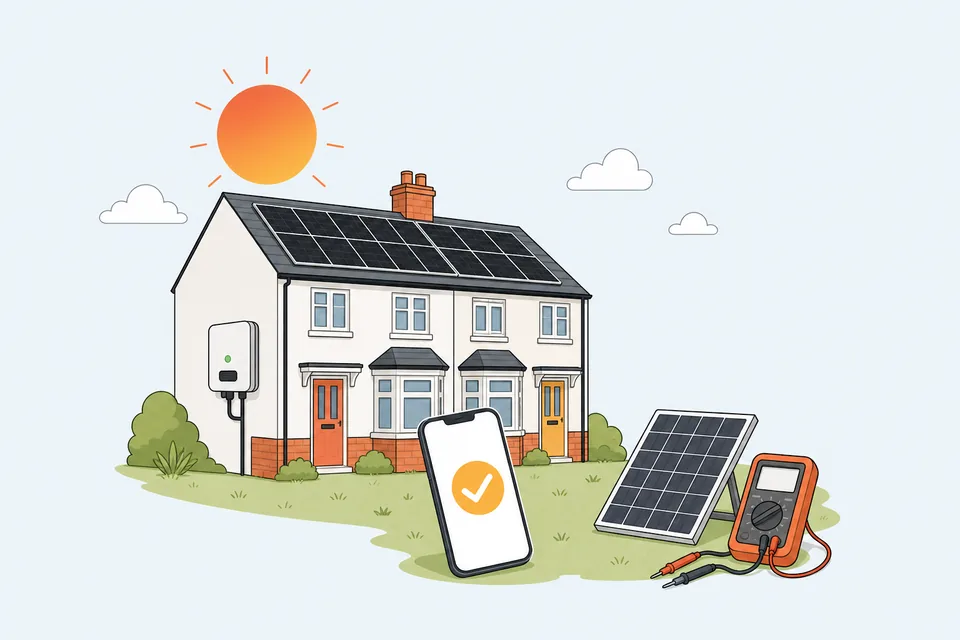
How to test solar panels on your roof from the ground
Check what the whole system makes, not each panel. These four checks need no tools, and you never go near the roof.
Step 1: Look at the inverter
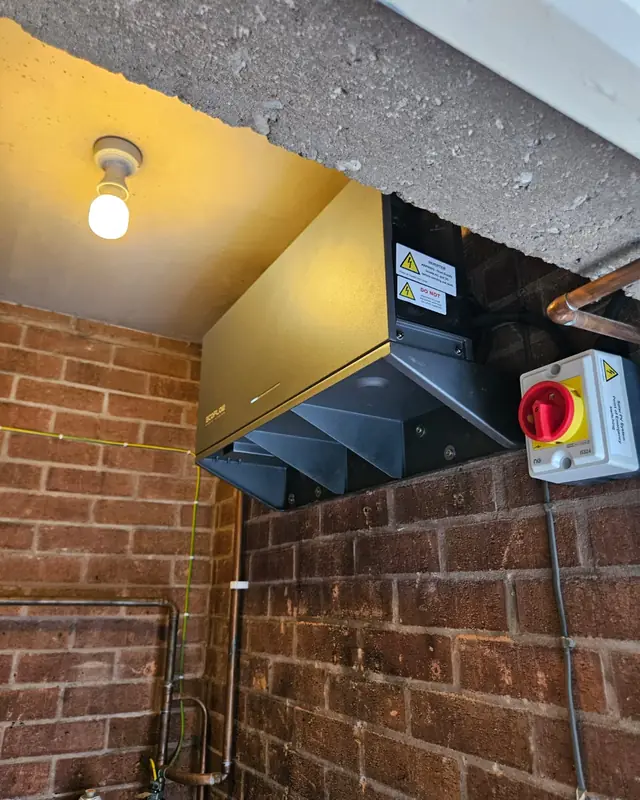
The inverter turns the DC electricity from the roof into the AC your home uses. It's usually in the loft, the garage or on an outside wall, with a status light and often a small screen.
- Green or "normal": it's working. On Fox ESS's H1 hybrid inverters, for example, green means normal and red means a fault.
- Red, or a fault message: write down the code and the time, then call your installer.
- Nothing lit on a bright day: the system has stopped. Tell your installer, and say if the solar switch on your fuse board has tripped.
Leave the covers on. Fox ESS's manual says the tasks it describes can only be done by qualified electricians.
Step 2: Open your monitoring app
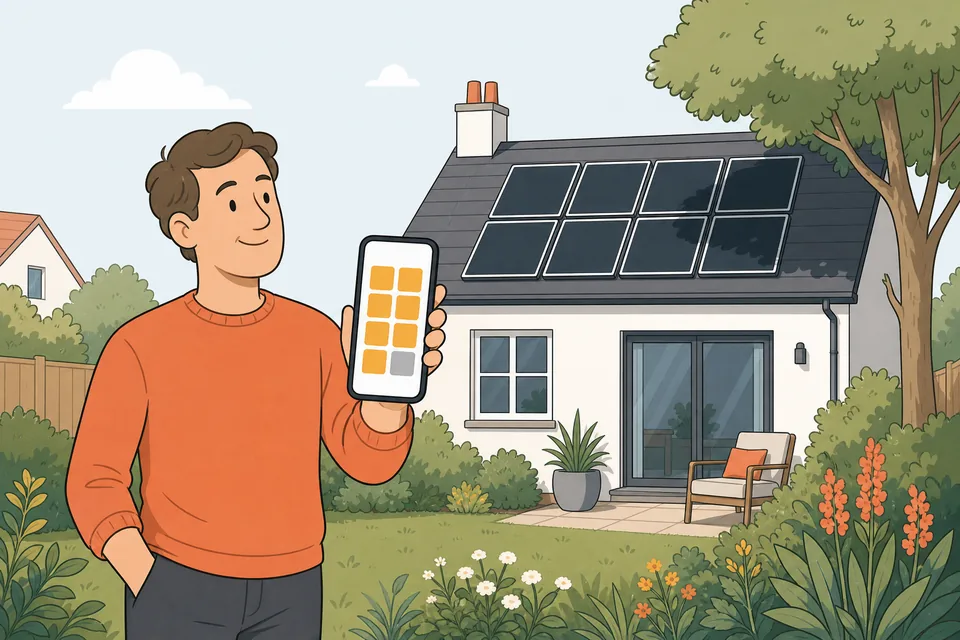
If your inverter sends its readings to an app or website, start there. Fox ESS's manual says its app shows the inverter's working status, performance and any fault information, at home or away.
- Look on a bright day around midday, when output should be near its highest.
- Compare today with a similar day last week, or the same month last year.
- With two strings (sets of panels on separate inputs) facing the same way, compare them. One far below the other suggests shade, dirt or a fault on that side.
Learn what a normal summer and winter day look like, so a bad one stands out.
Ask your installer to show you the app at handover. One of our customers wrote: "After installation everything you need to know about how to use it with the app and how to go about getting a feedback tariff is also explained." (Jai A., Trustpilot, July 2026).
Step 3: Read the generation meter
Every MCS certified system has a meter or display showing the total electricity it has made, in kWh. MCS's standard for installers says it should be readable without a tool, ladder or torch. The system should also be able to tell you within 48 hours if it stops working.
- Note the reading on the same date each month.
- Add up a year and compare it with the estimated annual generation on your MCS certificate.
- A meter that hasn't moved all day in good light means the system or the meter has stopped. Call your installer.
Step 4: Look from the ground
Looking is the quickest way to spot many faults, says the International Energy Agency's PV programme. Stand in the garden or across the road, with binoculars if you have them. Look for:
- cracked or shattered glass
- brown or burnt-looking marks
- a panel that has slipped or lifted
- heavy dirt, moss, leaves or bird droppings
- cables hanging loose or chewed
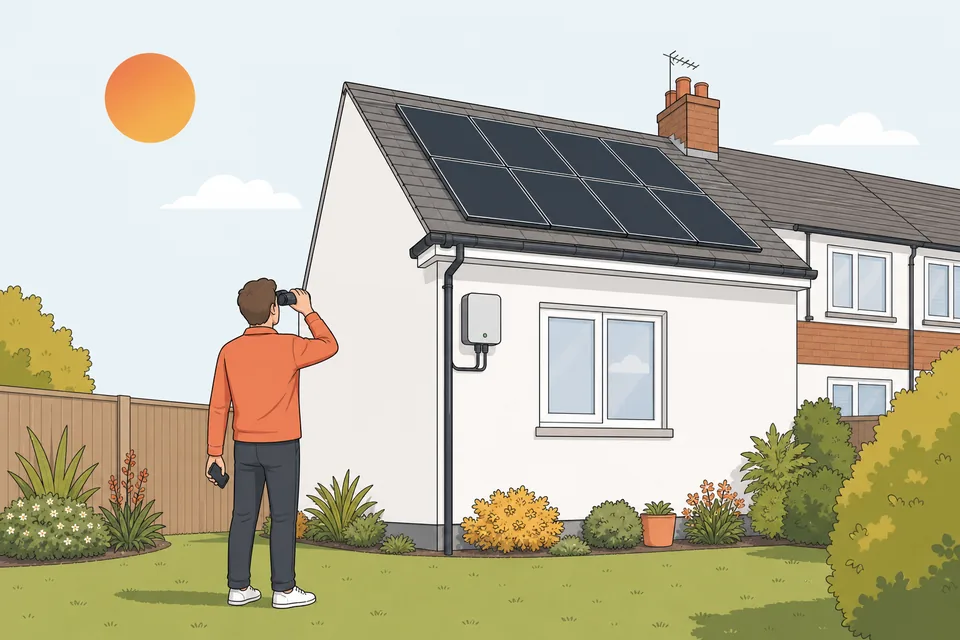
Don't climb up. The Energy Saving Trust says solar panels aren't designed to support the weight of a person, and it's safer to avoid working at height without the right training or equipment. Damaged cable is an electric shock hazard: report it to your installer straight away.
What a normal solar panel reading looks like
Normal is close to the same month last year, once you allow for the weather. A slow dip over the years is ageing. A sudden drop to almost nothing on a bright day is a fault.
Weather. UK sunshine swings: government figures show 2024 had the lowest sunshine on record and 2025 the highest since records began in 2001. Solar's load factor, the share of its full power a system makes over a year, rose from 9.2% to 11.1%. That's about a fifth more electricity per kW (21%, our sum).
Season. Compare a month with the same month, never December with June. See do solar panels work in winter?
Age. Panels lose a little power each year. Trina's warranty, for example, allows up to 1% in the first year and no more than 0.4% a year after that. More in how long solar panels last.
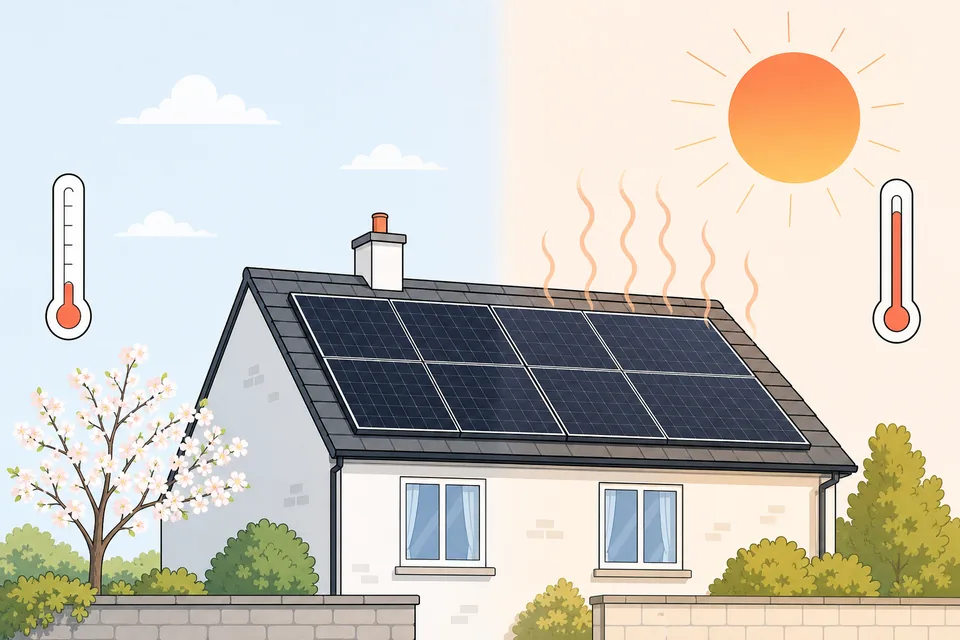
Heat. Hot panels make a little less: on Trina's datasheet, power falls 0.29% and voltage 0.24% for each degree the cells warm up.
Trina's 455 W panel is rated at 348 W in weaker light than the label's (800 W/m², air at 20°C, cells about 43°C). Most of that gap is the light; heat takes about 5% (our sum). So a reading below the label on a sunny day is normal.
| What you see | What it usually means | What to do |
|---|---|---|
| Lower output on a dull day or in winter | Normal | Compare with the same month last year |
| Slightly lower output in a hot spell | Normal: hot panels make a little less | Nothing |
| A slow fall over several years | Normal ageing, if it's within the warranty | Compare with the warranty's yearly limit |
| A red light or a fault code | An inverter fault | Note the code and call your installer |
| Nothing at all on a bright day | The inverter has stopped, or a switch has tripped | Call your installer |
| One string far below the other, both facing the same way | Shade, dirt or a fault on that string | Look from the ground, then call your installer |
| The generation meter isn't moving | The meter or the system has stopped | Call your installer |
The inverter is the usual suspect. In a Which? survey of more than 2,000 members with solar panels in April 2024, 68% had no technical issues. Inverter problems were by far the most common, at 15%.
Thinking about a new solar system?
We design and fit solar and battery systems, all MCS certified. Free consultation, a written quote, and no pressure to sign.
Or call 0333 577 6576, Monday to Friday, 9am to 5pm. We'll only use your details for your quote. Privacy policy
Why roof wiring is a job for a qualified installer
A roof system's DC wiring can carry hundreds of volts whenever light falls on it, and you can't switch that off at the roof. Add a ladder and a sloping roof, and a meter check becomes two hazards at once.
The BRE, the UK's building research body, says the solar DC supply, from the panels to the DC isolator, "will still be live during daylight". Switching off the isolator doesn't make the cables between it and the roof safe to touch.
| What it is | Volts (nothing connected, or the limit) | Who should check it |
|---|---|---|
| A 12 V camping or shed panel | 18 to 28 V (REDARC) | You, with the maker's manual |
| A 24 V loose panel | 34 to 56 V (REDARC) | You, with the maker's manual |
| One home panel, on the roof in a string | 53.4 V and up to 10.77 A (Trina 455 W) | A qualified installer |
| Ten home roof panels wired in a string | About 534 V (our sum) | A qualified installer |
| A home hybrid inverter's DC limit (Fox ESS H1) | Up to 600 V | A qualified installer |
So the line isn't one module's volts. It's the height, and the string the modules are wired into.
Fox ESS's manual puts it plainly: what PV modules put out is "very high and within a dangerous voltage range".
Electrical safety on the DC side is why MCS installers inspect and check every new system before handover. They bring testing equipment built for these voltages, such as Fluke's meters rated to 1,500 V.
What an installer's panel testing covers
A qualified installer repeats the checks made when your system was commissioned. MCS requires every new system to be inspected and checked to the industry Code of Practice before handover. Its model report forms are adapted from BS EN IEC 62446-1, the standard for testing PV systems.
The basic set, which IEC 62446-1 applies to every PV system, covers:
- Earthing: the protective earth and bonding are continuous.
- Polarity: positive and negative are the right way round.
- Each string's volts: with nothing connected, against what the panels should give.
- Each string's current: with the string shorted through the tester, or while it's running.
- Insulation resistance: nothing leaking to earth.
- A working check: the switches, isolators and inverter all do their job.
Larger or more complex systems get two more:
- An IV curve: a tracer plots amps against volts. The International Energy Agency's PV programme notes the curve's shape reveals defects a single reading misses.
- Thermal imaging: an infrared camera shows hot spots, which can run tens of degrees hotter than their surroundings. It needs strong sun, at least 700 W/m², on a cloudless day.
Cell cracks from rough handling often can't be seen by eye, the same review says. Only electroluminescence or lock-in thermography reveals them.
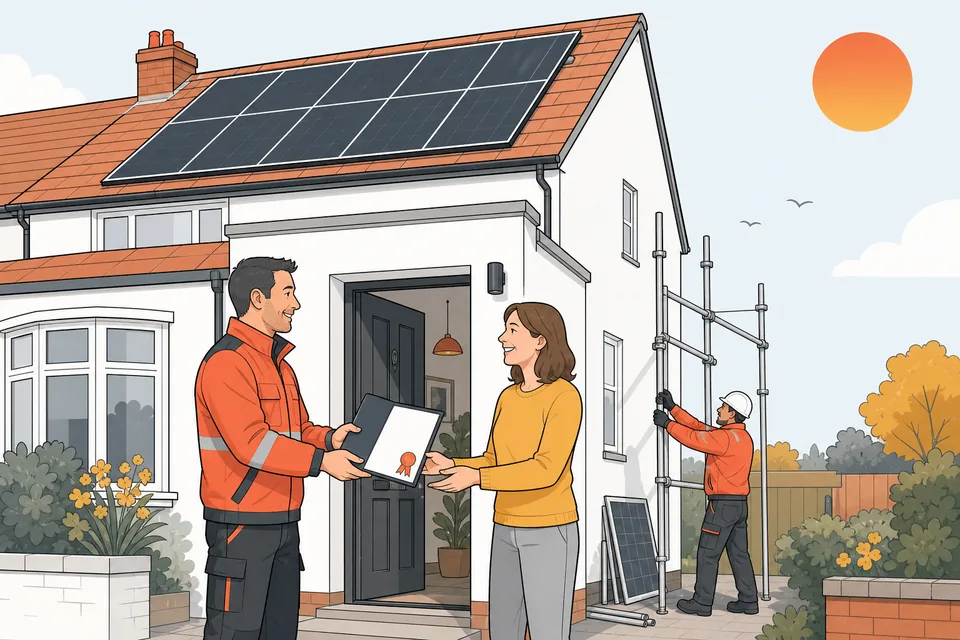
Ask for the results in writing. MCS's model report has a section for each string's readings, polarity and insulation resistance, and a box for when the next inspection is due.
How often? Our solar panel maintenance schedule sets out what to check and when.
How to measure a loose panel with a multimeter
Disconnect it, read the label, check the volts in full sun, then plug it back in and check the amps while it charges. This is for one loose 12 V or 24 V camping, caravan or shed panel. Where the maker's manual says something different, follow the manual.
You'll need a digital meter with a DC volts range above the label's volts (Renogy's advice), the label or manual, and full, bright sun around midday.
Step 1: Disconnect it from the charge controller
Unplug it from the controller (the box between it and the battery) and from anything else, as REDARC, an Australian maker of 12 V systems, advises. Renogy says to turn off or cover the solar panels before working on their wiring.
Step 2: Read the label on the back
The label gives its electrical characteristics, measured in lab conditions: 1,000 W/m² of light with the cells at 25°C. Note these figures:
| On the label | What it means |
|---|---|
| Open circuit voltage Voc | Volts with nothing connected. Your meter reading is compared with this. |
| Short circuit current Isc | The most amps it can push, with its leads joined. |
| Vmp and Imp | The volts and amps when it's working at its best. |
| Pmax | Its rated power in watts (Vmp times Imp). |
Step 3: Check the voltage in full sunlight
- Take off any coverings and face it towards the sun.
- Plug the black lead into COM and the red lead into the V socket.
- Switch your multimeter to DC volts.
- Touch the probes to the output terminals or connectors: red to positive, black to negative.
- Read the display. A minus sign means the probes are the wrong way round.
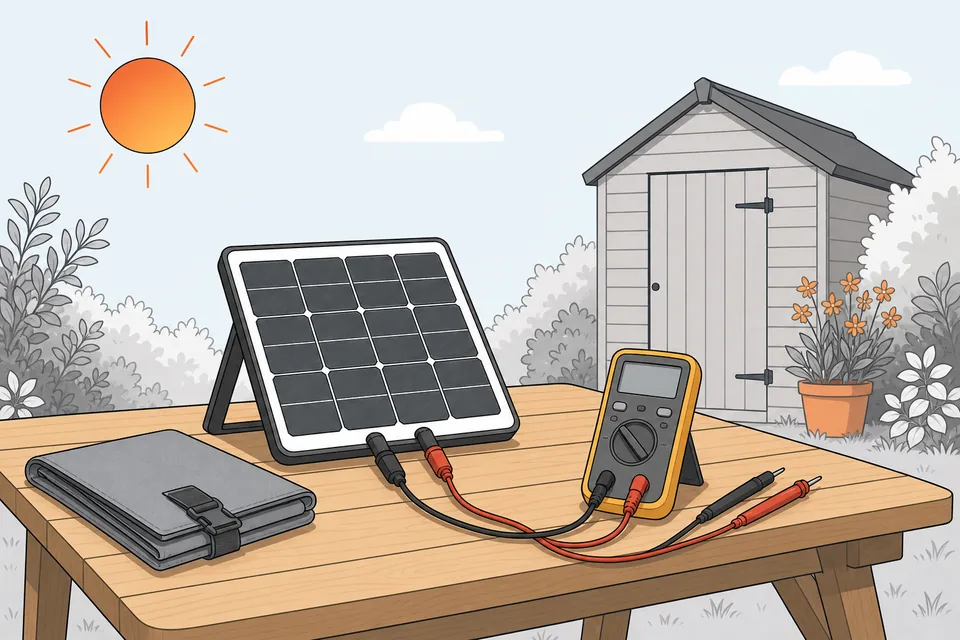
Compare the reading with the label. Renogy says a healthy panel reads within 10% of it: 21.87 V to 26.73 V for one labelled 24.3 V. Fluke, a meter maker, uses the same 10% rule. Renogy also asks for it to face south, tilted at about 30°, with no shade.
A hazy sky or a hot day pulls the reading lower, so check again in better light before calling it faulty.
Step 4: Check the current while it's charging
A panel can pass the voltage check and still have a fault: REDARC says a load can expose hidden faults, so a check while it works helps you identify one.
Plug it back into the controller in the order its manual gives. If you're using the inline meter below, fit it between the panel and the controller as you reconnect, so you never unplug anything while it's charging.
With a clamp meter
A DC clamp gives a current reading from a cable without being wired into it. Clamp it round one of the panel's cables while it charges the battery in full sun. Fluke sells one for checking a module's output.
With a watt meter
This sits inline, between the panel and what it charges, and shows volts, amps and watts as it works. It lets you track your solar panel voltage, amps and power output on a real load.
One from Powerwerx plugs in with MC4 solar connectors and measures up to 60 V: fine for most 12 V kits, never a roof string. For a 24 V kit, check the label's volts with nothing connected are well under 60 V, as they rise on a cold, bright day. Powerwerx says going over its ratings damages the meter.
Compare the amps with other sunny days. Renogy says low charging amps aren't always a fault, as the battery may be nearly full. If they stay low in good light, it suggests checking the connectors, cables and any inline fuse for looseness, corrosion or heat damage.
Why we leave out the amperage setting
Some guides, Renogy's 2025 one included, put the meter in DC current mode with the probes across the panel's terminals. That joins its two leads through the meter. Renogy's September 2026 guide warns: "Never place a multimeter across a battery or PV terminal while the meter is set to measure current."
Touched across a battery, a meter left on amps shorts it. If the red lead is ever in the amps socket, move it back to the V socket before the probes touch anything.
How panels are tested before they're sold
Panels certified under MCS pass a long series of lab checks first. MCS's solar PV standard says the modules fitted must be listed on its website, and its product standard, MCS 005, requires them to meet BS EN IEC 61215, the international design standard.
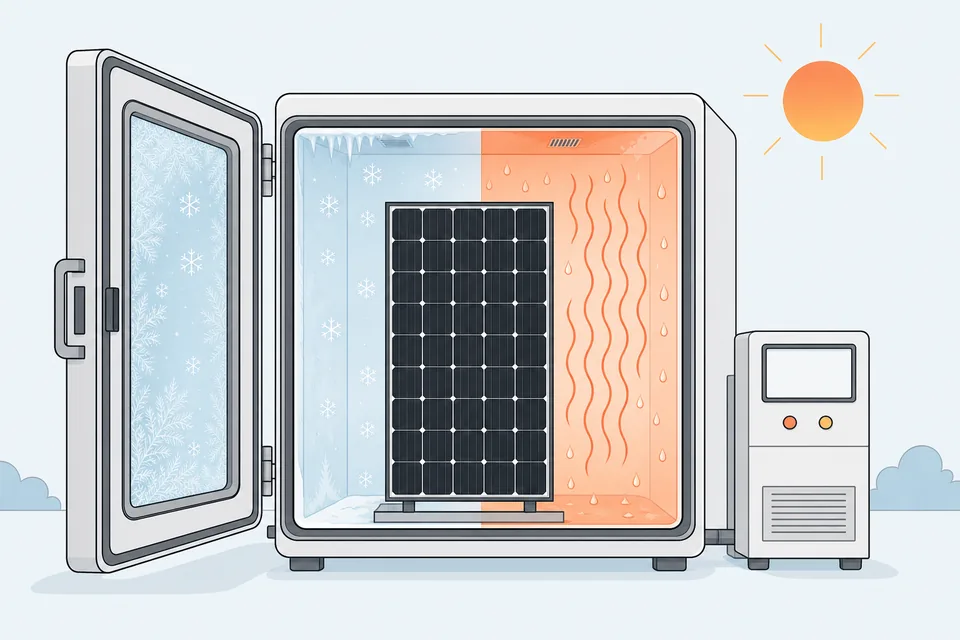
IEC says the sequence shows a module can withstand prolonged exposure outdoors. Fraunhofer ISE's module lab in Germany, which runs all of IEC 61215's module tests, lists climate tests and load tests it can run, including:
- Heat and cold: 200 cycles between minus 40°C and 85°C.
- Humidity freeze test: 10 cycles between minus 40°C and 85°C at 85% humidity.
- Damp heat: a damp heat test runs for 1,000 hours, about six weeks, at 85°C and 85% humidity.
- Mechanical load: pressing and pulling on the glass, for example to 5,400 Pa depending on the module's design, plus 1,000 cycles at 1,000 Pa.
- Hail: ice balls from 25 mm up to 45 mm fired at it.
MCS 005's product audits also review the end-of-line checks makers run on finished modules.
The watts on the label are controlled too. MCS 005 doesn't allow a power tolerance range wider than 10%, and Trina, for example, gives its panel a tolerance of 0 to +5 W.
What to do if your test finds a problem
Call the company that fitted your system, with your readings, photos and any fault code. Don't open the inverter, the isolators or a junction box.
- Your installer first. MCS says to contact your installer first, explain the problem and the outcome you want, and allow about two weeks for a reply.
- Then MCS. MCS is the single point of contact for complaints about MCS certified installers. It acknowledges complaints within 5 working days and aims to resolve most within 8 weeks.
- The warranties. A faulty panel may be covered by the maker's product warranty, and lost output by its performance warranty. Check before you pay for a new one.
If we fitted your system, call us on 0333 577 6576 and we'll talk it through. We don't do repair visits, so for a system another company fitted, your original installer is the right call. For the common faults and what fixes them, see common solar panel problems.
Questions people ask
Can you check panels at night or on a cloudy day?
Not usefully. Panels need light to make electricity, and REDARC says readings at night or in poor sunlight give false and misleading results. Wait for full, bright sun around midday.
How many volts should a 12 V panel give?
Usually 18 to 28 V with nothing connected, REDARC says, and 34 to 56 V for a 24 V one. The exact figure is on its label.
Can a normal reading hide a fault?
Yes. REDARC says the basic checks can read within the specifications, yet putting a load on can expose hidden faults. Cracks in the cells often can't be seen by eye either. An installer's IV curve, thermal imaging or crack imaging can find what a basic meter misses.
How often should a home system be checked?
The Energy Saving Trust suggests checking your panels every 12 to 18 months, which you can do from the ground, and a full professional service every three to five years. Look at your app or meter each month in between.
Does dirt lower the reading?
It can. The Energy Saving Trust says dirty solar panels can reduce how much electricity they generate. Look from the ground first, and never climb up to clean them.
About this guide
Written by the SolarSave team in Retford: MCS certified installers, led by a founder in solar since 2010. We checked every rule and figure against MCS, the BRE, the Energy Saving Trust, DESNZ, Which?, the International Energy Agency's PV programme, a German test lab and the makers' own manuals and datasheets on 16 November 2026. This guide is general safety information. Your installer's advice for your own system comes first.
The 19 sources we checked
- MCS: MIS 3002 Solar PV standard, issue 2.0 (clauses 3.5.1, 3.7.1, 3.7.3, 3.7.5 and 4.1.2, appendix C), 18 March 2026, checked 16 November 2026
- MCS: Installations Database guidance, creating electricity generating certificates, July 2025, checked 16 November 2026
- MCS: MCS 005, The Solar PV Standard (Product), issue 4.0, 1 August 2024, checked 16 November 2026
- MCS: What to do if things go wrong, updated 7 September 2026, checked 16 November 2026
- Energy Saving Trust: How to clean and maintain solar panels, updated 1 October 2026, checked 16 November 2026
- Which?: The most common solar panel problems (survey of members), 25 July 2024, checked 16 November 2026
- DESNZ: Digest of UK Energy Statistics 2026, chapter 6 (solar load factors and sunshine), checked 16 November 2026
- BRE: Solar panel systems and fire safety, 11 November 2013, checked 16 November 2026
- Fox ESS: H1-G2-WL series hybrid inverter user manual, V1.0.3, checked 16 November 2026
- Trina Solar: Vertex S+ NEG9R.28 datasheet (2026), checked 16 November 2026
- REDARC: How to test solar panels and solar blankets, checked 16 November 2026
- Renogy: How to troubleshoot solar panels, 4 August 2025, checked 16 November 2026
- Renogy: Solar charge controller troubleshooting guide, 18 September 2026, checked 16 November 2026
- Fluke: How to test solar panels for common problems, checked 16 November 2026
- Powerwerx: Watt meter, DC inline power analyser with MC4 solar connectors, checked 16 November 2026
- Hioki: Maintenance of solar PV systems according to the IEC 62446-1 standard, checked 16 November 2026
- IEA PVPS Task 13: Review of failures of photovoltaic modules, March 2014, checked 16 November 2026
- Fraunhofer ISE TestLab PV Modules: Testing and measurement procedures, checked 16 November 2026
- IEC: IEC 61215-2:2021, PV modules, design qualification and type approval, test procedures, 24 February 2021, checked 16 November 2026