

The short answer for a UK home
Most UK homes
Stay on the mains
with solar panels and a battery
Use your own power first, buy the rest and get paid for what you export. Our pick for almost everyone.
Solar from October to December
About a tenth
of the year's UK solar electricity in 2025
So a home with no mains needs a much bigger array, a big battery and a backup source.
In a power cut
Off
is the default for a standard set-up on the mains
Only a battery designed and wired for backup keeps chosen circuits running.
From DESNZ and UK Power Networks, checked 16 November 2026.
| Solar on the mains (on-grid) | Standalone (off-grid) | |
|---|---|---|
| When the sun isn't enough | You buy from the mains | The battery, then a generator |
| Battery | Optional | Essential, and big |
| Export payments (SEG) | Yes, with MCS and an export meter | None |
| Network paperwork | A G98 notice or G99 approval | None, with no link to the network |
| Standing charge | About 54.83p a day (October to December 2026) | None |
| In a power cut | Switches off, unless built for backup | Unaffected, until the battery runs flat |
| MCS certificate | Yes, when an MCS installer fits it | Outside MCS standards |
| Best for | Almost every UK home | Remote places with no practical mains supply |
What does an on-grid system do with your solar energy?
It uses your solar power first and swaps the rest with the mains, so you never have to size the panels for the darkest week.
- In daylight: the panels' cells turn light into direct current. The inverter turns that into the alternating current your sockets use, and your home uses it first.
- When you make more than you use: the spare flows out to the network. With an export tariff, you're paid for it.
- In the evening and on dull days: you buy what you need, just as you do now.
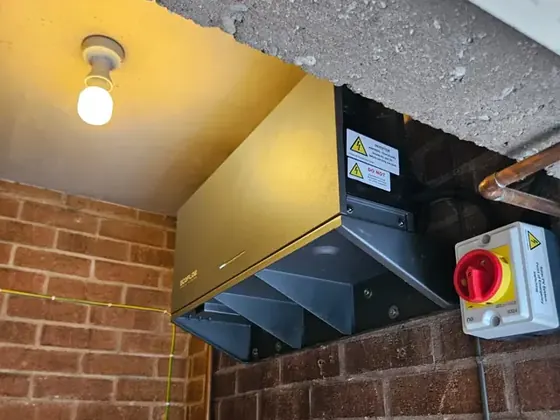
Your local network has to know about it. Which rule applies depends on the combined size of every inverter at your home, including a battery's own inverter:
- G98: for small set-ups, up to 16 amps per phase in total, about 3.68 kW on a normal home supply. Your installer tells the network within 28 days of switch-on.
- G99: for anything bigger. The network must give permission before it can connect. In our experience a reply takes anything from 2 to 90 days, depending on the network.
Our entry-level Fox ESS set-up, with its battery, connects under G98, so there's no wait for approval. The full rules are in G98 vs G99.
What does an off grid system need instead of grid electricity?
Everything the mains does for you now: power at night, a buffer for dull weeks and a backup for when both run out. An off-grid home has no live grid connection, so its system must operate entirely independently.
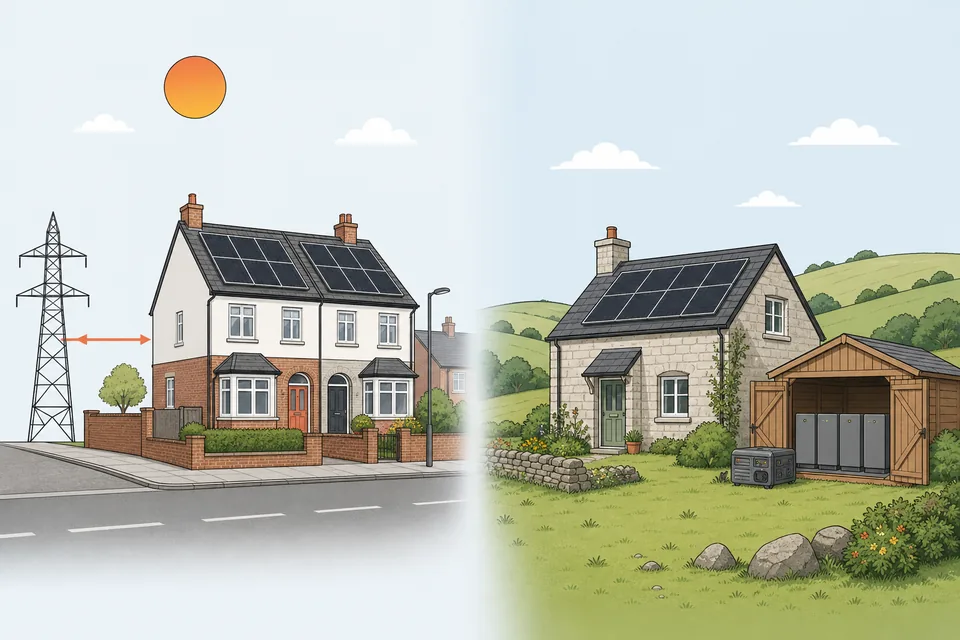
Solar panels, batteries and a backup generator
The US Department of Energy lists the main kit a standalone set-up uses on top of its panels:
- Batteries store electricity for the hours your panels make none.
- Charge controllers keep the batteries full without overcharging them, and control the flow between the panels, the batteries and your appliances.
- An inverter turns the stored direct current into mains-style alternating current. Some, such as Victron's MultiPlus-II, have battery chargers built in, so a generator can top the batteries up.
- A backup generator can cover the slumps when the panels can't keep up. Some standalone set-ups use a small wind turbine as well as panels.
The whole set-up has to be sized for your household's use on the darkest days, not the average day. Off-grid living also means running your own power station: if the batteries are flat and the generator has no fuel, nothing else keeps the lights on.
If your home has a supply now, going standalone means asking your network operator to remove it, and you pay for that. National Grid's distribution arm, the network operator for Nottingham and Derby, says a low-voltage disconnection can usually be done within 21 working days. UK Power Networks, which covers another region, says 65% of its customers paid £805 to £2,650 plus VAT to remove an underground supply. An exact price needs a survey.
Can a UK home go completely off-grid?
Yes, but it's hard on solar alone, because UK panels make so little from October to December. They still generate electricity on dull days, just not much of it.
- A tenth of the year's solar: UK solar made a record 20 TWh in 2025, but only 2.1 TWh from October to December, on government figures.
- About a third of the spring output: the government tracked 282,047 systems on the Feed-in Tariff. From October to December 2024 they averaged 4.7% of their full power, against 13.6% from April to June.
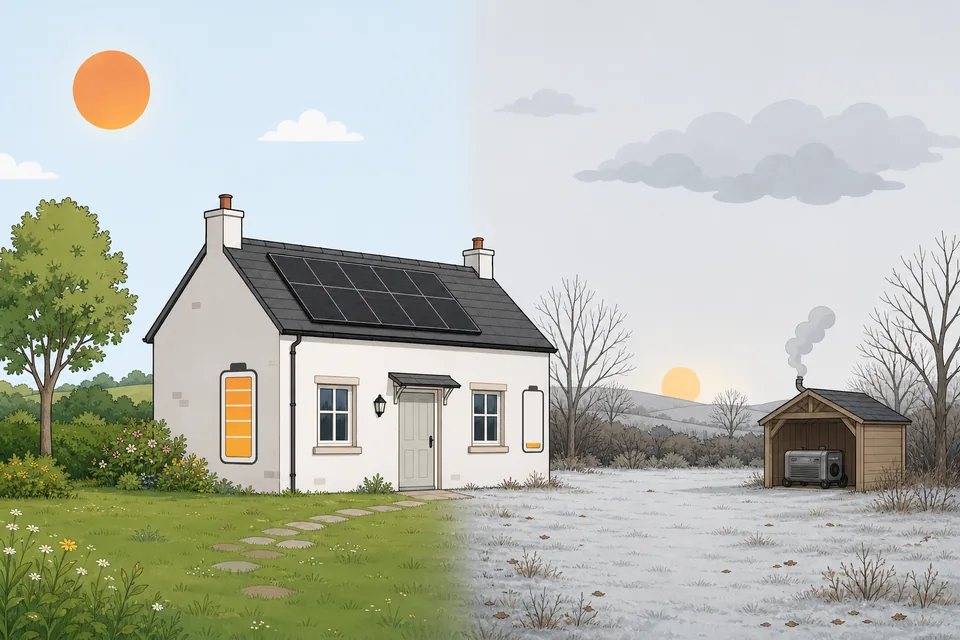
If you want to power your home entirely from your own roof, here are our sums, from Ofgem and government figures:
- Ofgem's typical home uses 2,500 kWh of electricity a year, about 6.8 kWh a day.
- A 4 kW array at 4.7% makes about 4.5 kWh a day on average from October to December. That's a third short.
- To match the average day in those months, you'd need about 6 kW of panels. That's an average: a week of dull weather makes less.
- To cover three dull days in a row from storage, you'd need about 20 kWh of usable battery. The Energy Saving Trust says a typical home battery might be 10 kWh.
That gap is why off-grid solar installations lean so hard on big batteries and a generator. Off-grid solar makes most sense where a mains supply isn't practical, such as a remote property, a cabin or a boat. More on the dark months in do solar panels work in winter?
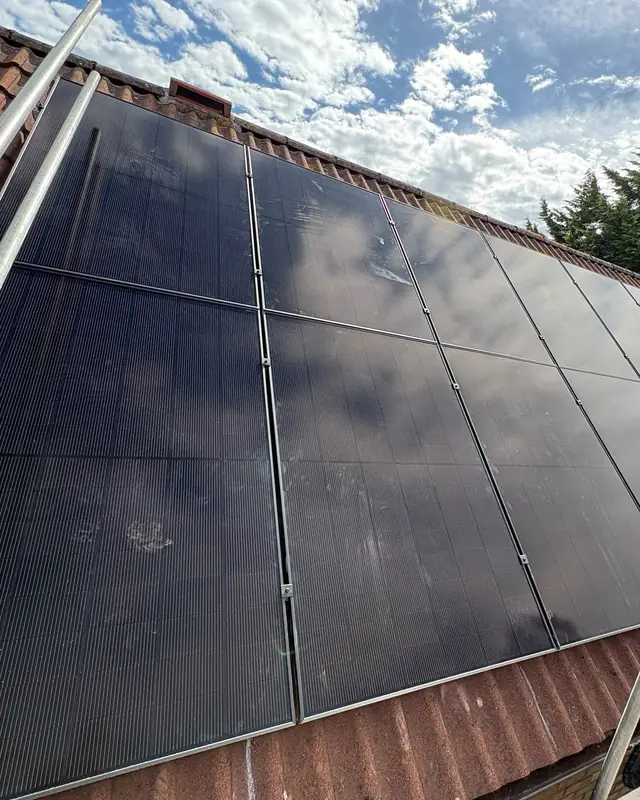
Want solar with a battery?
Free consultation and a written quote, with no pressure to sign. Our entry-level set-up connects under G98: no wait for network approval.
Or call 0333 577 6576, Monday to Friday, 9am to 5pm. We'll only use your details for your quote. Privacy policy
Which costs less to run, and what can each earn?
A home on the mains pays a standing charge, but can earn export payments and buy cheap night-time power. A standalone home pays no bills, but carries the whole cost of its kit and fuel.
- Standing charge: the daily fee for your supply. Ofgem's price cap sets it at 54.83p a day for electricity from October to December 2026, on average for direct debit. That's about £200 a year.
- Units you buy: 26.32p per kWh on average under the same cap. Every unit your panels or battery supply is one you don't buy.
Export payments need MCS and a connection
The Smart Export Guarantee (SEG) pays you for every unit you feed back to the network, but not for what you use yourself. To get it, GOV.UK says you need:
- an installation and installer certified through MCS, or an equivalent scheme
- a meter that can give half-hourly export readings, usually a smart meter
- somewhere to send the power, which means a mains connection
A standalone home can't meet these. MCS's solar standard covers set-ups normally linked to the network, and its battery standard lists off-grid batteries as out of scope. Rates and how to apply are in our guide to SEG export payments.
Battery storage you can top up overnight
On the mains, a battery doesn't have to carry you through a dark week. It can fill up on a cheap overnight tariff, then power the house the next day. One of our customers put it like this: "…we are now (hopefully) getting the full benefit of overnight cheap rate electricity powering batteries and day time the batteries powering the house." (Peter W., Google, November 2025).
A standalone home needs storage for several days, not one evening. The Energy Saving Trust puts a home battery at £1,500 to £10,000. Size yours to your evening demand with what size solar battery do I need?
What happens in a power cut?
A standard set-up on the mains switches off. A standalone one carries on until its battery runs flat. A battery made for backup can keep chosen circuits running.
- Solar on the mains: UK Power Networks says solar systems are designed to shut down automatically in a power cut. That stops power flowing back while engineers work on the network. They usually restart about 20 seconds after power returns.
- The law behind it: the Electricity Safety, Quality and Continuity Regulations 2002 cover small sources on the mains, up to 16 amps per phase. One condition for running without a separate agreement is that the source disconnects itself when the network cuts the supply.
- Batteries: they usually shut down too, unless they're designed for backup, known as island mode.
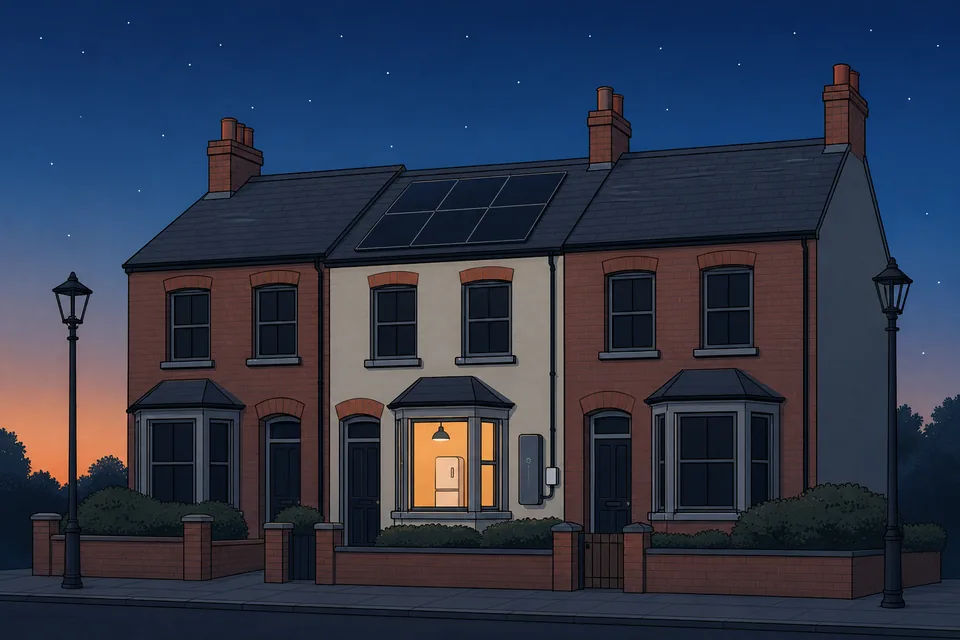
Backup power depends on the inverter and how it's wired, and makers' solutions differ. Some hybrid inverters have a separate backup output: Fox ESS lists an "EPS output (with battery)" on its H1 datasheet. In island mode, UK Power Networks says, a battery supplies selected circuits in the home. Ask whether your quote includes backup, and which circuits it covers.
Island mode takes extra kit. The MCS battery standard requires an island mode isolator that separates those circuits from the mains, and protection that doesn't rely on the network's earth. Ask your installer for a wiring diagram that shows what stays on.
If you run a generator as a switch-over supply, the law says it must never run alongside the network (regulation 21). More in are solar batteries worth it?
Why a battery system is the middle way
Solar panels and a battery on the mains give you most of what people want from going off-grid, without the risk. For most UK homes, the on-grid system we would recommend is exactly that. It's usually cheaper to build on the supply you already have than to replace it.
- Use your own solar power first.
- Store the spare for the evening.
- Fall back on the mains when the battery's empty, so a dull week costs you money, not your lights.
- Charge overnight on a cheap tariff when your panels produce little.
- Export the rest and get paid, with an MCS certificate.
Choose a standalone set-up if a mains supply isn't available or would cost more than the kit, and you're ready to manage batteries and a generator.
Choose solar on the mains, with a battery, if you already have a supply and want lower bills with a safety net.
Before you sign, ask your installer:
- Will the battery work in a power cut, and which circuits will it run?
- Is it G98 or G99, and who makes the application?
- Will the installation be MCS certified, so you can get export payments?
- Can the battery charge from the mains on a cheap tariff?
- How much of the battery's capacity can you actually use?
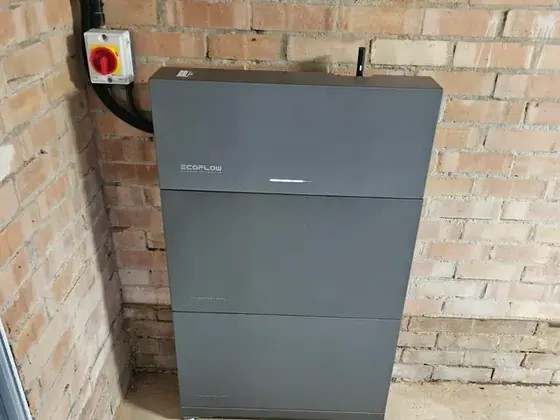
We fit two solar and battery systems that work alongside the mains: Fox ESS, our entry-level one, and EcoFlow, our premium one. We can also add a battery to panels another company fitted. See solar panels and a battery for what's included.
The pros and cons of the two systems
Standalone wins on independence. Solar on the mains wins on cost, simplicity and earnings.
Standalone: the good
- No electricity bills and no standing charge.
- Mains power cuts don't affect you.
- Possible where there's no mains supply at all.
Standalone: the bad
- Much bigger panels and batteries to get through the dark months.
- A generator and fuel for dull spells.
- No export payments and no MCS certificate.
- You look after all of it, and if the batteries run flat you have no power.
Solar on the mains: the good
- A smaller, cheaper set-up, because the mains covers nights and dull weeks.
- Export payments, with MCS.
- Cheap overnight charging, if you add a battery.
- Backup for chosen circuits, with the right inverter and wiring.
Solar on the mains: the bad
- You still pay a standing charge.
- A standard set-up switches off in a power cut.
- Bigger set-ups need the network's permission first, under G99.
Questions people ask
Do you have to tell the network about a standalone set-up?
Not if it isn't connected to the network. G98 and G99 cover generation that runs alongside the public network. If you switch between a generator and the mains, the switch must stop the two running together, and the wiring must meet British Standards (regulation 21).
Can the panels you already have run a home without the mains?
Not as a standard set-up. It shuts down when the mains goes off, by design. Running without the mains needs batteries, an inverter made to work on its own, and a backup source.
How much battery would a standalone home need?
Enough for your daily use, times the number of dull days you want to cover. On Ofgem's typical 6.8 kWh a day, three days is about 20 kWh of usable storage (our sum). A generator covers longer spells.
Will I still get an electricity bill with panels and a battery?
Yes, but usually a smaller one. You still pay the standing charge, 54.83p a day under the October to December 2026 price cap, plus any units you buy. Export payments can offset some of it.
About this guide
Written by the SolarSave team in Retford: MCS certified installers, led by a founder in solar since 2010. We checked every rule and figure against Ofgem, GOV.UK, DESNZ, MCS, legislation.gov.uk, the network operators and the makers' datasheets on 16 November 2026. Ofgem changes the price cap every three months, so we update those figures when it does.
The 20 sources we checked
- DESNZ: Energy Trends, October to December 2025 (solar generation), 2 April 2026, checked 16 November 2026
- DESNZ: Feed-in Tariff load factor analysis 2024/25, 18 December 2025, checked 16 November 2026
- Ofgem: Review of typical domestic consumption values, decision, 27 May 2026, checked 16 November 2026
- Ofgem: Energy price cap, 1 October to 31 December 2026, 26 August 2026, checked 16 November 2026
- Energy Saving Trust: Battery storage, updated 6 October 2026, checked 16 November 2026
- GOV.UK: Smart Export Guarantee, updated 19 October 2026, checked 16 November 2026
- Ofgem: Smart Export Guarantee, checked 16 November 2026
- MCS: MIS 3002 Solar PV installation standard (scope), issue 1.0, January 2025, checked 16 November 2026
- MCS: MIS 3012 Battery storage installation standard (scope and clause 3.5, island mode), issue 1.0, January 2025, checked 16 November 2026
- Energy Networks Association: Connecting generation to the electricity networks (G98 and G99), checked 16 November 2026
- MCS: Notifying DNOs, updated 14 July 2026, checked 16 November 2026
- legislation.gov.uk: Electricity Safety, Quality and Continuity Regulations 2002, regulation 21, checked 16 November 2026
- legislation.gov.uk: Electricity Safety, Quality and Continuity Regulations 2002, regulation 22, checked 16 November 2026
- UK Power Networks: Power cuts, voltage issues and your low carbon technologies, checked 16 November 2026
- Fox ESS: H1 G2 hybrid inverter datasheet (EPS output), V2.2, 9 June 2026, checked 16 November 2026
- US Department of Energy: Balance-of-system equipment required for renewable energy systems, checked 16 November 2026
- Victron Energy: MultiPlus-II inverter/charger datasheet, checked 16 November 2026
- Marlec: On-grid and off-grid solar-powered systems, updated 2 August 2024, checked 16 November 2026
- National Grid Electricity Distribution: Permanently disconnect a supply, checked 16 November 2026
- UK Power Networks: Permanently disconnect, cost and time, prices exclude VAT, checked 16 November 2026