

| What matters | On rails | Integrated kit | Solar tiles or slates |
|---|---|---|---|
| Price per kW (our sum) | About £1,690 | No official average | About £3,000 |
| Output from the same area | The most | About 3% a year less (2014 maker-led test) | About 80% as much |
| Look | Sits on top, up to 200 mm proud | Flush, with a metal border | Blends in best |
| Output warranty | 87.4% at 30 years (Trina) | 87% at 30 years (Marley) | 80% at 25 years (GB-Sol) |
| Repairs | Unclamp one module | Work round the flashing | Many small units and plugs |
| Best for | Most existing homes | New builds and re-covered roofs | Where looks come first |
Can solar panels replace roof tiles?
Yes. Two kinds of product do this: integrated kits, and solar slates or tiles. The most common option keeps the covering and fixes standard modules above it.
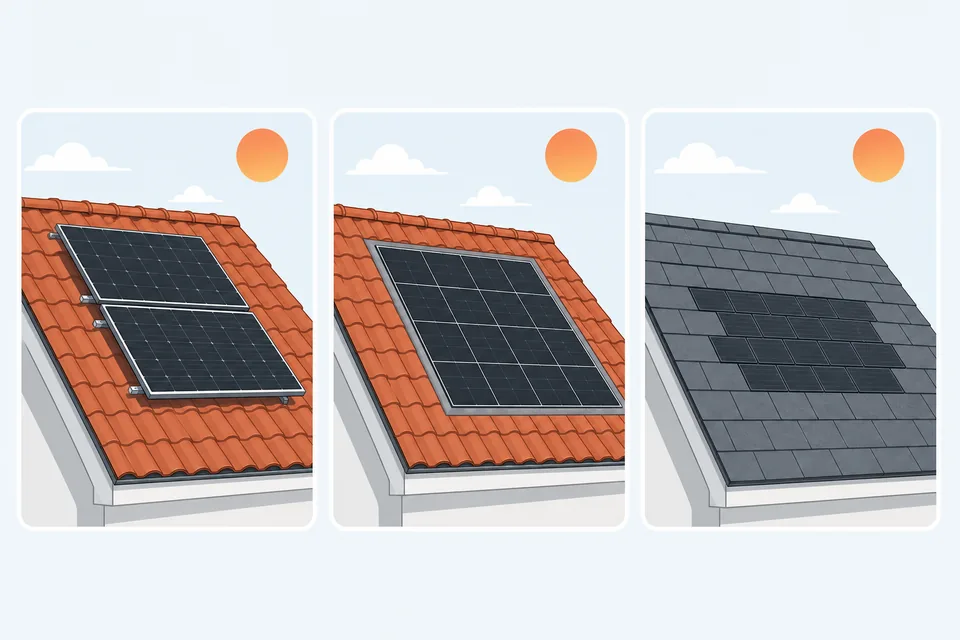
Traditional solar panels on rails
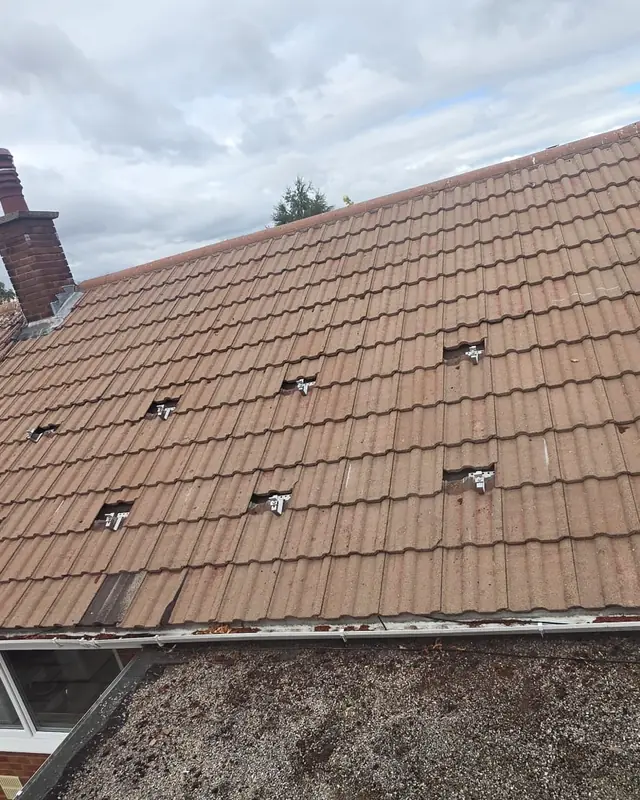
Metal hooks fix to the timbers under the tiles, and aluminium rails bolt to the hooks. Clamps then hold each module to the rails, as K2, a mounting maker, sets out. The covering stays put, which is why these are called on-roof solar panels.
How integrated solar kits work
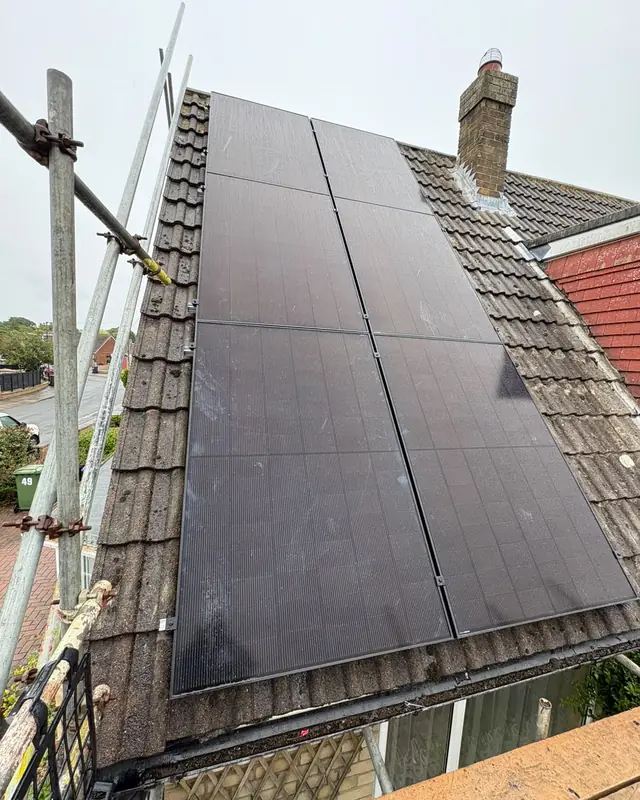
An integrated kit, often called in-roof, swaps a block of tiles for full-size modules. They are integrated into the covering, with flashing round the edge, so they lie almost flush.
Marley's SolarTile is one. Each 445 W module measures about 1.7 m by 1.1 m and, Marley says, will "directly replace roofing tiles".
How solar tiles and slates work
Solar tiles are small PV units made to look like ordinary tiles or slates. The Energy Saving Trust says they're also called solar slates or solar shingles.
GB-Sol, a Welsh maker, rates its PV Slate at 25 to 30 W each, with plugs linking each slate back to the inverter. So 4 kW needs roughly 135 to 160 of them, on our sums.
Like integrated kits, solar tiles replace conventional roofing materials, so they must keep the rain out too. Solar tiles work round awkward shapes, such as dormers, says the Trust.
How much more do they cost per kW?
A solar tile roof is about 1.5 to 2 times the price of a rail-mounted system. The Energy Saving Trust says tiles are pricier than panels fitted onto or into a roof.
| Option | Typical price | Per kW (our sum) | Where it comes from |
|---|---|---|---|
| On rails | About £7,600 for 4.5 kWp | About £1,690 | Energy Saving Trust via Which?, 30 October 2026 |
| Tile system | About £12,000 for 4 kWp | About £3,000 | Energy Saving Trust, November 2025 prices |
| Integrated kit | No official average | Ask for a written price | Get it priced for your house |
- Tile price: the Trust's figure leaves out stripping the old covering and the scaffolding. Which? says they can cost double a panel system.
- Integrated kits: on an existing house you pay to strip the covering under the array. On a new build you just buy less.
We fit panels on rails. Our solar and battery systems start from £7,500 fully installed (10 panels, a Fox ESS battery and scaffolding to one side), or from £4,995 for solar panels on their own. Prices include VAT, at 0% until 31 March 2027. See solar panel prices by size.
Want a written price?
We fit solar on rails and give you a written quote with the full price, with no pressure to sign.
Or call 0333 577 6576, Monday to Friday, 9am to 5pm. We'll only use your details for your quote. Privacy policy
Which makes the most energy?
Rail-mounted modules make the most from the same area, integrated kits slightly less, and a solar tile roof the least.
- Tile products: they typically produce only 80% of the electricity of panels covering the same area, the Energy Saving Trust says. GB-Sol puts its slates at around 7 m² per kW.
- Standard modules: a Trina Vertex S+ fits 450 to 475 W into 2 m², so each kW takes about 4.2 to 4.4 m² (our sum).
- Integrated kits: Marley's 445 W module is 23.6% efficient on its active area, about 22.8% on its full size (our sum). Traditional panels such as the Trina give 22.5% to 23.8%.
Why flush modules run warmer
Less air moves behind a flush module, and heat cuts output. The EU's PVGIS tool says restricted airflow can make modules up to 15°C hotter in full sun. At Trina's rating of 0.29% lost per °C, that's about 4% less power at that moment (our sum, not a yearly figure).
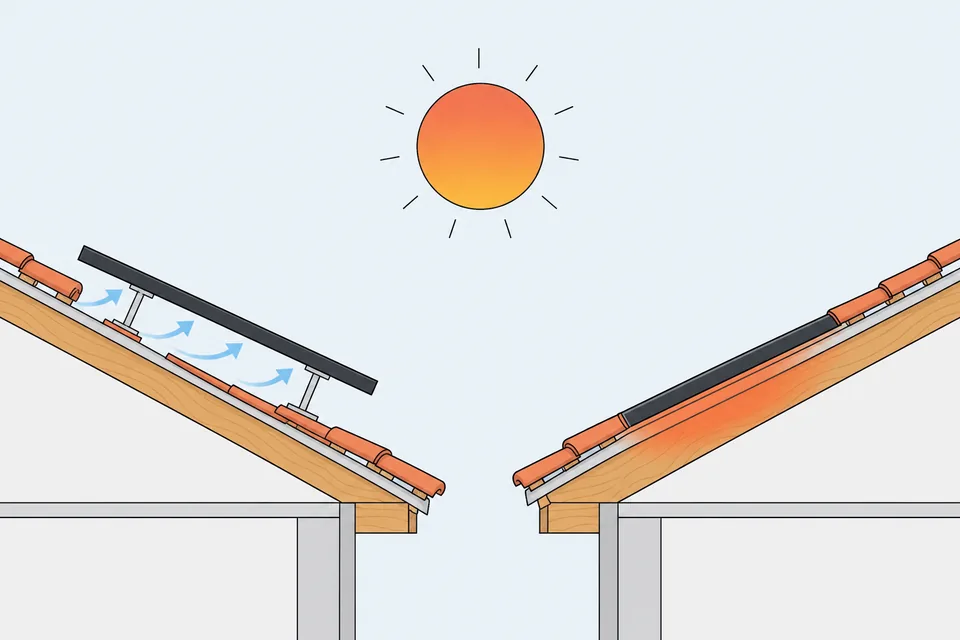
Viridian Solar, which makes integrated kits, and the University of Cambridge put in-roof PV only 3% behind a rack-mounted array, over 12 months of UK weather (reported in 2014). So rail-mounted solar panels generally produce a little more.
How long do they last, and who repairs them?
Output warranties are similar for modules on rails and integrated kits, and lower for the slates we checked. Repairs differ most. Tile products and integrated kits form part of the covering, so a fault can mean a roofer.
- On rails: around 30 years when looked after, says the Energy Saving Trust. Trina gives a 25-year product warranty and a performance warranty of 87.4% at year 30.
- Integrated kits: Marley guarantees 87% of the 445 W module's power at 30 years. Its weathertight guarantee runs 15 years, when the whole covering is Marley's system.
- Solar slates: GB-Sol gives 25 years on the product and on weatherproofing, and guarantees 80% of output at 25 years. The Trust says some tile products are designed to last 40 years.
Historic England warns that solar slates don't last nearly as long as a natural slate roof, so budget for more repairs. More in how long do solar panels last?
Repairs. On rails, the solar panels are not part of the covering, so a faulty one unclamps without lifting tiles. Flush modules are the weather layer, and Viridian recommends a fitter who knows roof work. Slates plug into each other under the covering, so a fault can be harder to trace.
Will it keep the rain out, and is it fire safe?
Yes, if the kit is certified and fitted to the maker's instructions. When modules replace part of the covering, they must do its job. MCS rules (MIS 3002) require:
- Certified kit: anything mounted above, or integrated into, a pitched roof must use kit certified to MCS 012.
- Fire: the installer must show the work hasn't affected how the roof behaves in a fire. Integrated kits need a fire rating that suits where they sit. Marley's module is rated BROOF, the best class under EN 13501-5.
- Weather: the system mustn't harm the building's weather tightness or structure. Viridian's kit is designed to sit over a continuous underfelt that drains into the gutter. GB-Sol tests its slates for weathertightness and wind uplift.
- Existing warranty: if the covering is still under warranty, the installer should check the work won't void it.
Natural slates should never be drilled through, says Historic England.
Do you need planning permission?
Usually not, for any of the three on a house in England. Listed homes are the exception. Under the rules in force since 27 August 2026, solar kit on a pitched roof must:
- stick out no more than 200 mm from the slope;
- stay below the highest part of the roof, not counting the chimney;
- be sited, as far as practicable, to minimise its effect on the building's appearance.
Until 27 August 2027, you can follow the older rules instead.
Integrated kits and tile products sit almost flush, so the 200 mm limit is easy to meet. The Planning Portal doesn't mention them separately, so in our reading the same limits apply. See planning permission for solar panels.
Conservation areas and listed homes
In a conservation area, the extra rule covers a wall, balcony or roof enclosure that fronts a road, not the slopes. So a front slope is usually fine, unless an Article 4 direction removes the right. Our conservation area guide has the details.
A listed home needs listed building consent for works that would affect its character. Historic England says solar slates may be acceptable where the covering isn't part of the building's historic integrity and the slates need replacing anyway.
Building regulations
Building regulations will normally apply, the Planning Portal says. The structure must be checked and proven to carry the extra weight, and the electrical work must comply. MCS installers must have a competent person do that check.
Replacing a roof covering needs approval in most situations, and should include better insulation. A covering much heavier or lighter than the old one may mean strengthening the roof structure itself.
When is integration worth paying for?
When the roof needs replacing anyway, or you're building a new home.
- Fewer tiles. Nine 445 W modules, about 4 kW, cover about 18 m² that needs no other covering (our sum from Marley's sizes).
- One scaffold for the roofers and the solar fitters.
- No second visit. Historic England suggests planning solar with any re-covering. Otherwise the array may need removing later.
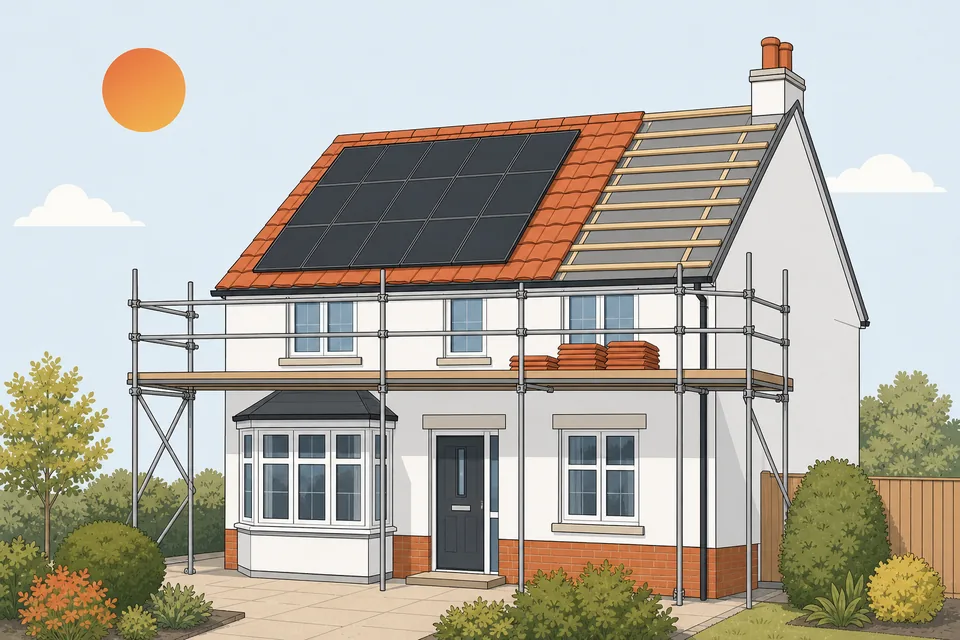
The Energy Saving Trust and Which? agree: tiles only really make sense during a renovation or a new build. Swapping panels you already have for tiles generally doesn't pay, the Trust adds.
In our view, if a roof replacement is several years away, rails now usually make more sense than waiting. Budget for taking the panels off and refitting them when the new covering goes on. If it's due soon, do that first, and get in-roof systems priced alongside rails.
Which should you choose?
For most homeowners, standard panels on rails.
- Covering in good condition: rails, with all-black modules if looks matter.
- New roof or new build: ask for an integrated kit and rails, priced side by side.
- Looks come first: solar slates or tiles, if you accept a higher price and less output.
Whichever you pick, the Trust recommends MCS certified installers and products, and at least three quotes. Our MCS certificate page explains why it matters.
Questions people ask
Do solar slates get 0% VAT?
Check before you sign. HMRC zero rates installing solar panels in homes until 31 March 2027, then 5%. Its definition covers PV "installed in, or on the site of, a building", but doesn't name tiles. Ask the installer to confirm the VAT on your quote, or check with HMRC.
Can people spot solar slates from the street?
Often. Historic England says the difference is usually still detectable to the naked eye. The Energy Saving Trust calls them hardly distinguishable from the matching tiles makers supply.
What's the minimum pitch for integrated kits?
It depends on the product. Marley's 445 W in-roof panels suit 20 to 60 degrees. GB-Sol gives 25 degrees or more for its slates, depending on location.
About this guide
Written by the SolarSave team in Retford: MCS certified installers, led by a founder in solar since 2010. We checked every figure against the Energy Saving Trust, Which?, MCS, the Planning Portal, Historic England, HMRC and the makers' own datasheets on 16 November 2026. Prices and rules change, so check the figures in your own quote.
The 21 sources we checked
- Energy Saving Trust: Solar roof tiles, 1 October 2026, checked 16 November 2026
- Which?: How much do solar panels cost? (Energy Saving Trust figure), 30 October 2026, checked 16 November 2026
- Which?: Are solar panels worth it? (solar tiles), 3 November 2026, checked 16 November 2026
- Which?: Solar panels buying advice (tiles and slates), 12 August 2026, checked 16 November 2026
- Energy Saving Trust: How to clean and maintain solar panels, updated 1 October 2026, checked 16 November 2026
- Trina Solar: Vertex S+ NEG9R.28 datasheet (2026), checked 16 November 2026
- Marley: SolarTile 445Wp datasheet, V1.0, 1 January 2026, checked 16 November 2026
- Marley: Installing the Marley SolarTile, checked 16 November 2026
- GB-Sol: PV Slate brochure, December 2023, checked 16 November 2026
- Viridian Solar: Clearline fusion installation manual, v1.11, checked 16 November 2026
- Modern Building Services: Energy performance of in-roof solar PV (Viridian Solar and the University of Cambridge), 5 March 2014, checked 16 November 2026
- K2 Systems: SolidRail system, components and technical data, checked 16 November 2026
- European Commission JRC: PVGIS user manual (mounting position), checked 16 November 2026
- MCS: MIS 3002 Solar PV installation standard, issue 1.0, checked 16 November 2026
- Planning Portal: Solar equipment mounted on a house or a block of flats, rules from 27 August 2026, checked 16 November 2026
- Planning Portal: Solar panels, building regulations, checked 16 November 2026
- Planning Portal: Building regulations, re-roofing, checked 16 November 2026
- GOV.UK: Planning practice guidance, when is permission required? (Article 4 directions), updated 26 July 2023, checked 16 November 2026
- legislation.gov.uk: Planning (Listed Buildings and Conservation Areas) Act 1990, section 7, up to date to 15 November 2026, checked 16 November 2026
- Historic England: Energy efficiency and historic buildings, solar electric (photovoltaics), HEAG173 v1.1, November 2018, checked 16 November 2026
- HMRC: VAT on energy-saving materials and heating equipment (Notice 708/6), checked 16 November 2026