

| Where the kit goes | Permission? | What to check |
|---|---|---|
| Any slope of the roof, front included | Not usually | No more than 0.2 m out, and no higher than the top of the roof |
| A wall, balcony or parapet that fronts a road | Yes | Public footpaths and bridleways count as roads here |
| A flat roof | Prior approval first | The fee is £249, and the council has up to 56 days |
| A street with an Article 4 direction | Often, for the front and side | Ask your council |
| A listed home, or a building in its grounds | Yes | Consent for the home (no fee), and planning permission for kit in its grounds |
| The garden, nearer the road than your home | Prior approval first | No more than 2 m tall |
Can panels go on a roof that faces the street?
Yes, usually. Homes in conservation areas keep their permitted development rights for rooftop solar. The government has already given permission, so you don't apply.
There, the extra limit on road-facing kit (the panels and their fixings) covers walls, balconies and roof enclosures, such as a parapet or railing. It doesn't apply to the slopes of the roof. City of York Council agrees that roof panels in these areas don't usually need permission, even on a roof that faces the street. So kit on your front slope will usually be allowed, unless an Article 4 direction covers your street.
Rooftop kit must stay within four limits:
- Close to the roof: no more than 0.2 m out from the roof slope.
- Height: no higher than the highest part of the roof, not counting the chimney.
- Sited with care: placed, as far as practical, to limit its effect on your home and the street.
- Removed when done: taken off as soon as reasonably practical once you no longer need it.
For every kind of home, see our general planning guide.
Walls, balconies and parapets that front a road
Wall-mounted panels generally cannot be fitted to a wall facing a road without planning permission.
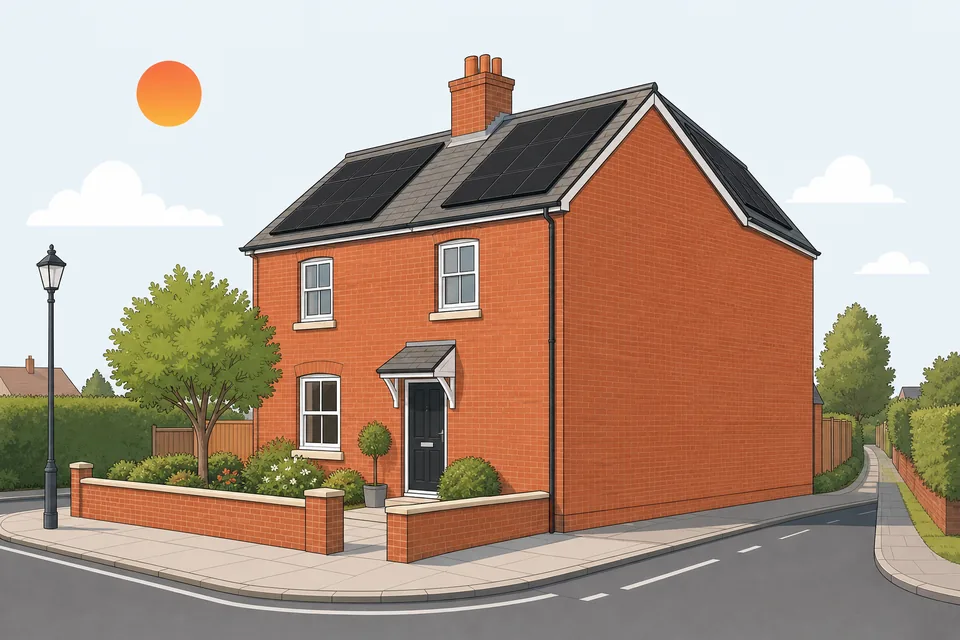
The law's word is highway, which takes in public footpaths and bridleways as well as roads. Government guidance says a wall doesn't normally front a road if it sits at more than 45 degrees to it, or a long way back from it. On a corner plot, two walls can face a road, so ask your council if you're not sure.
Other walls can take kit up to 0.4 m from the wall surface, or 0.2 m beside a road.
What changed on 27 August 2026?
New rules for homes came in that day. Balconies and roof enclosures that front a road now need permission, like walls. A listed home lost its automatic right to rooftop solar. Work the old law allowed can still go ahead until the end of 26 August 2027.
Flat roofs need prior approval first
On a flat roof, such as an extension or garage, kit can reach 0.6 m above the roof's highest part. Here, you must apply to the council before you start. It decides whether it needs to approve how the kit will look.
- Send the application. Include a written description, a site plan, your contact details and the fee: £249 from 1 April 2026.
- Neighbours are told. The council puts up a notice for at least 21 days or writes to your neighbours, then reads any comments.
- Wait for an answer. If the council hasn't decided within 56 days of receiving your application, you can go ahead.
- Fit what you applied for. The work must match the details you sent, or the ones the council approved.
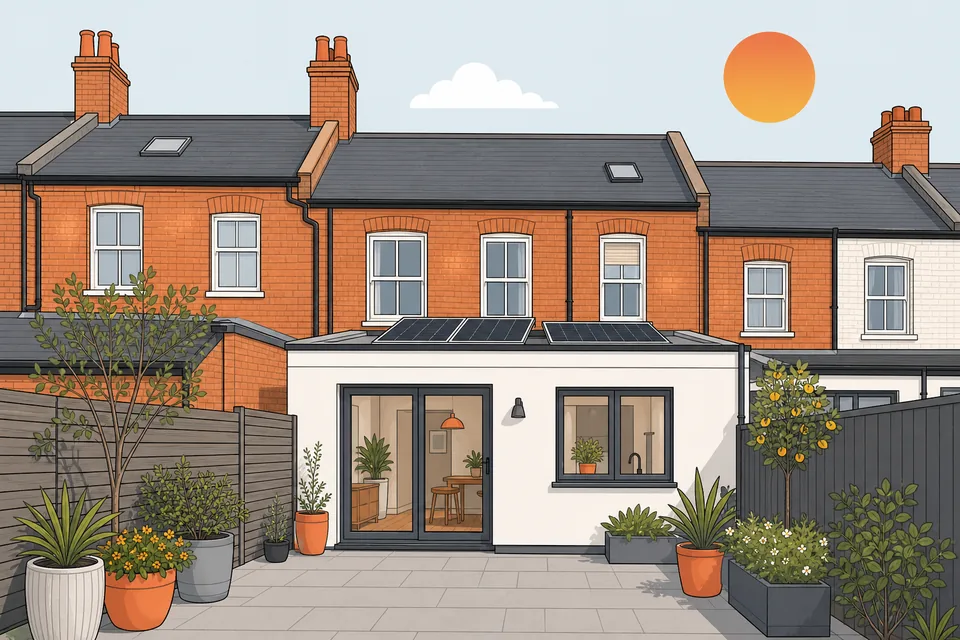
For layouts that work, see solar panels on a flat roof.
Article 4 directions in conservation areas near us
Councils designate these areas to protect their special architecture or history. There were 9,907 in England in 2024. Bassetlaw has 33, three of them in Retford.
An Article 4 direction lets a council remove permitted development rights on named streets. It isn't a ban: you apply for planning permission, and the council judges your plans.
We checked each council's own documents:
| Council | Where | What needs permission |
|---|---|---|
| Bassetlaw District Council | Worksop: Mr Straw's | Solar on the front and side slopes of the roof (confirmed 19 December 2013) |
| City of York Council | York: parts of Heslington (Main Street, Holburns Croft, Hall Park and School Lane) | Solar on the front and side slopes of the roof (in force 10 June 2023) |
| Hull City Council | Hull: the Avenues and Pearson Park | Solar on a slope of the roof that faces a road, on the home or a building in its grounds |
| Sheffield City Council | Sheffield: Nether Edge and Broomhill | Homes "may" be covered: solar on a slope of the roof that faces a road |
In Saltaire, Bradford, every property in the Article 4 area has been listed since 1984, so our advice on listed homes applies.
Neither of Bassetlaw's Article 4 pages names a direction in Retford, so we found none there. Ask the council to be sure.
How to check your street
- Ask your council first. Government guidance says it should always be your first point of contact.
- Look at the national data. The government's Article 4 data maps many directions but may be incomplete.
- Read what it removes. Solar is Part 14 of today's order, and Part 40 in older directions. In our reading, a direction that only removes "alterations to the roof" doesn't cover solar.
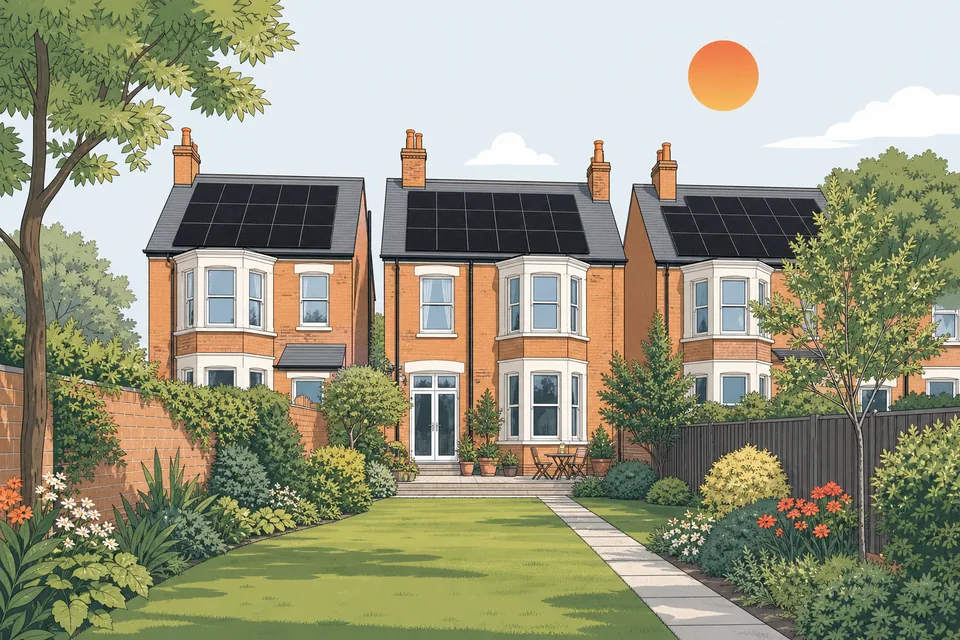
Home in a protected street?
Free consultation and a written quote. Tell us early if your home is listed or covered by an Article 4 direction, and we'll take that into account in your quote.
Or call 0333 577 6576, Monday to Friday, 9am to 5pm. We'll only use your details for your quote. Privacy policy
Listed homes need listed building consent
A listed home always needs consent before solar goes on, and it's free to apply. Fitting without it is a criminal offence. Since 27 August 2026, a listed home has no automatic right to rooftop solar, so after the transition you may need planning permission as well. Nor is there one for other buildings in its grounds, or for its garden.
Official guidance for listed buildings sets out where approval is most likely:
- Hidden from view, in a roof valley or behind a parapet: generally acceptable.
- Less prominent slopes, such as a rear wing: generally acceptable even if visible, with possible exceptions for Grade I and II* buildings.
- Main slopes: generally not acceptable. Panels on the front elevation are unlikely to win approval.
In our reading, that means many Grade II listed buildings can potentially accommodate solar panels, usually on a hidden or less prominent slope. Even then, solar panels can be challenging on an old roof. The fixings should avoid damaging the historic fabric, and slates should never be drilled through.
Where councils accept a solar installation
The less you see from the street, the better. The guidance is written for listed buildings, but it helps wherever a council judges how kit looks:
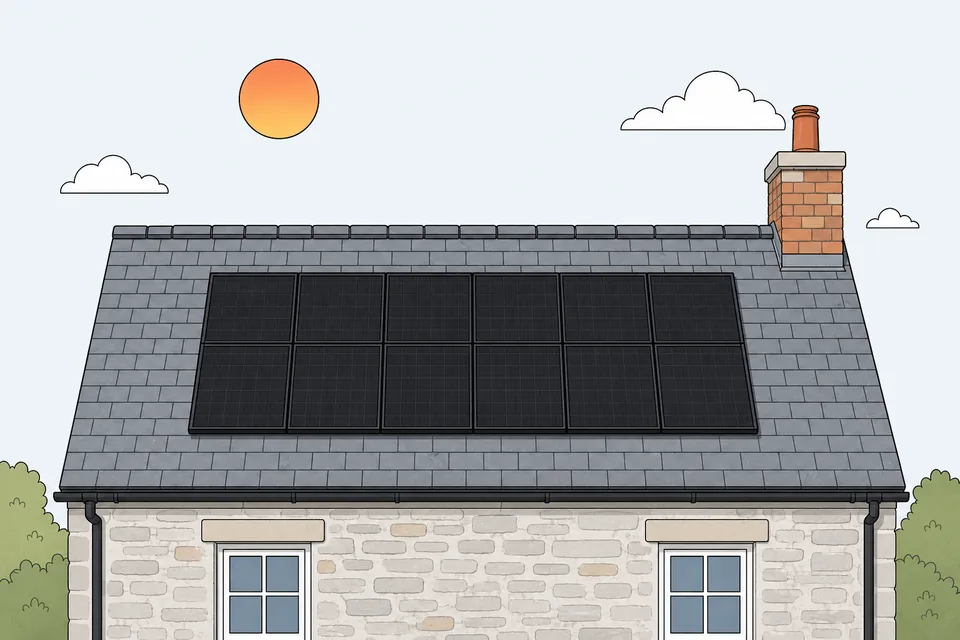
- Use a rear or hidden slope first.
- Choose black frames, with nothing silvered or reflective.
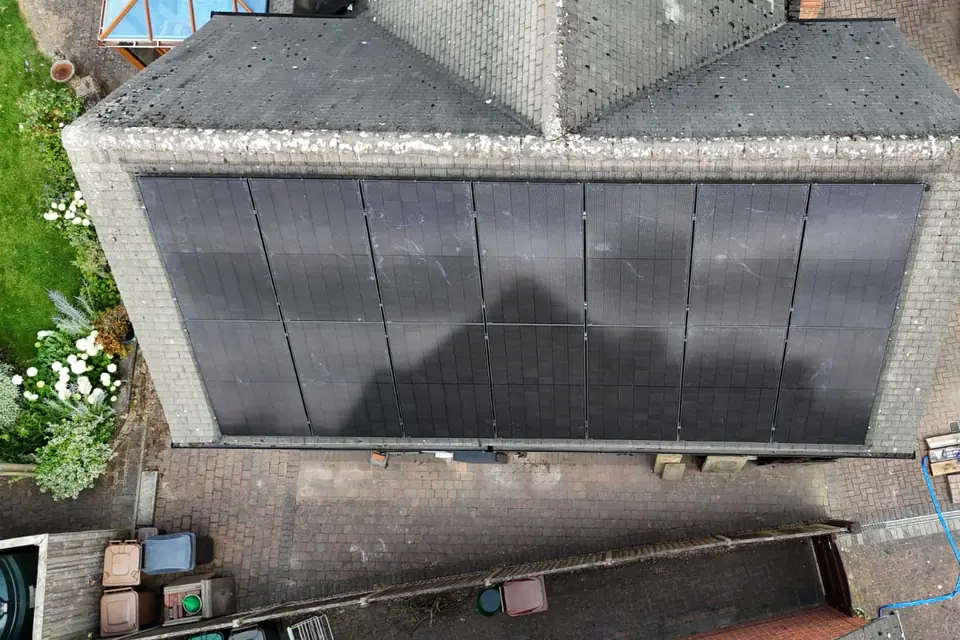
- Keep the kit in one neat rectangle, evenly spaced between the chimney and the eaves.
- Avoid stepped or broken-up layouts.
- Keep it close to the roof.
Roof materials, solar tiles and in-roof kits
Solar tiles and in-roof kits replace part of the roof covering. We haven't found government guidance on how the law treats them. In our reading, the same limits apply as for other rooftop solar.
Heritage advice says solar slates may suit a roof whose covering isn't part of the building's special interest, ideally when the old slates need replacing. Compare the options in our solar tiles guide.
Applying for planning permission, and other checks
If your plans fall outside these limits, there are restrictions, but you can still apply:
- Get advice. Your council may offer pre-application advice or a quick check. City of York Council, for example, charges £120 including VAT to tell you whether you need permission.
- Apply. A householder application costs £548 from 1 April 2026. Draft fee changes would raise it to £575 from 8 December 2026. Include drawings that show the design and where the kit goes.
- Neighbours are told. They can comment, as with prior approval, and the council publishes the application online.
- Wait for a decision, usually within 8 weeks.
- If it's refused, change your plans and apply again, or appeal within 12 weeks of the decision letter.
In deciding, the council must pay special attention to keeping the area's character. National policy also tells it to give substantial weight to energy efficiency on existing buildings, including solar that isn't already allowed.
Not sure you need permission at all? A lawful development certificate gives a legally binding answer. It costs half the planning fee: £274 for a home.
Garden arrays and flats
- Nearer the road than the house: no more than 2 m tall, and prior approval of how it looks first.
- Within 5 m of your boundary: prior approval first.
- Size: no more than 9 m² of panels in each installation.
- Listed homes: no garden array in the grounds without permission.
- Flats: rooftop solar is allowed within stricter limits, but never on a wall that fronts a road. Flat roofs need prior approval, and your freeholder may need to agree too.
Building regulations still apply
Even without planning, the roof must be checked to carry the kit's weight, and the new circuit is notifiable electrical work. An installer in a competent person scheme can certify it, and must give you a certificate and tell building control within 30 days.
Questions people ask
Does the 10-year rule apply to solar?
For planning, yes. A council can't take enforcement action once 10 years have passed since unauthorised work was substantially completed, or a shorter period for work finished before 25 April 2024. Listed homes are different: fitting solar without consent is a criminal offence.
How do I check if my street is protected?
Your council's website may show protected streets on a map. If not, ask its planning team. To check whether your property is listed, search the national list of listed buildings.
About this guide
Written by the SolarSave team in Retford: MCS certified installers, led by a founder in solar since 2010. We checked every rule against the legislation, government guidance and council sources on 16 November 2026. The rules for homes changed on 27 August 2026, and we update this page when they change again.
The 39 sources we checked
- legislation.gov.uk: GPDO 2015, Part 14 Class A (solar on homes), as amended to 27 August 2026, checked 16 November 2026
- legislation.gov.uk: GPDO 2015, Part 14 paragraph J.4 (prior approval procedure), checked 16 November 2026
- legislation.gov.uk: S.I. 2026/896, article 4 (solar in gardens), in force 27 August 2026, checked 16 November 2026
- legislation.gov.uk: S.I. 2026/896, article 6 (transitional provision), in force 27 August 2026, checked 16 November 2026
- GOV.UK: Permitted development rights for householders, technical guidance, updated 10 September 2019, checked 16 November 2026
- City of York Council: Solar panels guidance, updated 30 June 2026, checked 16 November 2026
- City of York Council: Heslington Article 4 Direction, notice of confirmation, 23 March 2023, in force 10 June 2023, checked 16 November 2026
- Bassetlaw District Council: Mr Straw's Conservation Area Article 4 Direction guide, confirmed 19 December 2013, checked 16 November 2026
- Bassetlaw District Council: Article 4 directions, updated 28 September 2026, checked 16 November 2026
- Bassetlaw District Council: Article 4(1) directions for conservation areas, updated 1 June 2026, checked 16 November 2026
- Bassetlaw District Council: Conservation areas in Bassetlaw, a guide for householders, updated 8 December 2025, checked 16 November 2026
- Hull City Council: Avenues and Pearson Park Article 4 direction, checked 16 November 2026
- Sheffield City Council: Conservation areas, checked 16 November 2026
- Bradford Council: Article 4 directions (Saltaire), checked 16 November 2026
- GOV.UK: Planning practice guidance, when is permission required?, updated 26 July 2023, checked 16 November 2026
- planning.data.gov.uk: Article 4 direction areas, checked 16 November 2026
- legislation.gov.uk: GPDO 2015, Part 1 Class C (other alterations to the roof), checked 16 November 2026
- Historic England: Advice Note 18, adapting historic buildings for energy and carbon efficiency (v1.0), July 2024, checked 16 November 2026
- Historic England: Energy efficiency and historic buildings, solar electric (photovoltaics), HEAG173 v1.1, November 2018, checked 16 November 2026
- legislation.gov.uk: Planning (Listed Buildings and Conservation Areas) Act 1990, section 7, up to date to 15 November 2026, checked 16 November 2026
- legislation.gov.uk: Planning (Listed Buildings and Conservation Areas) Act 1990, section 9, up to date to 15 November 2026, checked 16 November 2026
- legislation.gov.uk: Planning (Listed Buildings and Conservation Areas) Act 1990, section 69, up to date to 13 November 2026, checked 16 November 2026
- legislation.gov.uk: Planning (Listed Buildings and Conservation Areas) Act 1990, section 72, up to date to 15 November 2026, checked 16 November 2026
- Planning Portal: Application fees in England (V2026.1), from 1 April 2026, checked 16 November 2026
- legislation.gov.uk: Draft Town and Country Planning (Fees) (Amendment and Transitional Provision) Regulations 2026, still a draft, proposed from 8 December 2026, checked 16 November 2026
- legislation.gov.uk: Fees Regulations 2012, regulation 11 (lawful development certificates), checked 16 November 2026
- legislation.gov.uk: Development Management Procedure Order 2015, article 15 (publicity), checked 16 November 2026
- GOV.UK: Determining a planning application, updated 8 April 2026, checked 16 November 2026
- GOV.UK: Appeal a householder planning decision, how long you have, checked 16 November 2026
- GOV.UK: National Planning Policy Framework, chapter 5 (policy CC2), updated 20 October 2026, checked 16 November 2026
- legislation.gov.uk: Town and Country Planning Act 1990, section 171B (time limits), up to date to 13 November 2026, checked 16 November 2026
- legislation.gov.uk: S.I. 2024/452, regulation 5 (transitional provision), checked 16 November 2026
- Planning Portal: Solar panels, building regulations, checked 16 November 2026
- legislation.gov.uk: Building Regulations 2010, regulation 20, up to date to 15 November 2026, checked 16 November 2026
- GOV.UK: Approved Document P, electrical safety in dwellings, 2013 edition, checked 16 November 2026
- Historic England: Conservation areas across England, 2024 (Heritage Counts), 2024, checked 16 November 2026
- Historic England: Search the List (National Heritage List for England), checked 16 November 2026
- Planning Portal: Solar equipment mounted on a house or a block of flats (leaseholders), checked 16 November 2026
- legislation.gov.uk: S.I. 2008/675, article 2 (Part 40, domestic microgeneration, in the 1995 order), checked 16 November 2026