

In short
- From 24 March 2027, a new house sent to building control needs on-site renewable electricity, in practice PV, unless its roof can't make a reasonable amount.
- Houses sent to building control before then can still be built to the older requirements, if work on them starts before 24 March 2028.
- Before you complete, ask for the MCS certificate, the system size in kW and the handover information.
- Later, you can usually add battery storage or more panels. Check your planning permission and new-home warranty first.
Do building regulations require PV on a new house?
Not directly. From 24 March 2027 they require on-site renewable electricity, in practice PV, at first only for houses sent to building control from that date. Until then, Part L of the regulations sets carbon and energy targets for each new home, and the companies that build homes choose how to hit them. A gas boiler with solar photovoltaic (PV) panels has been the lowest-cost way in the short run for many housebuilders, the government says.
- Since 15 June 2022: the benchmark home that new houses are measured against (the "notional dwelling" in Approved Document L) has PV on its roof. Its size in kW is 40% of the ground floor area divided by 6.5, facing south-east or south-west.
- 2023 and 2024: an official analysis of energy certificates found 75% of homes built to the 2021 regulations in those years used a gas boiler and PV to comply. The other 25% used an air source heat pump.
- 30 June 2025: the government said panels would come by default on newly built homes.
- 24 March 2026: it published the final rules and guidance, which take effect on 24 March 2027.
Why some new houses have no panels
Often because the developer met the targets with an air source heat pump instead. A quarter of homes built to the 2021 regulations in 2023 and 2024 took that route, and the official impact assessment models it without panels. A shaded or awkward roof can also rule panels out.
A house without panels can still have them added, like any other home. Our solar panel cost guide shows what a system costs.
What the Future Homes Standard changes in March 2027
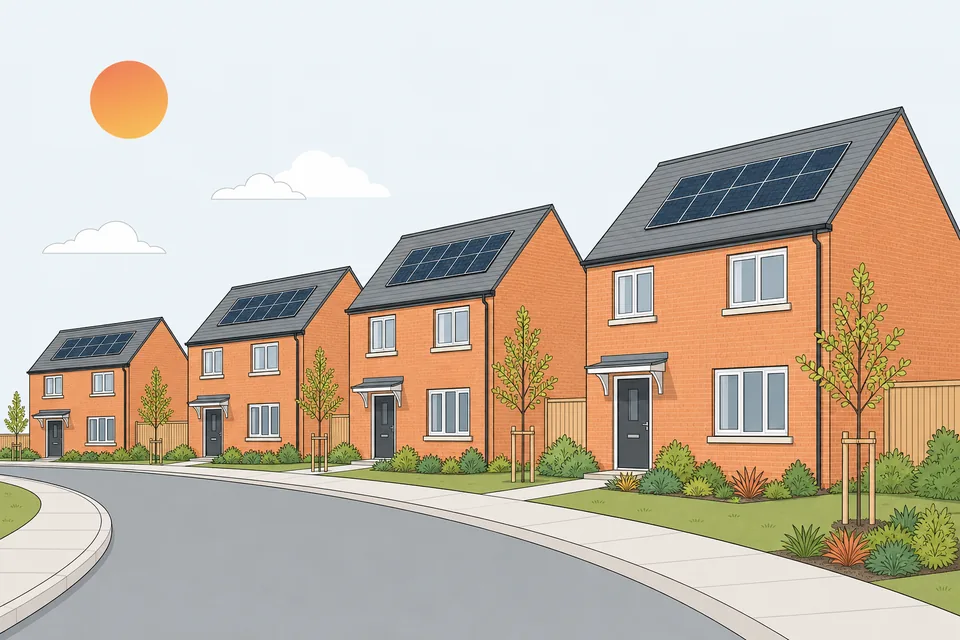
Developers will be required to install a system for on-site renewable electricity on each house, or building containing homes, sent to building control from 24 March 2027. The electricity must be available to the people living there, and the system must be capable of "a reasonable output".
The law doesn't name a technology, so it's not quite right to say solar panels are legally required. In practice, ministers expect PV to be the main way to comply.
The 2026 edition of Approved Document L explains what "reasonable" means:
- The reference array: panels over an area equal to 40% of the home's ground floor area, at 0.22 kW per square metre. They face south-east to south-west at a 45 degree pitch, with no shade. Panels over the roof area that's reasonably practicable can be used instead.
- Less is allowed where roof windows, vents, plant or maintenance access routes get in the way. The shortfall is flagged in the home's energy report (the BREL report) for building control.
- No panels are needed if the roof couldn't produce 720 kWh a year. The consultation response says that's roughly less than two panels.
- Buildings 18 metres or taller, such as tall blocks of flats, are exempt.
Here's what that means for one house:
| Benchmark since June 2022 | Reference from March 2027 | |
|---|---|---|
| Area of panels | 20 m² | 20 m² |
| Size of system | About 3.1 kW | About 4.4 kW |
| Must the developer fit it? | No, it's a benchmark | Yes, or as much as the roof reasonably allows |
The area is the same. The 2027 figure is bigger because it assumes more efficient panels. The wider package also cuts carbon by at least 75% on average, compared with a home built to 2013 regulations, with low-carbon heating such as a heat pump.
Which homes can still be built to the 2021 regulations?
Homes already in the system. If a building notice, initial notice or full plans application went to building control before 24 March 2027, the 2021 version still applies. Work on that building must start before 24 March 2028. This now works building by building, not across a whole site as the 2013 arrangements did.
Houses on older sites still being built to the 2010 requirements under those arrangements keep them only if work on that house starts before 24 March 2028.
So a house finished in 2028 may still have a small system or none. Buying off-plan? Ask the sales office which version of Part L your plot is being built to, and whether it will have PV.
Wales has its own requirement, from 4 March 2027. A separate Future Buildings Standard covers other new buildings, from commercial offices and warehouses to schools.
What comes with a developer's system
Expect a system designed to meet the regulations, which can be smaller than one you'd choose to cut your bills. The regulations and MCS say you should get:
- Panels on the roof. On-roof solar panels are fitted above the tiles. In-roof kits replace the roof covering, and their flashing kits form the main weatherproof barrier, says LABC Warranty.
- An inverter, which turns the panels' direct current into the alternating current your appliances need. The Energy Saving Trust says it generally needs replacing after around 12 years.
- A generation meter. MCS installations must record and display the total electricity made, readable without a tool, ladder or torch.
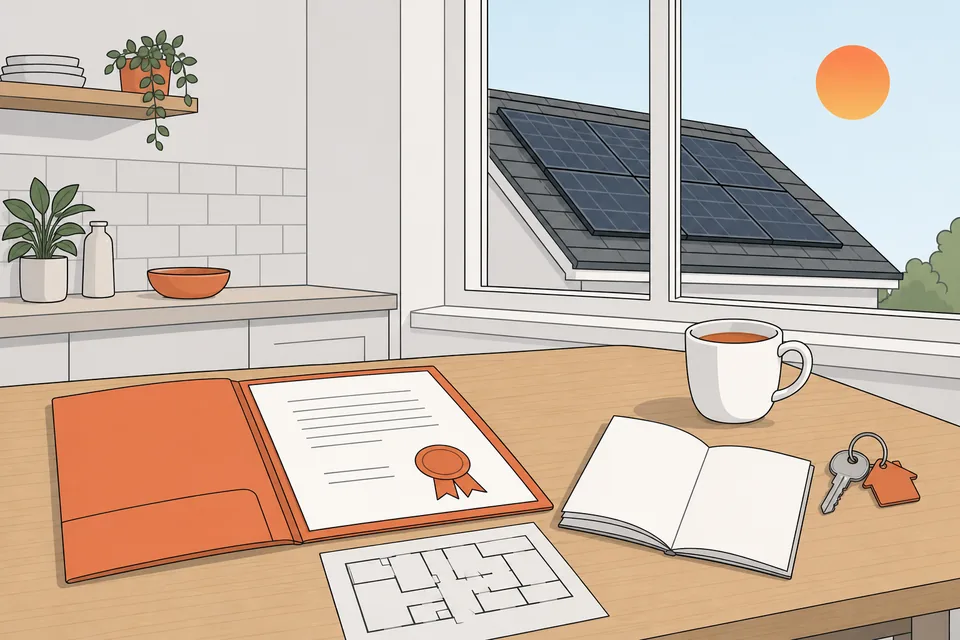
- Instructions. You should get operating and maintenance instructions specific to your home, with a floor plan showing where everything is and a completed commissioning sheet.
- A Home User Guide, which covers on-site electricity generation where the home has it.
- Compliance paperwork: a signed BREL report, photos showing the quality of the build, and the recommendations from the on-construction EPC.
Don't assume you can store electricity for the evening. The 2027 requirement doesn't cover storage, although some people asked for it in the consultation.
How to check the system before you complete
Ask the sales office for these before completion, or as soon as you get the keys:
- The size in kW. Look for the rated power on the commissioning paperwork. Compare it with the example above. A large roof with a small system is worth asking about.
- The MCS certificate. MCS installers must issue it within 14 days of commissioning, or 30 days under MCS's redeveloped scheme. MCS isn't a legal requirement, so ask for it in writing. Without it, or a certificate from an equivalent scheme, you can't get SEG payments. Our guide to what an MCS certificate is shows what it should say.
- The handover information. The person carrying out the building work, usually the developer, must give the owner the system's operating and maintenance information within five days of finishing.
- A meter reading. Note it on the day you move in, then once a year, so you spot a fault early.
- The contract and insurance. The Energy Saving Trust suggests checking the system is listed in the sale agreement for the property, and that your home insurance covers it.
- Who to call. Keep the installer's name with the paperwork. Under NHBC's policy, the builder handles defects for the first two years (see below).
We email our own customers a handover pack within 7 working days. One customer wrote: "Stephanie coordinated the install and follow ups superbly from head office, ensuring all documents from quotation to handover pack were present and correct." (Andrew B., Trustpilot, October 2023).
Want more from your panels?
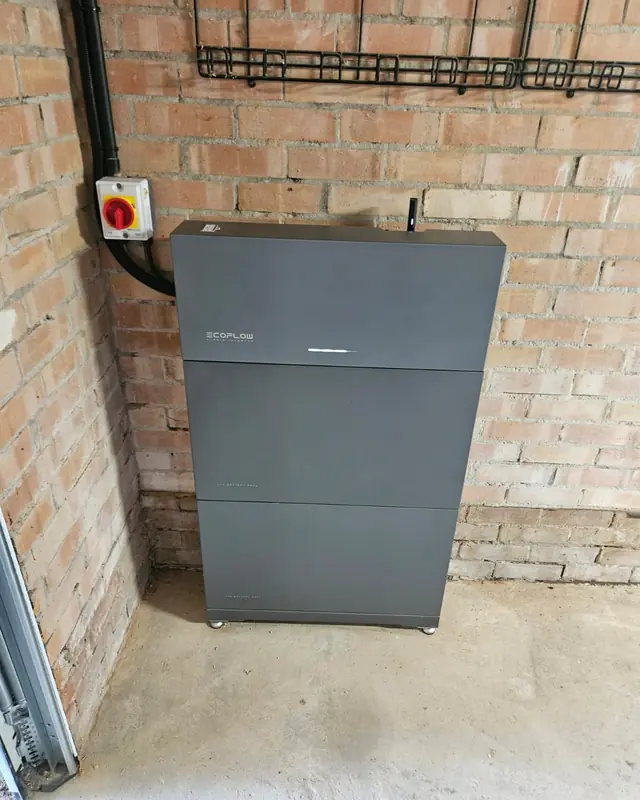
We can look at the system your home came with and quote for a battery or extra panels. Free consultation, a written quote and no pressure to sign.
Or call 0333 577 6576, Monday to Friday, 9am to 5pm. We'll only use your details for your quote. Privacy policy
Getting paid for the solar energy you send to the grid
You can be, through the Smart Export Guarantee (SEG), once three things are in place:
- An MCS certificate, or one from an equivalent scheme, for the installation and the installer.
- A meter that records half-hourly readings, usually a smart meter. Ask your energy supplier if you haven't got one.
- A SEG tariff. You can pick any supplier that offers one, not only the one that sells you electricity.
Rates vary by supplier. Compare them in our best SEG tariffs table.
DIY solar panels you fit yourself won't get an MCS certificate, because the system has to be commissioned by an MCS certified installer. That means no SEG payments, unless an equivalent scheme certifies them.
Can you add a battery or more panels later?
Yes, in most cases. Storing daytime electricity lets you use it in the evening, and more panels make more of it.
Adding storage
Batteries can join the system your home came with. We add batteries to panels other companies fitted, and design them around what's already there. See adding a battery to existing panels.
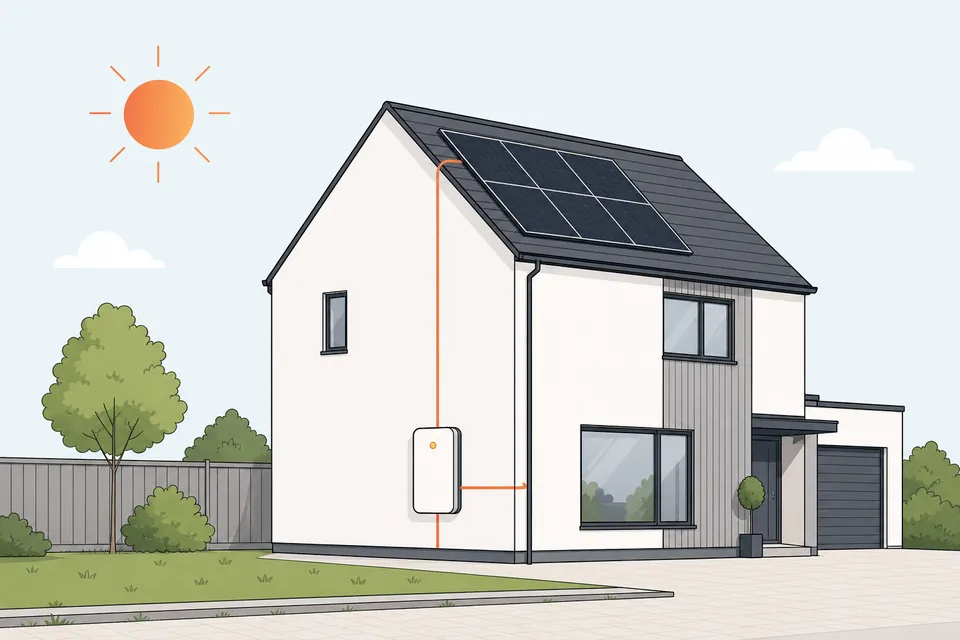
For the grid, storage counts as generation. Everything together is limited to 16 amps per phase, about 3.68 kW on a single-phase supply, for the simple fit-then-notify route. Over that, the network operator has to approve it first. Our G98 vs G99 guide explains.
Adding more panels
Check the roof first. The developer may already have used the best slope. Panels built into the roof are part of its covering, so new ones have to work around them.
Then check planning. Panels on a house may be permitted development, but the council may have removed those rights in the planning permission for the house. Official guidance says to check with the council first. Our guide to planning permission for panels covers the limits.
Fitting panels or batteries to a home has 0% VAT until 31 March 2027, then 5%. See VAT on panels, and how many panels you need for sizing.
Will adding panels affect your new-home warranty?
It can limit what's covered, so read your policy before anyone drills into a new roof. NHBC's Buildmark Choice policy booklet (2025) is one example:
- It excludes anything done to the home after the completion date, and work done by anyone other than the builder.
- It doesn't cover replacing panels just because they don't make enough electricity.
- For the first two years, the builder must put things right at its own cost. Report faults to the developer in that time.
Other providers, such as LABC Warranty and Premier Guarantee, set their own terms. Tell your installer the house is new, and keep their paperwork with the policy.
Self-builds: plan the panel installation at design stage
A self-built house has to meet the same requirement as a developer's, so put the PV into your plans early. The transition dates are the same too.
- The roof. The reference array faces south-east to south-west at 45 degrees, with no shade. Keep rooflights and vents off that slope where you can.
- The installer. Use an MCS certified installer if you want SEG payments.
- VAT. HMRC zero-rates energy-saving materials fitted as part of new home construction. Through the DIY housebuilders scheme, you can also claim back VAT on building materials and services, within 6 months of finishing. Check with HMRC or your accountant how it applies to you.
- Timing. Agree the delivery date for the panels and when they go on, so the roofer and installer aren't waiting on each other.
- Room for batteries. Decide where one could go later, even if you don't fit one yet.
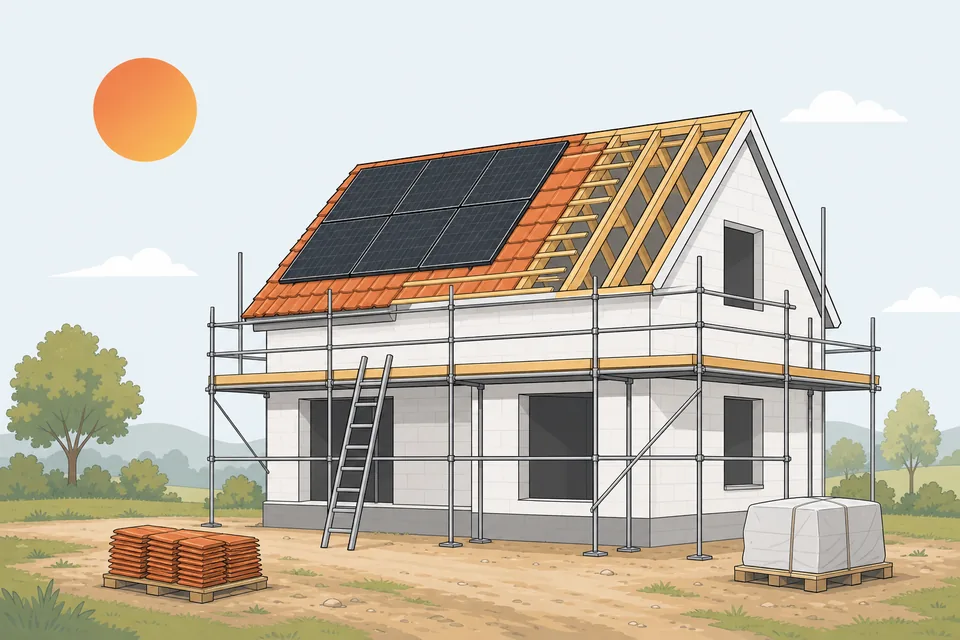
The short version: when a house went to building control, and when work on it started, decide which requirements apply. If you're buying, check the system and paperwork before you complete.
Questions people ask
Will a newly built house come with batteries?
Don't count on it. The 2027 requirement is for generating electricity, not storing it. Ask the sales office, or add one after you move in.
Can I ask the developer for a bigger system?
Yes, you can ask. Do it early, before your plot's roof goes on, and get any upgrade you agree written into your contract.
Does the 2027 requirement apply to extensions?
No. It applies when a building containing a home is put up. It doesn't make you add panels to an extension or an older house.
Do I need planning permission to install solar panels later?
Often not, but check the planning permission for your house first. A condition on it may have removed your permitted development rights.
Is it the same in Wales?
Wales has its own version. Its new requirement for renewable electricity on newly built homes takes effect on 4 March 2027.
About this guide
Written by the SolarSave team in Retford: MCS certified installers, led by a founder in solar since 2010. We checked every rule and date against GOV.UK, legislation.gov.uk, the Approved Documents, MCS, HMRC and the new-home warranty providers' own documents on 16 November 2026. We'll update this page when the 2027 requirement takes effect, or sooner if anything changes.
The 24 sources we checked
- MHCLG: The Future Homes and Buildings Standards, Building Circular 01/2026 (letter), 24 March 2026, checked 16 November 2026
- MHCLG: The Future Homes and Buildings Standards, 2023 consultation response, March 2026, checked 16 November 2026
- UK Parliament: Written statement HCWS1445, The Future Homes and Buildings Standards, 24 March 2026, checked 16 November 2026
- legislation.gov.uk: Explanatory memorandum to the Building Regulations etc. (Amendment) (England) Regulations 2026 (S.I. 2026/335), 2026, checked 16 November 2026
- MHCLG: Approved Document L, Volume 1: Dwellings, 2026 edition (takes effect 24 March 2027; paras 5.73 to 5.78, Appendix B), March 2026, checked 16 November 2026
- MHCLG: Approved Document L, Volume 1: Dwellings, 2021 edition incorporating 2023 amendments, in force since 15 June 2022, checked 16 November 2026
- legislation.gov.uk: Building Regulations 2010, regulation 40A (information about on-site electricity generation), checked 16 November 2026
- MHCLG: Final stage impact assessment, Future Homes Standard (Table 6, specification; Table 8, routes to compliance), March 2026, checked 16 November 2026
- GOV.UK: Homeowners could save hundreds on energy bills from solar drive, 30 June 2025, checked 16 November 2026
- GOV.UK: Government to make plug-in solar available within months, 24 March 2026, checked 16 November 2026
- Welsh Government: Building Regulations circular WGC 003/2026, 6 March 2026, checked 16 November 2026
- MCS: MCS certificate queries, updated 20 October 2026, checked 16 November 2026
- MCS: MIS 3002:2025 solar PV installation standard, issue 2.0 (clause 3.7, generation meter), 18 March 2026, checked 16 November 2026
- GOV.UK: Smart Export Guarantee, updated 19 October 2026, checked 16 November 2026
- Energy Saving Trust: Solar panels (how they work), checked 16 November 2026
- Energy Saving Trust: Buying a house with solar panels, checked 16 November 2026
- LABC Warranty: Roof integrated PV solar panels (technical guidance), February 2024, checked 16 November 2026
- Premier Guarantee: Roof integrated PV solar panel system, 1 August 2024, checked 16 November 2026
- NHBC: Buildmark Choice policy booklet (2025), 2025, checked 16 November 2026
- Energy Networks Association: Distributed Generation Connection Guide, G98 and G99 (v2.0), March 2025, checked 16 November 2026
- GOV.UK: Permitted development rights for householders, technical guidance, checked 16 November 2026
- Planning Portal: Solar panels, planning permission, checked 16 November 2026
- HMRC: VAT on energy-saving materials and heating equipment (VAT Notice 708/6), last updated 31 January 2024, checked 16 November 2026
- GOV.UK: Building a new home and VAT (DIY housebuilders scheme), updated 30 September 2026, checked 16 November 2026