

In short
- Mono cells are cut from one crystal; poly cells from a block of many crystals. That's why mono looks black and poly looks blue.
- Like for like, mono made about 8% more power from the same size panel in 2020, on Canadian Solar's datasheets.
- Against a 2016 poly panel, a 2026 mono panel fits about 36% more power into each square metre.
- Poly has gone: in practice, it's no longer made. Fraunhofer ISE counted none made worldwide in 2025.
- Already have poly? Keep it while it works, don't wire new ones into the same string, and check the Feed-in Tariff rules first.
| Polycrystalline | Monocrystalline | |
|---|---|---|
| Made from | Many crystals set in a block | A single crystal |
| Looks | Blue and speckled | Even black |
| Panel efficiency | 15.6% to 16.5% (2016); up to 19.0% (2020) | 19.5% to 20.6% (2020); up to 23.8% (2026) |
| Power per square metre | About 165 W (2016 panel) | About 225 W (2026 panel) |
| Power lost per °C of heat | 0.36% to 0.41% | 0.29% to 0.35% |
| Product warranty | 10 years (2016 panel) | 25 years (2026 panel) |
| Made in 2025 | None | 690 GWp of the 706 GWp made |
| Offered for UK homes | Rarely: being phased out, says Which? | Yes: the most popular type, says Which? |
What's the difference between monocrystalline and polycrystalline?
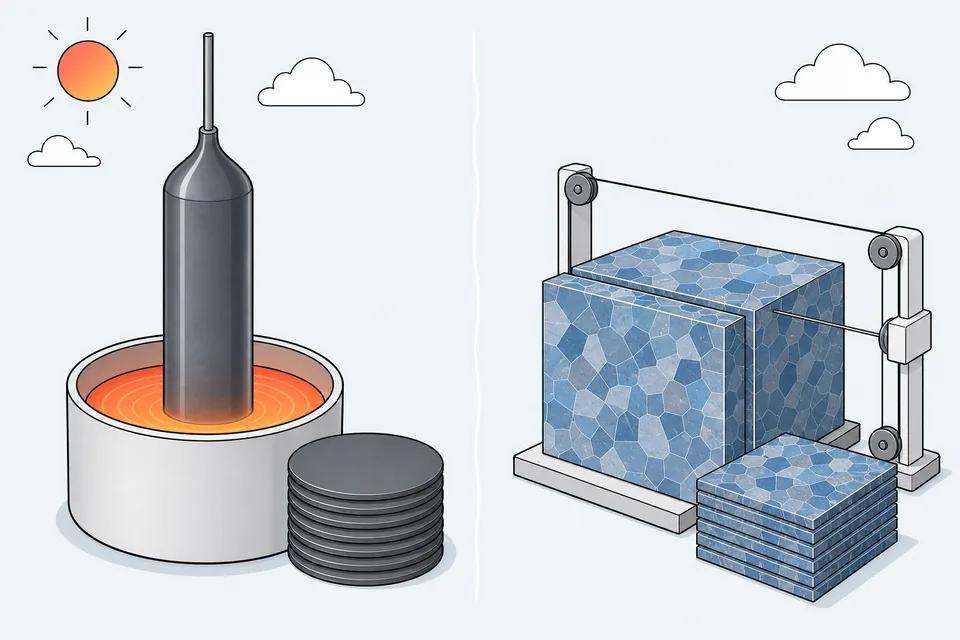
It's how the cells are made. Monocrystalline solar panels are made from cells cut from a single silicon crystal. Polycrystalline cells are cut from a block of many small crystals that grew together. That manufacturing difference drives everything else on this page.
How each type is made
- Monocrystalline. A round ingot grows as one crystal and is slowly pulled out of a vat of molten silicon, the US Department of Energy explains. Diamond-wire saws then slice it into wafers.
- Polycrystalline. The silicon is grown as a block, so many crystals form at once. The block is cut into bricks, then sliced into wafers. PVEducation, a university teaching site, says this method is simpler, and so cheaper.
The joins between the crystals are called grain boundaries. PVEducation explains that they waste some of the electricity a cell makes before it can flow out. That lowers a poly panel's efficiency, so the same space makes less power.
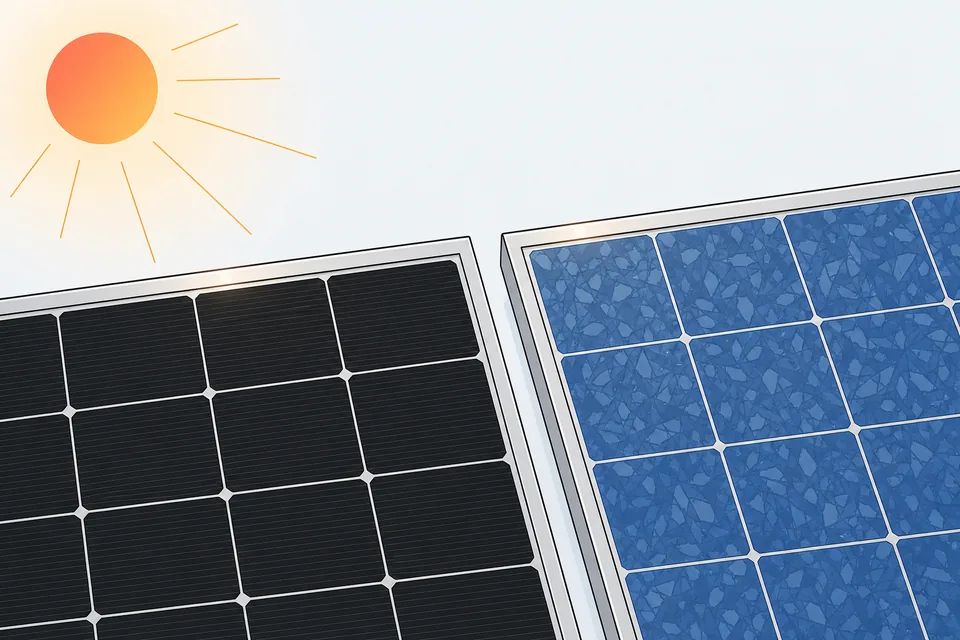
They also change the look. Each crystal faces a slightly different way, so a poly cell shows light and dark patches. Which? describes poly as blue-ish and mono as dark black.
How do the two types compare on real datasheets?
Like for like, mono made about 8% more power from the same size panel in 2020. Against a poly panel from the mid-2010s, a 2026 mono panel fits about 36% more power into each square metre.
Like for like: one maker, one size, 2020
In May 2020, Canadian Solar sold its HiKu panel in both types. Both versions used the same 2,108 x 1,048 mm frame and the same 144 cells, and weighed the same 24.9 kg.
| Poly (CS3W-P) | Mono PERC (CS3W-MS) | |
|---|---|---|
| Power | 395 to 420 W | 430 to 455 W |
| Panel efficiency | 17.9% to 19.0% | 19.5% to 20.6% |
| Power lost per °C of heat | 0.36% | 0.35% |
So polycrystalline panels generally offer power ratings a step below mono ones of the same size. Here the best mono panel made 35 W more than the best poly panel, about 8% more. On heat, the two were level.
That gap adds up. On a 10-panel system, 35 W a panel is 350 W, or 0.35 kWp. At 880 kWh per kWp, a middle figure for recent UK years (see below), that's roughly 300 kWh more a year.
A 2016 poly panel against a 2026 mono panel
Trina sold its Honey poly panel in 2016. Its Vertex S+ is a current N-type mono panel. N-type describes the kind of wafer, and it now dominates: the industry's ITRPV roadmap puts it at about 82% of the market in 2025.
| Honey TSM-PD05 (poly, 2016) | Vertex S+ NEG9R.28 (mono, 2026) | |
|---|---|---|
| Power | 255 to 270 W | 450 to 475 W |
| Panel efficiency | 15.6% to 16.5% | 22.5% to 23.8% |
| Size and weight | 1,650 x 992 mm, 18.6 kg | 1,762 x 1,134 mm, 21.0 kg |
| Power per square metre | About 165 W | About 225 W |
| Power lost per °C of heat | 0.41% | 0.29% |
| Product warranty | 10 years | 25 years |
| Performance warranty | 25 years | 30 years, with 87.4% of output guaranteed at the end |
Part of this gap is ten years of progress, and that progress went almost entirely into mono. Fraunhofer ISE says commercial monocrystalline modules went from about 17% to just under 25% efficient over the past decade.
Which is better for UK homes?
Monocrystalline. It wins on power per roof and warranties, and today's N-type designs lose less to heat. It's also the type you'll be offered: Which? says poly is being phased out in the UK, and you're unlikely to get a quote for them.
How much more power fits on a roof?
About a third more from the same space. Here's how much more power monocrystalline panels produce than polycrystalline panels on 20 m² of roof, using the two Trina models above.
- 2016 poly: 12 panels of 270 W fit in 20 m². That's 3.24 kWp (kilowatts peak, the system's rated power).
- 2026 mono: 10 panels of 450 W fit in the same space. That's 4.5 kWp, 39% more.
- Each year: UK solar made about 805 kWh per kWp in dull 2024 and 970 in sunny 2025, on government figures. At a middle figure of 880, that's about 2,850 kWh against 3,960 kWh, roughly 1,100 kWh more.
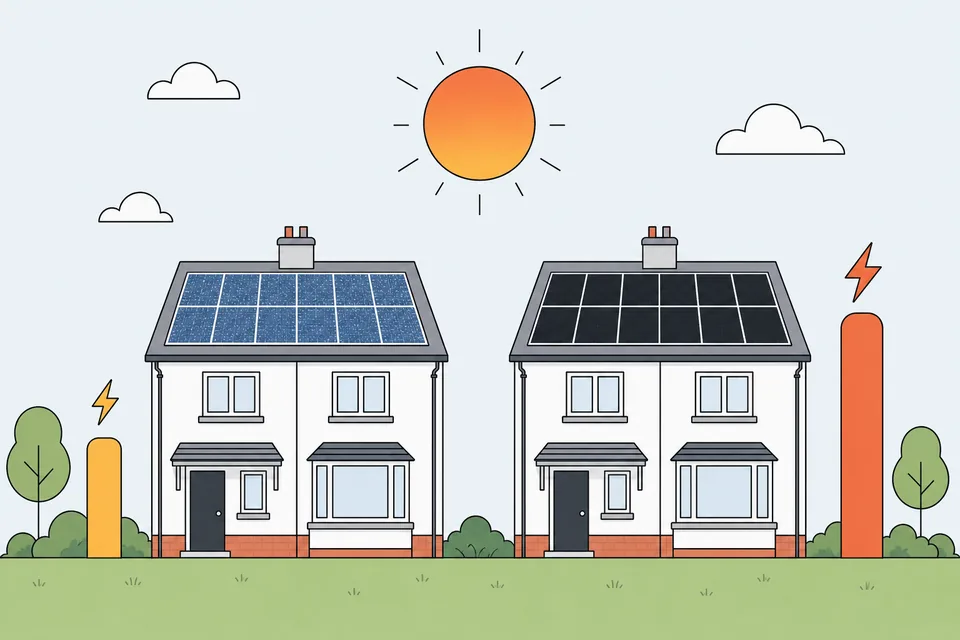
Real layouts depend on the shape, shade and direction of your roof, so treat this as a guide. Our guide to how many solar panels you need does the sums for your home.
Do poly panels cope better with heat?
No. Every datasheet gives a temperature coefficient: the share of its power a panel loses for each °C its cells run above 25°C. Lower is better.
- 2020 pair: 0.36% for poly and 0.35% for mono. No real difference.
- 2016 poly against 2026 mono: 0.41% against 0.29%. In the standard NOCT running test on both Trina datasheets (800 W/m² of sunlight, 20°C air and a light breeze), the cells reach 43°C to 44°C. At that heat the poly panel loses about 7.8% of its rated power and the mono panel about 5.2%.
Which? says poly doesn't cope very well in extreme heat. The datasheets suggest that's mainly true against today's N-type mono designs. In the UK the difference mostly shows on warm, sunny days.
Low light, looks and warranties
- Cloudy days. Which? says monocrystalline panels perform better than other types in low levels of sunlight.
- Looks. Mono is an even black, poly is blue. Which you prefer on your home is a matter of taste.
- Warranties. The 2016 poly panel had a 10-year product warranty. The 2026 mono panel has 25 years, plus a 30-year performance warranty.
The panels we fit come with a 25-year product warranty and a 30-year performance warranty. Ask which panel is in your quote, then check its datasheet: the cell type, efficiency and warranties are all on it.
Get a free quote for your home
Free consultation and a written quote with the full price, and no pressure to sign.
Or call 0333 577 6576, Monday to Friday, 9am to 5pm. We'll only use your details for your quote. Privacy policy
Are polycrystalline solar panels still made?
In practice, no. Fraunhofer ISE, a German solar research institute, counted none made in 2025 and says multi-crystalline technology "has disappeared from the market".
- 2015: only 35% of panels shipped worldwide were monocrystalline, says NREL (the US National Renewable Energy Laboratory, now the National Laboratory of the Rockies). Poly was widely used.
- 2022: mono reached 96% of world shipments, says the US Department of Energy.
- 2023: 98%, says NREL.
- 2025: 690 GWp of mono were made, out of 706 GWp in all, and no poly, says Fraunhofer ISE.
These are world figures for every kind of panel, residential and solar farm alike. We haven't found a UK split, but Which? says poly is being phased out here. If a quote today offers poly, ask for the datasheet and check the warranty terms.
Is poly cheaper?
Not in a way you can use now. Some guides still say polycrystalline panels may be more cost-efficient, and that monocrystalline solar panels are more expensive. Poly was cheaper to make, says PVEducation. But with none being made, there's no cheaper poly option to choose. The ITRPV roadmap also reports that price premiums for N-type designs have largely disappeared.
Our systems start from £4,995 for solar panels on their own, or £7,500 for 10 panels, a Fox ESS battery and scaffolding to one side, fully installed. Prices include VAT, at 0% until 31 March 2027. More in solar panel cost.
Which type is greener?
We haven't found a recent like-for-like study of the two. What has changed is how much material a panel needs. Fraunhofer ISE says the silicon used per watt fell from about 16 g in 2004 to about 2 g in 2024. It also says systems made in Europe and fitted in Northern Europe repay the energy used to make them in about 1.1 years.
How to tell which type of solar panels you have
Look at the colour first, then check the model.
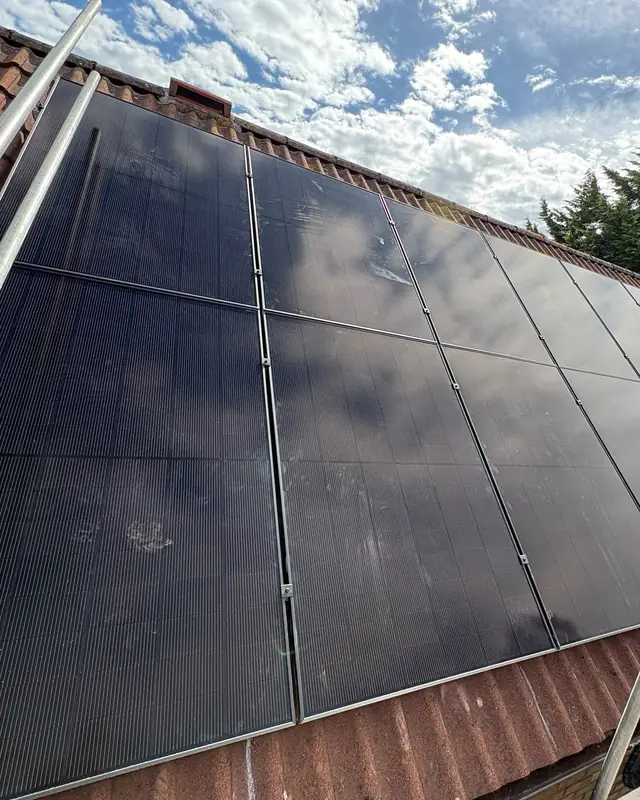
- Look at the cells. Blue cells with a speckled, shard-like pattern mean poly. Even black cells mean mono.
- Find the model. MCS says your MCS certificate includes "the type and model of the installed technology". Ask your installer for a copy if you can't find it. If they've closed, MCS can supply one for £36, including VAT. Our guide to the MCS certificate explains more.
- Check the datasheet. Search for the model name. The cell line on the datasheet will say mono or monocrystalline, or multicrystalline or polycrystalline. Multicrystalline and polycrystalline mean the same thing.
Can't see the cells clearly from the ground? A photo taken from the garden and zoomed in usually shows them. Never climb up to check.
Got polycrystalline panels already?
Keep them while they work. Don't wire new ones into the same string, and check the Feed-in Tariff rules before you change the system.
Should you replace them?
Not just because they're poly. Which? says poly lasts as long as mono, and the 2016 poly panel above came with a 25-year performance warranty.
- Check the output. Compare each year's generation with the estimate in your installer's paperwork, allowing for the weather. Monitoring tells you whether older panels are reliable.
- Weigh up the gain. If you're thinking about new ones anyway, the 20 m² example above shows the scale: about 1,100 kWh a year more. Set that against the cost, the scaffolding and any Feed-in Tariff payments at stake (see below).
- Look for damage. Cracked glass, burn marks and browning are faults listed by the International Energy Agency's PV programme. Ask an installer to check any you see. Our guide to testing a solar panel explains how.
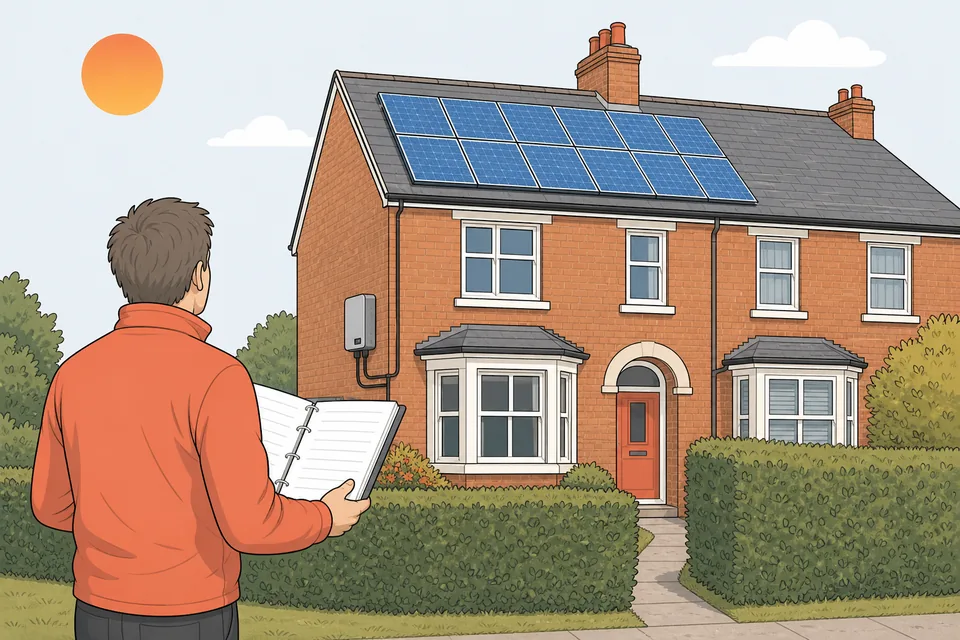
More on wear and replacement in how long do solar panels last?
Can you add mono to a poly system?
Not in the same string. A string is a row of panels wired one after another into the inverter, and the weakest panel holds the rest back. REC, a panel maker, says:
- panels from different makers, cell sizes or technologies must not be combined in a string
- a lower-rated replacement drags the whole output down, so use one from the same product series where possible
- if half or more of a string needs replacing, replace the whole string
Optimisers can help. Tigo, an optimiser maker, says its optimisers let installers mix panel types in a string, within set limits. Read do you need optimisers or microinverters?
What about the Feed-in Tariff?
Check before you add anything. Ofgem's guidance for Feed-in Tariff (FIT) generators, version 19 of April 2026, says:
- any extension commissioned on or after 15 January 2016 gets no FIT payments
- you must contact your FIT licensee, the supplier that pays your FIT, if you increase or reduce the system's capacity
- you can repair or replace panels or the inverter, as long as the installation still meets the scheme rules
The rules depend on your installation, so check with your FIT licensee first.
Which monocrystalline panels should you choose?
The choice now is between kinds of mono panel. Almost every panel sold today uses monocrystalline solar cells, and they differ in how each cell is built.
The main designs are PERC, TOPCon, heterojunction and back-contact. On the ITRPV roadmap, the newer designs reach about 23.5% to 24.1%, against 21.7% for PERC. TOPCon and heterojunction panels typically use half-cut cells, the roadmap notes. Some panels are also bifacial: they collect light on both sides, Trina explains.
When panels compare closely on efficiency, the warranty and the maker's UK support matter more. Whatever the panel type, ask for its datasheet before you sign.
Our guide to the best solar panels UK homes can buy compares four current models and their warranties. For real-world figures, see solar panel efficiency. For brands, see JA Solar vs AIKO vs LONGi, and for what's coming, new solar panel technology.
Are there other types besides crystalline solar?
Yes, but you're unlikely to see them on a UK home. The main other type is thin-film solar, which uses a thin layer of light-absorbing material instead of wafers. Fraunhofer ISE puts it at 2% to 3% of the market. Which? says it's usually the cheapest type but less efficient, and light and flexible enough for caravans and boats.
The bottom line
Buying new? Choose mono: it makes more power from the same roof, and it's the type you'll be offered. Already have poly panels? Keep them while they work, don't add new ones to the same string, and check the Feed-in Tariff first. Getting a quote? Ask which panel is in it, then read its datasheet.
Questions people ask
Is mono or poly better?
Mono. Monocrystalline panels make more power from the same space, lose less to heat on today's N-type designs and carry longer product warranties. In practice, poly is no longer made: Fraunhofer ISE counted none in 2025.
Why are polycrystalline cells blue?
Each cell is made of many small crystals facing different ways, so it shows light and dark patches that look blue and speckled. A mono cell is one crystal and looks an even black.
Can you mix mono and poly?
Not in the same string. REC, a panel maker, says different technologies must not be combined in one. Optimisers can allow mixing within set limits, says Tigo. Ask your installer how they'd wire them.
Does mono work better on cloudy days?
Which? says monocrystalline panels perform better than other types in low levels of sunlight. Every type makes less power under cloud.
Is monocrystalline worth the extra cost?
You won't usually face that choice now. Which? says poly is being phased out, and the ITRPV roadmap reports that price premiums for N-type designs have largely disappeared.
How long does a poly system last?
As long as a mono one, says Which?. The 2016 Trina poly panel we compared came with a 25-year performance warranty.
About this guide
Written by the SolarSave team in Retford: MCS certified installers, led by a founder in solar since 2010. We took every panel figure from the maker's own datasheet, and checked every other figure and rule at its source, on 16 November 2026. We haven't tested these panels ourselves. We update this page when datasheets or rules change.
The 18 sources we checked
- Canadian Solar: HiKu CS3W-P polycrystalline datasheet, V5.591_EN (UK distributor copy), May 2020, checked 16 November 2026
- Canadian Solar: HiKu CS3W-MS mono PERC datasheet, V5.59_AU, May 2020, checked 16 November 2026
- Trina Solar: Honey TSM-PD05 multicrystalline datasheet, TSM_EN_2016_B (UK distributor copy), 2016, checked 16 November 2026
- Trina Solar: Vertex S+ NEG9R.28 datasheet, TSM_EN_2026_A, 2026, checked 16 November 2026
- Fraunhofer ISE: Photovoltaics Report, updated 14 July 2026, checked 16 November 2026
- NREL: Spring 2024 Solar Industry Update, 14 May 2024, checked 16 November 2026
- US Department of Energy: Crystalline silicon photovoltaics research, updated 17 December 2025, checked 16 November 2026
- PVEducation (Honsberg and Bowden): Multicrystalline silicon, checked 16 November 2026
- PV Tech: ITRPV 2026 roadmap, 25 June 2026, checked 16 November 2026
- Which?: Buying advice for solar panels, 12 August 2026, checked 16 November 2026
- DESNZ: Digest of UK Energy Statistics 2026, chapter 6 (solar load factors), checked 16 November 2026
- REC: Managing mismatches when replacing panels (best practice guide), checked 16 November 2026
- Tigo Energy: Mix and match different PV modules (manufacturer support article), checked 16 November 2026
- Ofgem: Feed-in Tariffs, guidance for generators (version 19), 1 April 2026, checked 16 November 2026
- MCS: MCS certificate queries, updated 20 October 2026, checked 16 November 2026
- HMRC: VAT on energy-saving materials and heating equipment (Notice 708/6), zero rate runs to 31 March 2027, checked 16 November 2026
- Trina Solar: Why bifacial modules are on the rise for utility-scale solar installations (maker's blog), 26 October 2020, checked 16 November 2026
- IEA PVPS Task 13: Review of failures of photovoltaic modules, March 2014, checked 16 November 2026