

In short
- The benefit: every unit of solar power you use on the spot is one you don't buy. On 2026 prices, that's worth about three times a unit you export.
- Fragile and asbestos roofs: fibre cement and many rooflights won't hold a person. Survey first, and expect some roofs to need new sheets before anything goes up.
- Strength: a competent person must check the roof can carry the panels, plus snow and wind.
- Planning: roof panels on an agricultural building in England are usually permitted development. Over 50 kW, ask the council for prior approval first.
- Grid: above 3.68 kW on a single-phase supply, or 11.04 kW on three-phase, the network operator must approve the connection first.
| Building | Usually a good fit? | Check first |
|---|---|---|
| Barns and machinery sheds | Often: long, open roof slopes | The roof sheets, purlins and rooflights |
| Grain stores | Often, if fans and handling run in daylight | Dust near electrical kit at harvest |
| Dairies | Yes, if much of the milking and cooling runs in daylight | Early milking may need a battery |
| Poultry and pig units | Possible, if fans and lights run in daylight | Ammonia-tested panels and the building's remaining life |
| Old fibre cement sheds | Only after a survey | Asbestos, and whether the sheets need replacing first |
What are the benefits for your farm?
Cheaper electricity, mainly. Every unit your solar PV makes that you use on the spot is a unit you don't buy from the grid.
In the second quarter of 2026, businesses paid an average of 24.51p per kWh, including the Climate Change Levy, on government figures. E.ON Next's business export tariff paid 8.5p per kWh when we checked. So a unit used in the yard is worth roughly three times a unit sent to the grid.
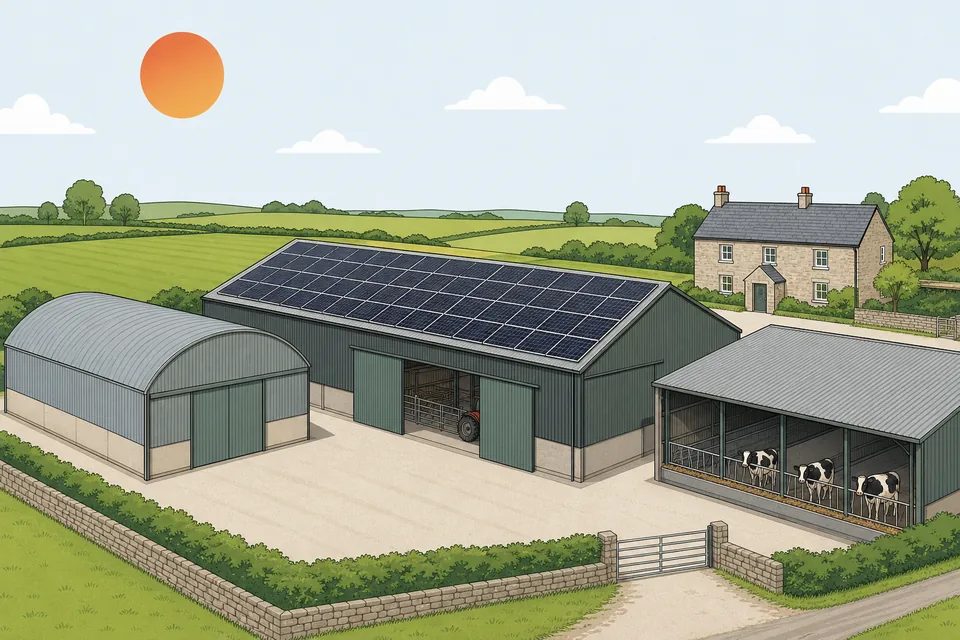
Barns and sheds suit this for four reasons:
- Big roofs. Barns, grain stores and livestock sheds often have long slopes that do nothing else.
- Daytime demand. Plenty of work in agriculture uses electricity in daylight: milk cooling, fans, pumps, workshops and grain handling.
- Land stays in use. Panels on rooftops leave every field free for crops or grazing. Panels on farmland contribute too, but they take land and usually need planning permission.
- Clean energy goals. Solar energy is renewable energy made where you use it, which helps if your business or your buyers set carbon targets.
Be realistic about the scale. Panels won't dramatically cut farm energy costs if most of your use falls at night or in midwinter. They don't touch tractor diesel or heating fuel either.
Roofs are also the simplest way of boosting land efficiency, because the building does two jobs at once.
Panels over crops, field arrays and solar farms are in our guide to agricultural solar panels.
Which roofs suit panels best?
The best roofs for solar have a big, unshaded slope facing anywhere from east through south to west, on a building that's sound and will stand for decades.
- Direction. Which? says a south-facing roof is optimal. An east or west-facing roof makes about 15% less, and a north-facing one around 30% less.
- Pitch. Which? puts the ideal slope at 30 to 40 degrees. A shallower shed roof still works.
- Shade. Which? says a roof with 20% shading or less is best. Watch for silos, trees and taller buildings that throw shadows in the morning or evening sunlight.
- Sheets. Find out what the roof is made of. Fibre cement is fragile and may contain asbestos, so it needs the checks in the next section.
- Rooflights. Many rooflight sheets are fragile too. Plan the layout so panels don't cover the light your stock or staff need.
High-efficiency panels for limited space
Monocrystalline panels are the most popular and most efficient type, says Which?, while polycrystalline panels are being phased out in the UK. Today's monocrystalline panels often top 23%: 2026 industry figures put TOPCon and heterojunction modules at 23.5% and back-contact modules at 24.1%, against 21.7% for older PERC ones.
High-efficiency panels generate more electricity from the same amount of roof. That matters on small areas, such as a lean-to or a dairy roof broken up by rooflights. If space is tight, ask for the best power per panel, not just the cheapest kit.
Bifacial panels can boost energy output by catching light on their back as well. The IEA's research shows the gain rises with the height of the panels and a bright surface below, so panels laid close to a pitched roof gain little. They suit frames on the ground or on flat roofs better.
Can panels go on asbestos or fragile roofs?
Sometimes, but only after a survey and a safe plan for working at height. Many older sheds have fibre cement sheets, which HSE treats as fragile, and these are often called asbestos cement.
HSE's guidance for agriculture says fragile roofs include fibre cement sheets, corroded metal sheets and many rooflight sheets. They can break without warning, and roughly half the deaths and serious injuries caused by falls involve work on fragile roofs.
Get an asbestos survey before installing
HSE says most farms will have some asbestos, and recommends a survey by a specialist company. Where work breaks into the building fabric, a more intrusive refurbishment survey may be needed.
- Share what you know. HSE says the duty to manage asbestos covers all non-domestic premises, and owners must give their asbestos information to anyone who might work on or disturb it.
- Drilling counts as asbestos work. If the fixings go through asbestos cement sheets, that means drilling them. That can be non-licensed work, but it still needs a risk assessment, trained workers and the right controls. HSE publishes task sheets for drilling asbestos cement and for removing sheets.
- Badly broken sheets need more care. Removing asbestos cement that will be badly damaged or broken up is notifiable non-licensed work, which comes with extra duties.
- Old sheets can't be reused. HSE says there's a complete ban on reusing asbestos cement anywhere other than where it was first fitted.
Hiring someone for building work also makes you the client under the construction safety rules (CDM). HSE says you must check suitable management arrangements are in place, and that you and the contractor have duties you can't pass to each other by contract.
If the sheets are weathered, replacing them first saves taking the panels off later to re-roof. The NFU has pointed out that a solar project can help pay for replacing an old asbestos roof. Ask any solar installer, us included, how they'll work on the roof and who will handle the asbestos.
Nobody should walk on fragile sheets. HSE's advice:
- Treat every roof as fragile until you know otherwise, and put warning signs at the ways up.
- Work from below where you can, using safe access equipment.
- Otherwise use platforms that span at least three purlins, with guard rails, nets or coverings. HSE says a combination of stagings and nets tied tight up to the roof is the safest method.
- Don't just leapfrog a pair of platforms across the roof.
- Never walk the line of the purlins.
- Never lift people in grain buckets, potato boxes or on pallets. Use a purpose-built work platform instead.
Will the roof take the weight?
Don't assume it can. MCS rules say a suitably competent person must check the roof structure can carry the loads. If the roof is in any way unusual, or there's any doubt, a qualified structural engineer must be consulted.
MCS counts a roof pitched under 30 degrees as unusual, and one where snow can build up, such as in valleys or behind parapets. So a shallow shed roof needs an engineer's check.
Panels are light for their size. Trina's Vertex S+, for example, weighs 21 kg and covers about 2 square metres, roughly 10.5 kg per square metre. The roof mounting kit adds its own weight, and the whole frame has to cope with snow and with wind trying to lift the panels.
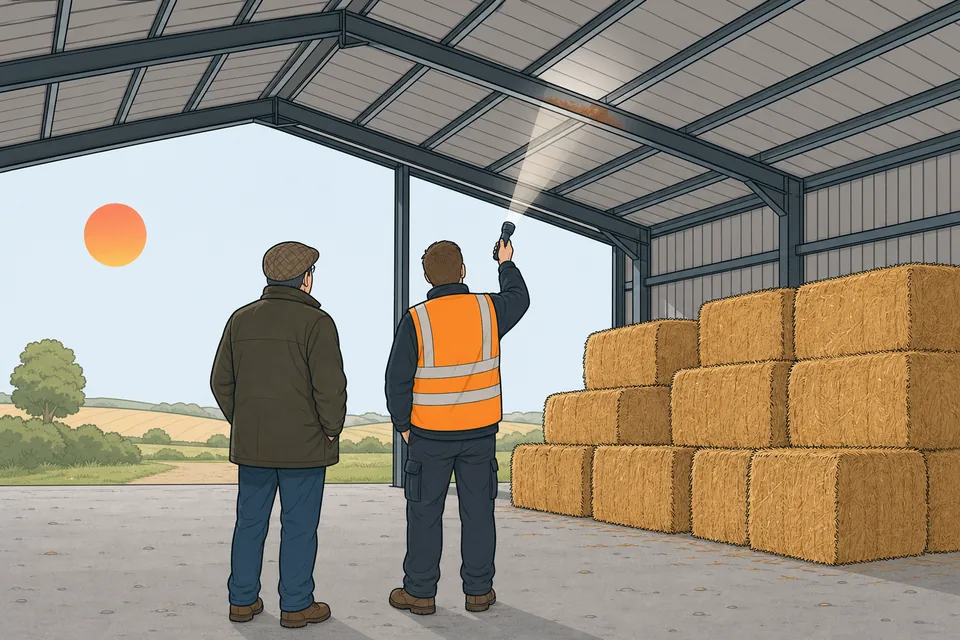
You can spot warning signs yourself from the floor. In one HSE case, a farmer and a worker fell while repairing a leaking cow shed roof. A timber purlin, rotted by water soaking through the roof, had probably fractured. HSE said a look from the building floor for obvious distress or decay would have been reasonable. Look for:
- rusted steel purlins or rafters
- rotten or long-soaked timber
- sagging lines in the roof
- cracked, slipped or patched sheets, and leaks
Before the check, dig out what you know about your farm structures: their age, any drawings, and past repairs or storm damage. It all helps whoever assesses the structure.
NFU Mutual's guidance says a lightweight building is unlikely to bear the extra weight, and to look for another location if so. It asks for a qualified structural engineer to check the roof can carry the panels, including snow in severe weather. Any structural work the engineer recommends should be finished first, with written confirmation kept on file.
The fixings matter too. MCS says panels shouldn't harm the building's weather tightness or structure. NFU Mutual asks for every roof penetration to be sealed with suitable proprietary products, not mastic or sealant.
Finally, check the building will outlast the panels. The Energy Saving Trust says panels keep working for around 30 years with regular upkeep. More in how long do solar panels last?
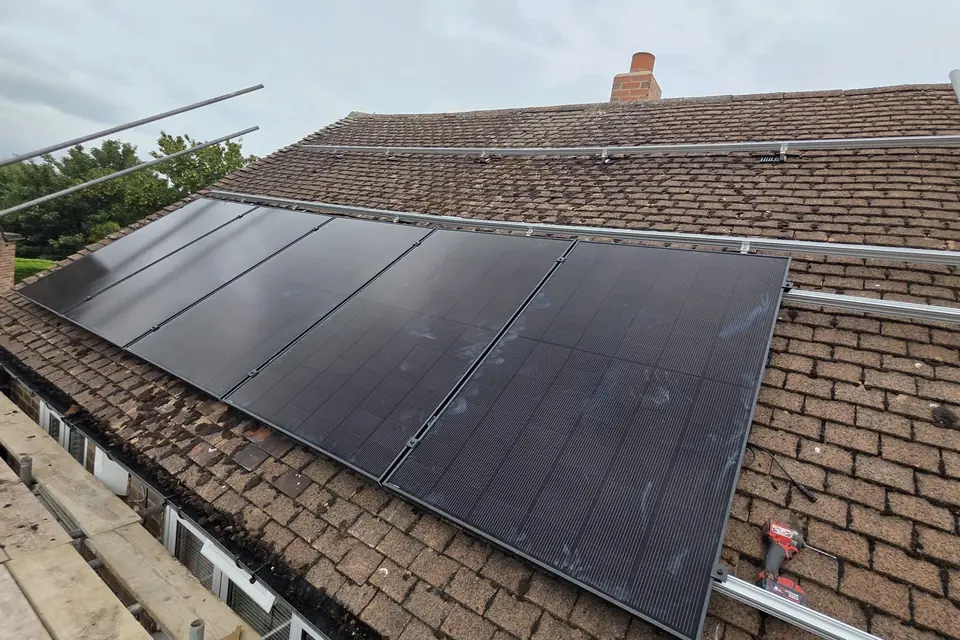
Thinking about panels on your sheds?
We fit solar PV on farm buildings that are structurally sound, within 100 miles of Doncaster. Free consultation, a written quote and no pressure to sign.
Or call 0333 577 6576, Monday to Friday, 9am to 5pm. We'll only use your details for your quote. Privacy policy
Livestock sheds: ammonia, dust and cleaning
Panels can go on livestock sheds and other agricultural buildings, but the air around some of them is harsh. Ask for panels tested for ammonia, keep them clear of fan outlets, and plan how they'll be cleaned without anyone on the roof.
- Ammonia. IEC 62716 is the ammonia corrosion test for solar modules. The standards body describes highly corrosive wet air, as in stables on agricultural businesses, which could degrade some panel parts. Check the datasheet: Trina's Vertex S+, for example, lists it.
- Fans and vents. Air in livestock housing holds a lot of ammonia, and panels near the ventilation take the worst of it. Lay them out away from extract fans and ridge vents where you can.
- Rails and clamps. They sit in the same air, so ask what they're made of.
- Rodents. In agricultural premises where rodents are a problem, RC62, the fire safety code for panels, suggests running cables in sealed trunking or ducts.
- Grain dust. RC62 gives grain stores at harvest, where the dust could be explosive, as an example of where a DSEAR assessment (the rules on explosive atmospheres) is needed.
- The building's life. The NFU noted in 2013 that pig and poultry houses are often rebuilt every 10 to 15 years. Fit panels to a building that will last.
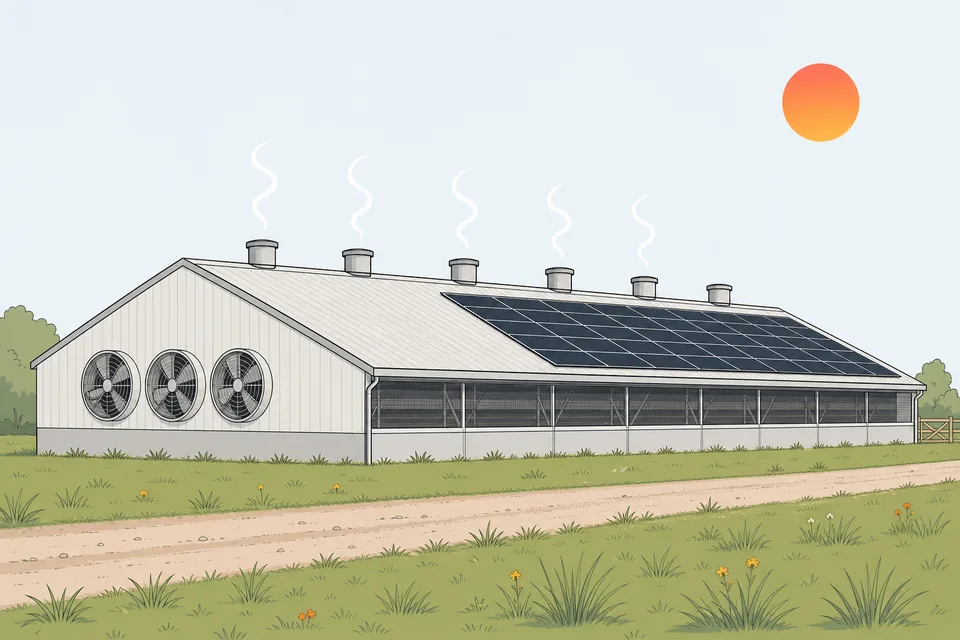
Agree the practical side before anyone arrives on site: where the scaffold, lifting kit and vans go, when stock needs moving, and any biosecurity rules for visitors.
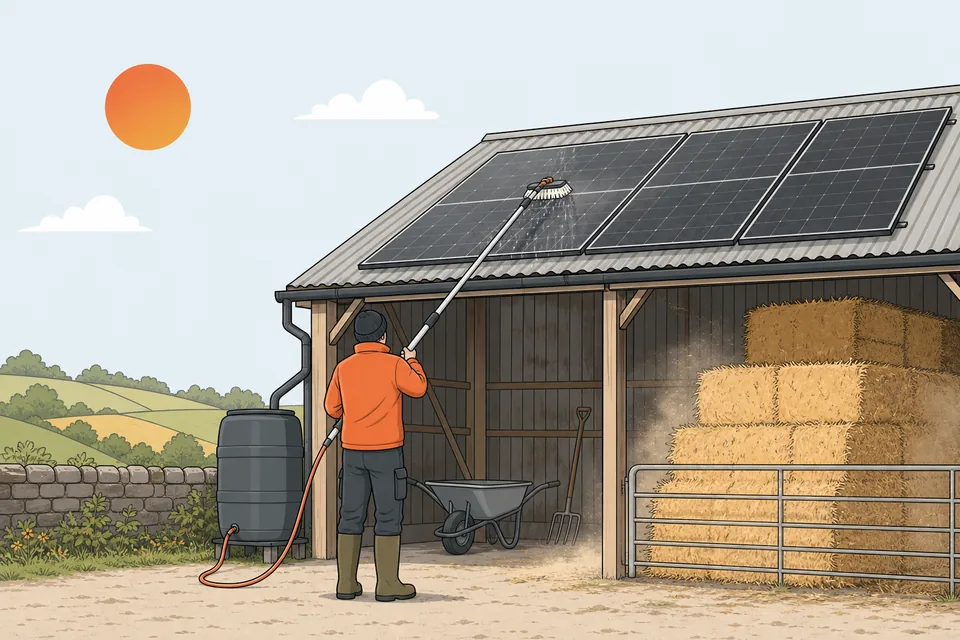
Cleaning panels over stock
Clean when they're visibly dirty, from the ground. The Energy Saving Trust says panels near farmland or other dusty places may need cleaning more often, and so may panels regularly hit by bird droppings.
- Use just water and a soft brush or sponge, for example on a long water-fed pole.
- Avoid high-pressure power washers, and skip washing-up liquid, which leaves a residue.
- Never stand on the panels, or on a fragile roof to reach them.
- Have a professional service every 3 to 5 years, says the Energy Saving Trust. RC62 recommends inspecting commercial systems at least once a year, and says infrared thermography is a cost-effective way to check panel health.
Roof space and grid connection for farm solar
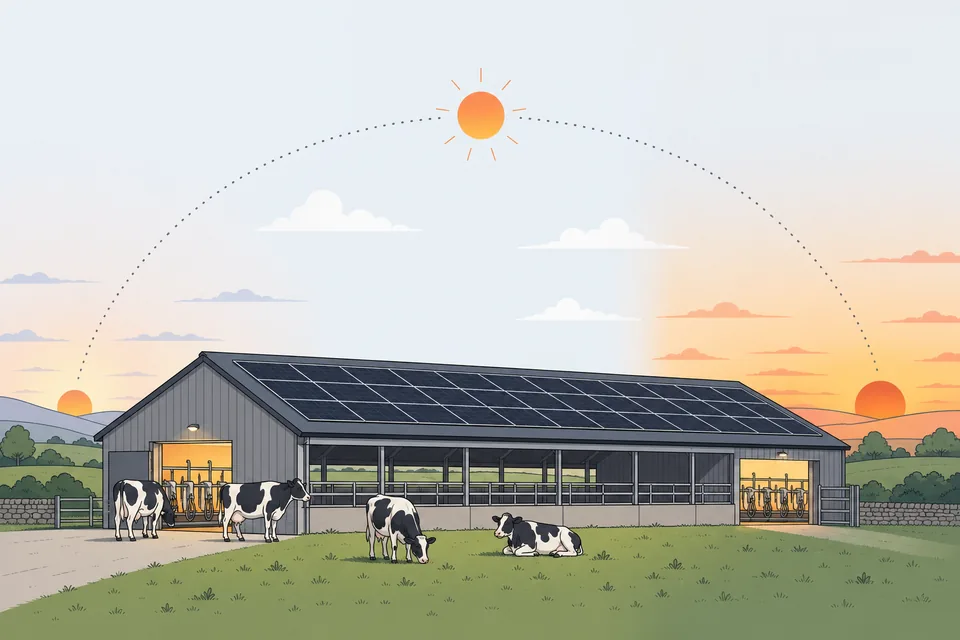
Size the system to the power you use in daylight, not to the size of the roof. Your smart meter's data shows when you use electricity hour by hour. Matching a system to the farm's use, with a worked example, is in our guide for farm businesses.
On dairy farms, for example, milking that starts before sunrise draws on the grid or a battery.
How much roof do you need?
With 450 to 475 W panels such as Trina's Vertex S+, which covers about 2 square metres, allow roughly 4.2 to 4.4 square metres of panel for each kWp (kilowatt peak). At that size, a 50 kWp solar array is about 106 to 112 panels, or roughly 210 to 225 square metres of panels.
Then add the 1 m gap that permitted development needs at every roof edge, and keep clear of rooflights, vents and shade. What the power could save, and the payback, are in our agricultural guide, linked above; costs for business roofs are in our commercial solar cost guide. When you're ready for real figures, ask us for a free quote.
Connecting to the grid: G98 and G99
Small solar arrays connect first and tell the network operator after. Under G98, that covers up to 16 amps per phase: about 3.68 kW on a single-phase supply, or 11.04 kW on three-phase. The operator must be told within 28 days.
For solar, the network operator counts the lower of the inverter's rating and the panels' rating, so the panels can add up to a little more than the limit. As a rough guide, 11.04 kW is 25 to 28 panels at 400 to 450 W. Anything bigger falls under G99, and the network operator must give permission before it's connected.
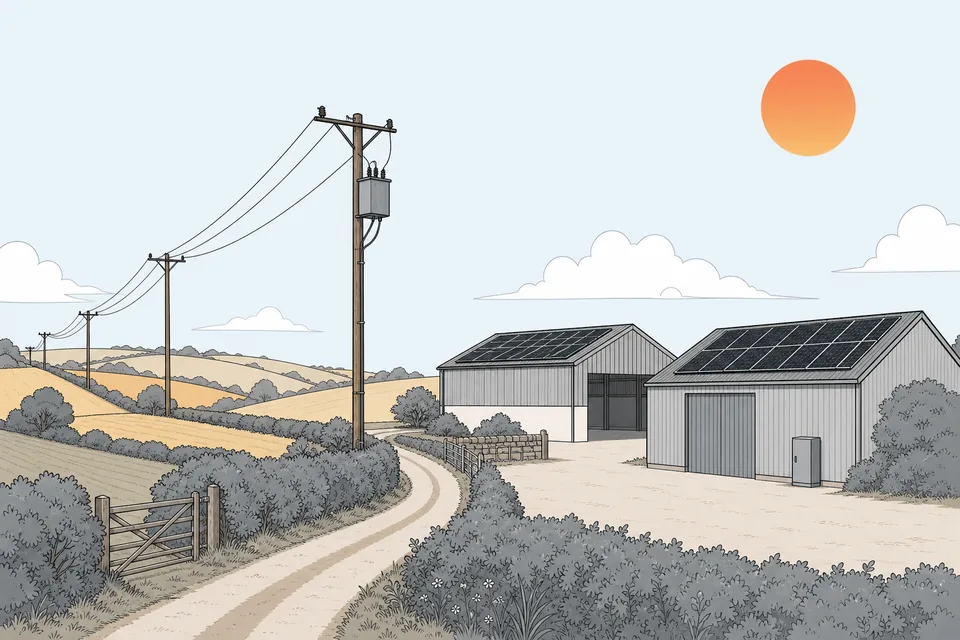
- Weak rural lines. Where the local network is short of room, the operator may cap your export with an export limitation scheme, or offer a connection that can be turned down at busy times.
- A cap isn't a waste. It limits only what goes back to the grid. You can still use the full output in the yard.
- Waiting times. In our experience, approval takes anything from 2 to 90 days, depending on the network operator and the spare capacity. We make the application for you.
The full process is in G98 vs G99.
Planning, insurance and paperwork
Most roof solar projects need no planning application, but they do need your insurer on board and the right certificates.
Do you need planning permission?
Usually not, for panels on the roof of an agricultural building in England. They're permitted development under Class J of the planning rules, within these limits:
- no more than 200 mm proud of a pitched roof, and on a flat roof no more than 1 m above its highest part
- at least 1 m from the edge of the roof
- not on a listed building or any building in its curtilage, and not on a scheduled monument, so barns within the curtilage (the grounds) of a listed farmhouse may need a planning application
- placed, as far as practicable, to keep the effect on the building's appearance small, and removed when no longer needed
Up to 50 kW counts as microgeneration. A bigger roof array needs the council's prior approval first, on design and appearance, especially glare for neighbours. You can start once the council says prior approval isn't needed or gives it, or if it hasn't told you its decision within 56 days. Since 21 December 2023 there's been no 1 MW cap on these rights.
Panels on farmland may require special permission: field arrays have their own planning rules, covered in our agricultural guide.
These are England's rules. Panels on the farmhouse follow the rules for homes, and Wales and Scotland have their own. See our planning permission guide.
Telling your insurer
Tell your insurer before you accept a quote. An insurance broker told Farmers Weekly that renewable generation won't be covered by standard farm insurance, and that conditions vary hugely between insurers.
RC62, the fire safety code for solar PV published by the Fire Protection Association and written by RISCAuthority and MCS, recommends:
- discussing the project with the property insurer
- fitting panels on non-combustible roofs, or adding a fire-resistant layer where that can't be avoided
- a switch that makes the DC wiring inside the building safe, in a prominent place firefighters can reach
- inspecting commercial systems at least once a year, by a competent person
NFU Mutual's data sheet adds three more: use MCS-approved contractors and kit, keep combustible materials and flammable liquids away from the inverter, and keep records of every inspection.
MCS, export payments, grants and tax
- MCS. The MCS installation standard covers solar PV systems up to 50 kWp, and we're MCS certified.
- Export payments, grants and tax. Selling spare power from a farm under the Smart Export Guarantee, grants (GOV.UK listed none open for solar on farms when we checked on 16 November 2026) and tax are all covered in our agricultural guide. Allowances are in capital allowances on solar panels. Check your own position with HMRC or your accountant.
The takeaway: check the sheets, the structure and what goes on underneath before you think about panel numbers.
Questions people ask
Can you put solar panels on a barn roof?
Yes, if the roof is strong enough, faces east, south or west without heavy shade, and its sheets are safe to work on or replaced first. Have the structure and any asbestos checked before you get quotes.
Do livestock sheds need ammonia-resistant panels?
It's sensible. Ask for solar modules that have passed IEC 62716, the ammonia corrosion test, and keep them away from fan outlets and ridge vents.
Can I put panels on the farmhouse as well?
Yes. Panels on the house follow the planning rules for homes, and installs in homes are zero-rated for VAT until 31 March 2027.
How long do the panels last?
Around 30 years with regular upkeep, says the Energy Saving Trust. Check the building underneath will last as long.
Do I need planning permission for panels on my sheds?
Usually not in England. Roof panels on an agricultural building are permitted development within the Class J limits, unless the building is listed, in a listed building's grounds or a scheduled monument. Over 50 kW, ask the council for prior approval first.
About this guide
Written by the SolarSave team in Retford: MCS certified installers, led by a founder in solar since 2010. We checked every rule and figure against HSE, MCS, legislation.gov.uk, the Planning Portal, DESNZ, GOV.UK, the Energy Networks Association, the fire safety code RC62 and the other sources below on 16 November 2026. Planning, grid and tax rules change, so check them again before you commit.
The 31 sources we checked
- DESNZ: Quarterly Energy Prices, September 2026 (non-domestic electricity prices), checked 16 November 2026
- E.ON Next: Smart Export Guarantee tariffs (business export rate), checked 16 November 2026
- Which?: Buying advice for solar panels (direction, pitch, shading, panel types), 12 August 2026, checked 16 November 2026
- PV Tech: ITRPV 2026, module efficiencies by technology, 25 June 2026, checked 16 November 2026
- IEA PVPS Task 13: Bifacial photovoltaic modules and systems (T13-14:2021), executive summary, April 2021, checked 16 November 2026
- Energy Saving Trust: How to clean and maintain solar panels, updated 1 October 2026, checked 16 November 2026
- Energy Saving Trust: Solar panels (panel output), checked 16 November 2026
- HSE (agriculture): Falls through fragile roofs, 18 July 2024, checked 16 November 2026
- HSE (agriculture): Walking and working on a fragile roof, 18 July 2024, checked 16 November 2026
- HSE (agriculture): Building work on farms (CDM and asbestos), 24 October 2024, checked 16 November 2026
- HSE: Asbestos, actions to take depending on your job role, updated 1 March 2021, checked 16 November 2026
- HSE: Non-licensed work with asbestos, updated 23 February 2024, checked 16 November 2026
- HSE: Asbestos essentials task sheets, updated 19 September 2025, checked 16 November 2026
- MCS: MIS 3002:2025 Solar PV installation standard (issue 2.0), 18 March 2026, checked 16 November 2026
- Trina Solar: Vertex S+ NEG9R.28 datasheet (2026), checked 16 November 2026
- NFU Mutual: Risk management programme for photovoltaic roof mounted systems (data sheet), checked 16 November 2026
- DIN: EN IEC 62716, ammonia corrosion testing of photovoltaic modules (project page), checked 16 November 2026
- pv magazine: Sanyo HIT modules pass ammonia resistance test (press release), 28 June 2011, checked 16 November 2026
- NFU: Solar photovoltaic electricity in agriculture (briefing), December 2013, checked 16 November 2026
- Fire Protection Association (written by RISCAuthority and MCS): RC62, recommendations for fire safety with PV panel installations (version 2), 2023, checked 16 November 2026
- AHDB: Understand when and how you use energy (dairy energy use), checked 16 November 2026
- Energy Networks Association: Distributed Generation Connection Guide, G98 and G99 (v2.0), March 2025, checked 16 November 2026
- MCS: Notifying DNOs, updated 14 July 2026, checked 16 November 2026
- legislation.gov.uk: GPDO 2015, Part 14 Class J (solar on non-domestic premises), checked 16 November 2026
- legislation.gov.uk: GPDO 2015, Part 14 Class K (stand-alone solar on non-domestic premises), checked 16 November 2026
- legislation.gov.uk: Energy Act 2004, section 82 (microgeneration: up to 50 kilowatts), checked 16 November 2026
- Planning Portal: Solar panels mounted on a non-domestic building, checked 16 November 2026
- Planning Portal: Updates in December to permitted development rights for solar panels, 19 December 2023, checked 16 November 2026
- Farmers Weekly: Insurance implications for renewable energy projects, 12 July 2024, checked 16 November 2026
- GOV.UK: Funding for farmers, growers and land managers, updated 1 October 2026, checked 16 November 2026
- HMRC: VAT on energy-saving materials and heating equipment (Notice 708/6), checked 16 November 2026