

Commercial solar costs and payback at a glance
What a 10 to 50 kW system costs
£1,256
per kW installed, the median for 2024/25
From DESNZ figures for MCS-certified installs. A 30 kW system at that rate is £37,680 before VAT.
How long it takes to pay back
6 to 8 years
in our 30 kW worked example, for a VAT-registered firm
With 80% of the power used on site, across a dull and a sunny year.
What each kWh is worth
24.5p
saved per kWh you use, against 3p to 8.5p per kWh sold
So size the system to your daytime use, not to sell spare power.
From DESNZ, Ofgem and two suppliers' published rates, checked 16 November 2026.
How much do commercial solar panels cost?
A commercial solar system of 10 to 50 kW costs about £1,256 per kW installed. That's the 2024/25 median in figures from the Department for Energy Security and Net Zero (DESNZ), drawn from MCS-certified installations and reported by pv magazine. In 2025/26 the median for this size fell a further 3% after inflation.
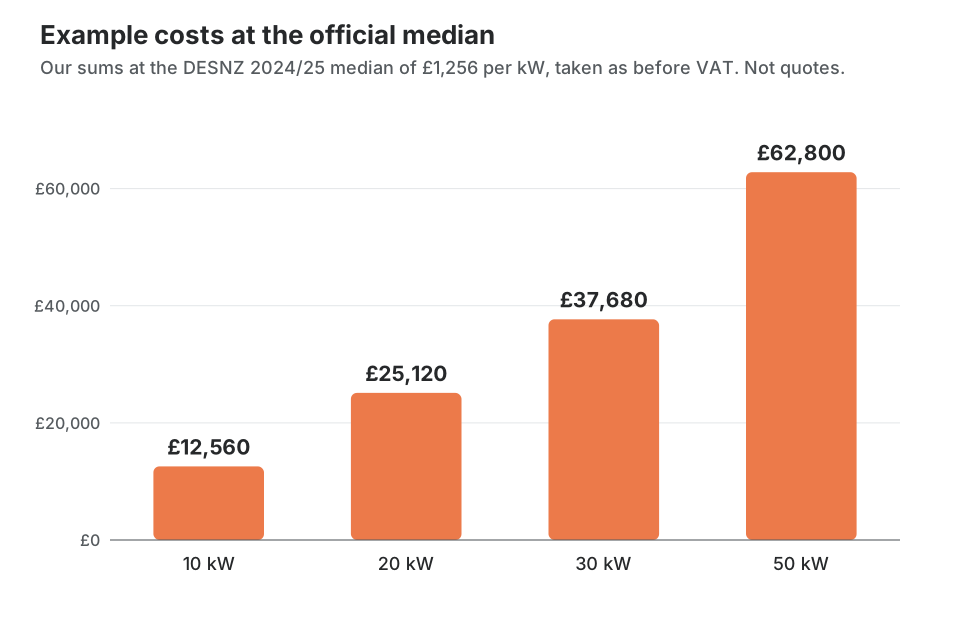
For four common sizes, that gives these example sums, not quotes or SolarSave prices:
| System size | Example cost before VAT | Output in an average year | Worth if all used on site |
|---|---|---|---|
| 10 kW | £12,560 | about 8,900 kWh | about £2,180 |
| 20 kW | £25,120 | about 17,800 kWh | about £4,360 |
| 30 kW | £37,680 | about 26,700 kWh | about £6,540 |
| 50 kW | £62,800 | about 44,500 kWh | about £10,900 |
Output uses about 890 kWh per kW a year (see sizing a system). Value uses 24.51p per kWh, the April to June 2026 average for firms.
VAT. DESNZ doesn't say whether its medians include VAT, so our examples treat them as prices before VAT. Firms usually pay 20% VAT on top, reclaimable if VAT registered. If yours isn't, 30 kW costs about £45,200, but your power bill carries VAT too, so the payback is much the same.
Why bigger systems cost less per kW
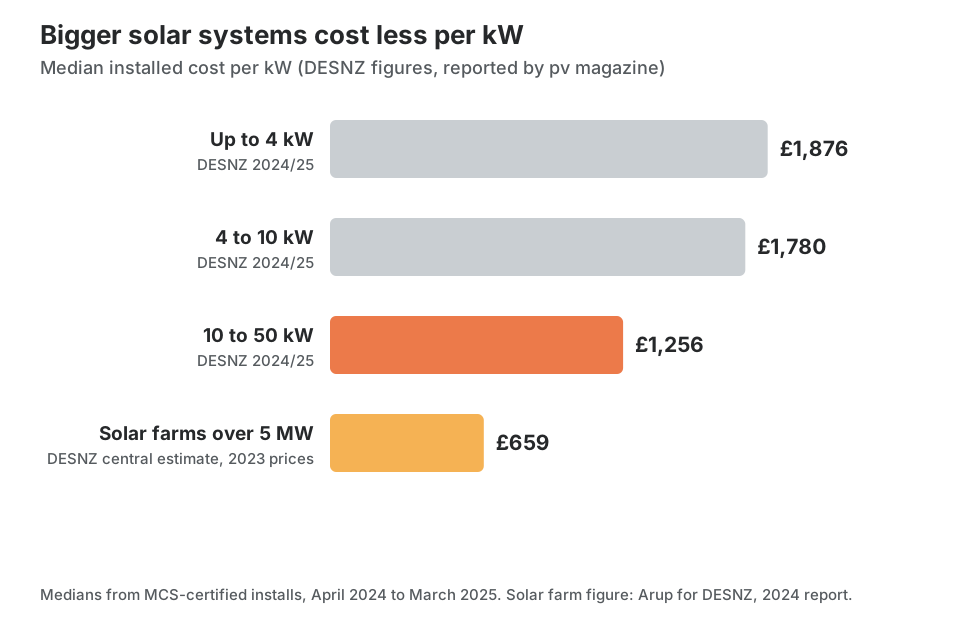
The price per kW falls as systems get bigger. DESNZ's medians drop from £1,876 per kW up to 4 kW to £1,256 for 10 to 50 kW. A report for DESNZ put solar farms over 5 MW at about £659 per kWp in its central case, in 2023 prices.
Fixed costs, such as design and paperwork, are shared across more panels. Home prices are on our solar panel cost page.
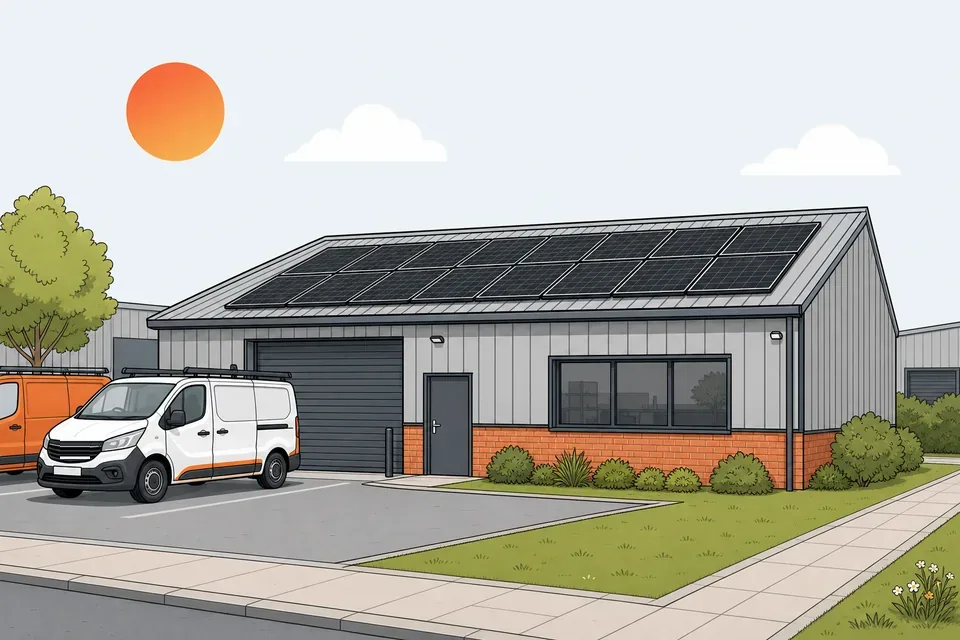
Every quote should be built for your commercial property. Ask any commercial solar company to break the price down, and check it covers:
- the panels, inverters, rails, fixings and other equipment
- scaffolding and edge protection
- the electrical work and a meter that records what the panels make
- the application to your network operator
- commissioning, certificates and a handover pack
- whether VAT is included in the figure
How long does commercial solar take to pay back?
In our worked example, about 6 to 8 years. How fast commercial solar in the UK typically pays back depends on the price per kW, the power the panels make and how much of it you use yourself.
The sum is simple: payback in years = cost ÷ yearly saving. The saving is the power you use times your unit price, plus the power you sell times the rate you're paid.
A worked example: a 30 kW workshop system
An example from official figures, not a quote:
- Cost: 30 kW at £1,256 per kW is £37,680 before VAT, for a firm that reclaims the VAT.
- Output: about 26,700 kWh in an average year, from 24,200 kWh in a dull year like 2024 to 29,200 kWh in a sunny one like 2025.
- Used on site: 80%, or about 21,340 kWh, saving 24.51p each. That's £5,230 a year.
- Sold: the other 20%, about 5,330 kWh, at an assumed 5p each. That's £267 a year.
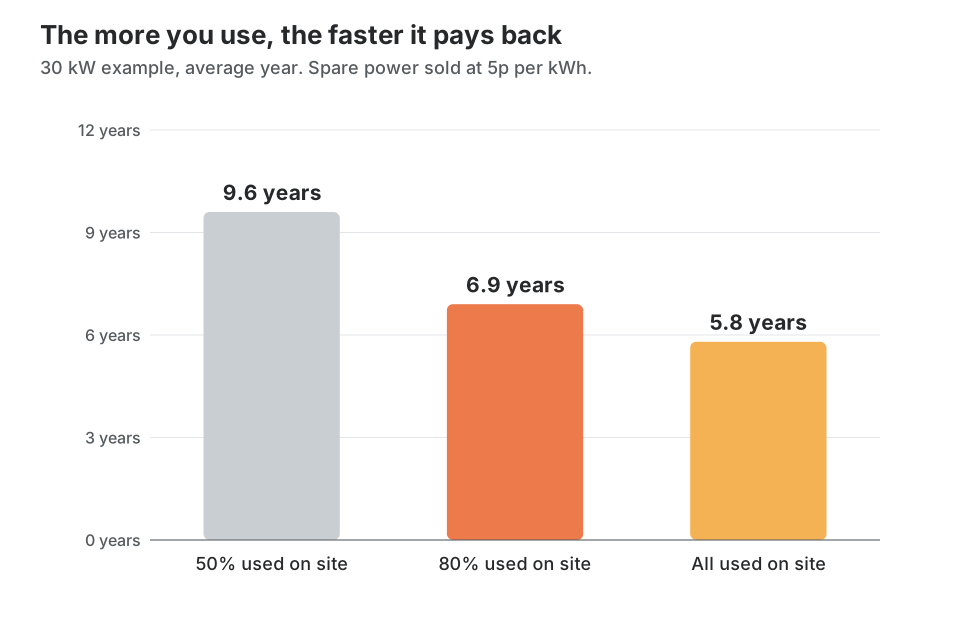
- Payback: about £5,500 saved a year, so 6.9 years (6.3 in a sunny year, 7.6 in a dull one).
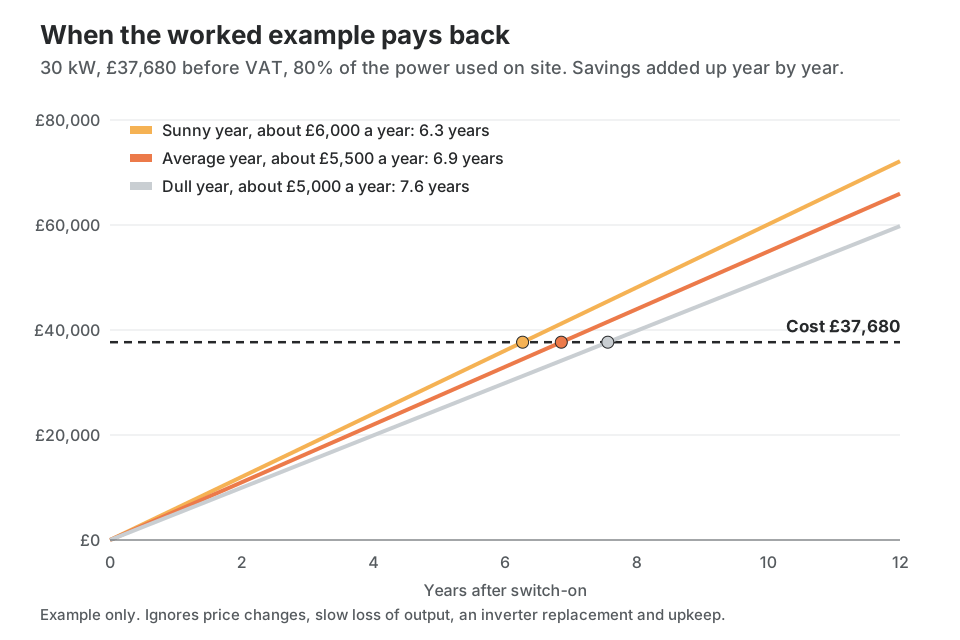
The example leaves out price changes, the slow loss of output, an inverter replacement, cleaning and insurance.
Using more of the power yourself gives the most rapid payback. With half the power used on site, the same system takes 9.6 years. With all of it used, 5.8 years.
Want figures for your own premises?
Tell us about your building and how you use power, and we'll send a written quote with the full price. No pressure to sign.
Or call 0333 577 6576, Monday to Friday, 9am to 5pm. We'll only use your details for your quote. Privacy policy
How much can solar panels save your firm?
Each kWh you use from your own panels saves what you'd have paid for it. For the average firm in April to June 2026, that was 24.51p per kWh, including the Climate Change Levy, says DESNZ.
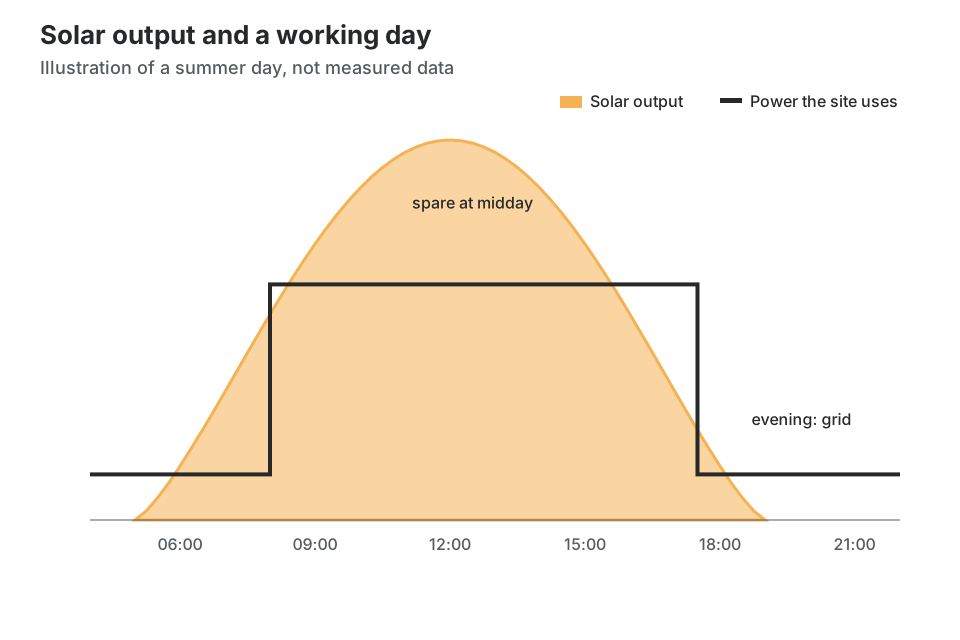
Commercial solar panels generate energy from daylight, most of it around midday. They harness energy from the sun, a clean, renewable source. Most firms are open while panels generate this power, so they can use it as it's made.
Examples:
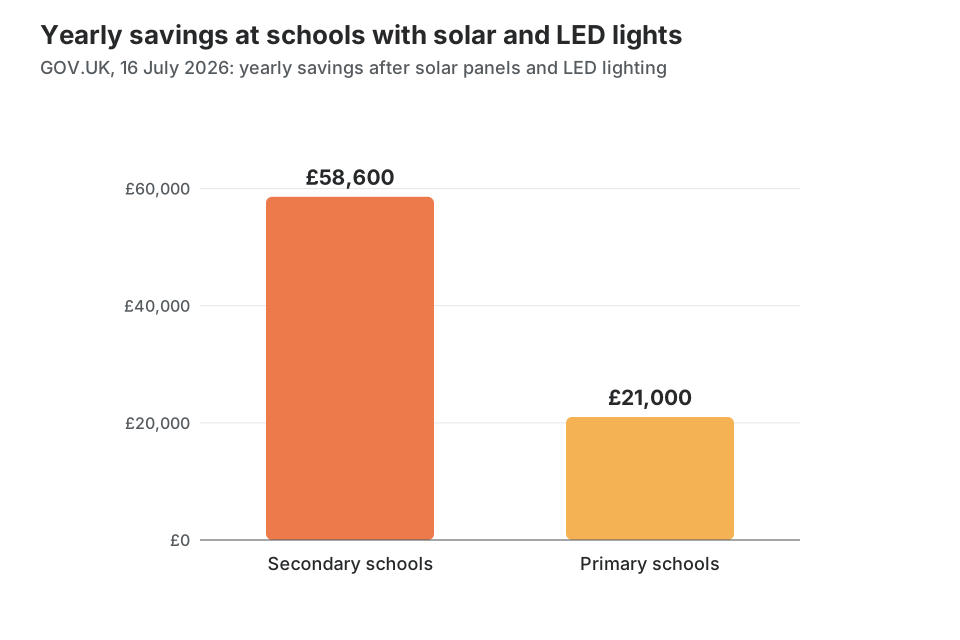
- Schools. GOV.UK says secondary schools that have had solar panels fitted and their lights upgraded to LED are saving £58,600 a year, and primaries £21,000. That includes the lighting.
- Warehouses. An industry estimate quoted in the government's Solar Roadmap says solar could cut a warehouse's annual power costs by 40% to 80%.
- Vans and cars. Daytime EV charging uses more of your solar power on site, where it's worth the most.
Getting paid for the power you don't use
A firm can be paid for spare power under the Smart Export Guarantee (SEG). Ofgem's rules cover systems up to 5 MW, and every rate must be above zero. Suppliers set their own rates.
To qualify, Ofgem's guidance says:
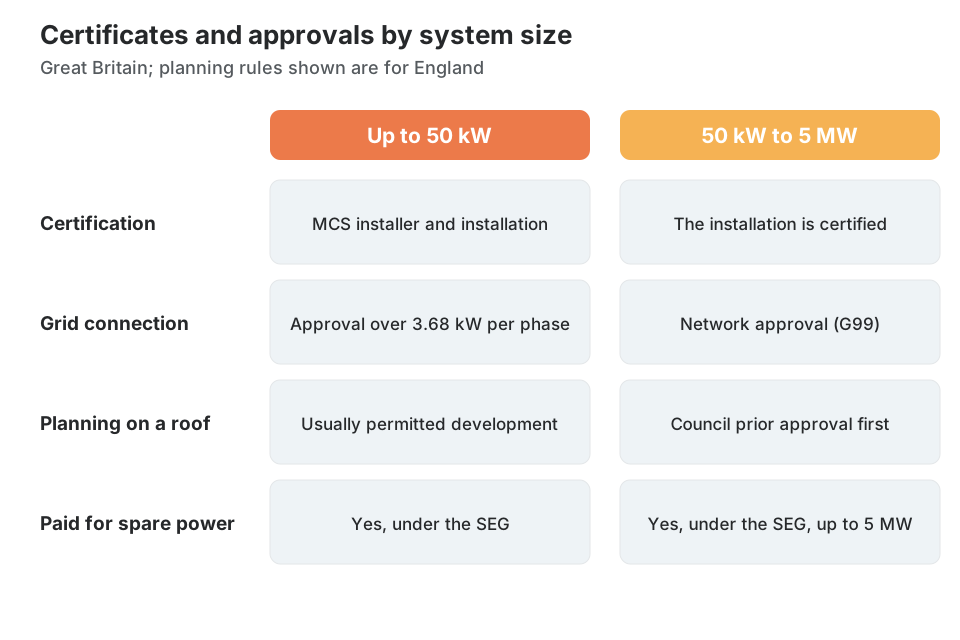
- up to 50 kW, both the system and whoever fits it need MCS certification or an equivalent
- from 50 kW to 5 MW, only the system itself needs certifying
- your meter must take half-hourly readings and be registered for the power you send out
Rates are low next to what you pay. On 16 November 2026, E.ON Next offered 8.5p per kWh on a 12-month business tariff for systems up to 5 MW, and 6p on a variable tariff. VoltX paid 3.02p.
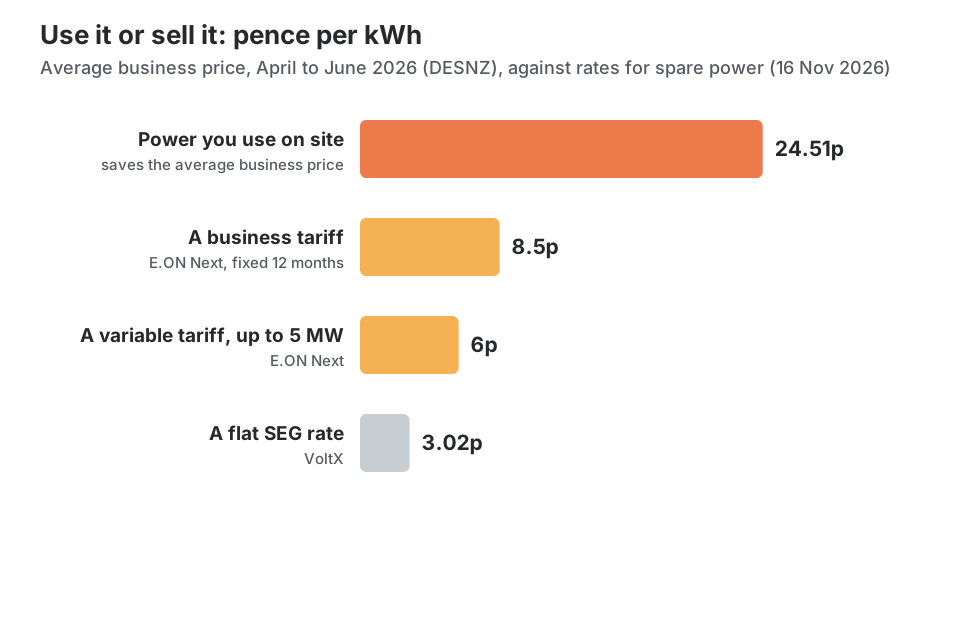
So sizing to your own use matters more than selling. Our guide to the SEG explains how payments work, and the best SEG tariffs compares rates for homes.
Tax relief, VAT and rates
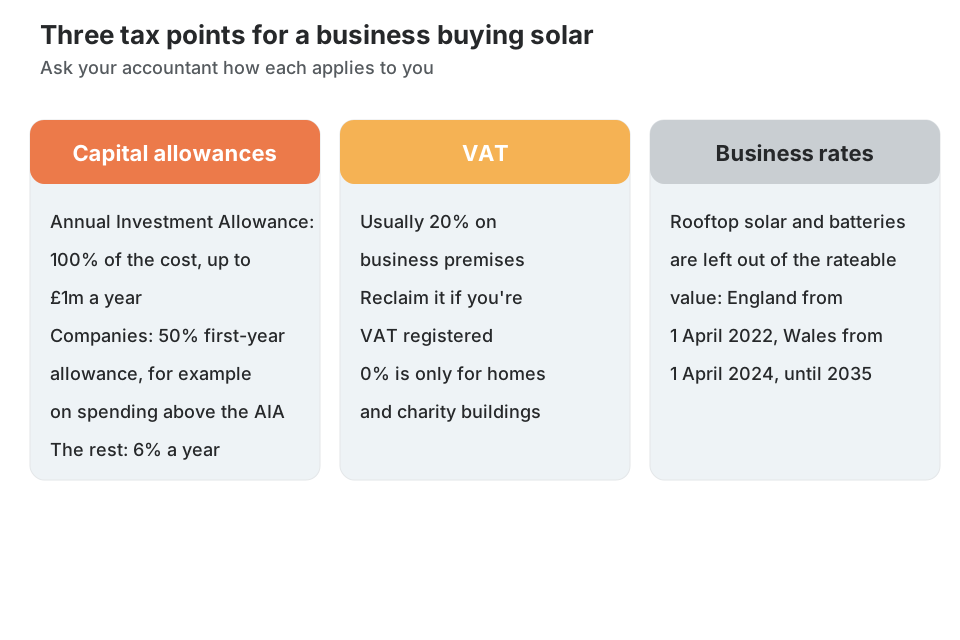
Three tax rules change the real cost. Ask your accountant how each applies to you.
Capital allowances
HMRC treats spending on solar panels as special rate spending for capital allowances. Many firms can use the Annual Investment Allowance (AIA) to deduct 100% of the cost from profits, on up to £1 million of spending a year.
Companies can also claim a 50% first-year allowance on new and unused panels, for example on spending above the AIA. Whatever isn't covered goes into the special rate pool, which gets 6% a year. Our guide to capital allowances on solar panels has worked examples.
Compare like with like, though. A lower energy bill raises your taxable profit, because heating and lighting are allowable costs of business premises.
If the AIA covers the whole cost, relief cuts the cost and tax trims the saving at the same rate. So our example still pays back in about 6.9 years. The relief mainly helps cash flow in year one.
VAT at the standard rate
The 0% VAT rate on solar panels is only for homes and buildings used solely for a relevant charitable purpose, until 31 March 2027. Business premises usually pay the standard rate of 20%. If you're VAT registered, you can reclaim VAT on items you buy for use in your business (see VAT on solar panels).
Business rates
In England and Wales, plant that generates or stores power from solar is left out of a property's rateable value until 1 April 2035. That began on 1 April 2022 in England and 1 April 2024 in Wales, says the VOA.
What size system does your firm need?
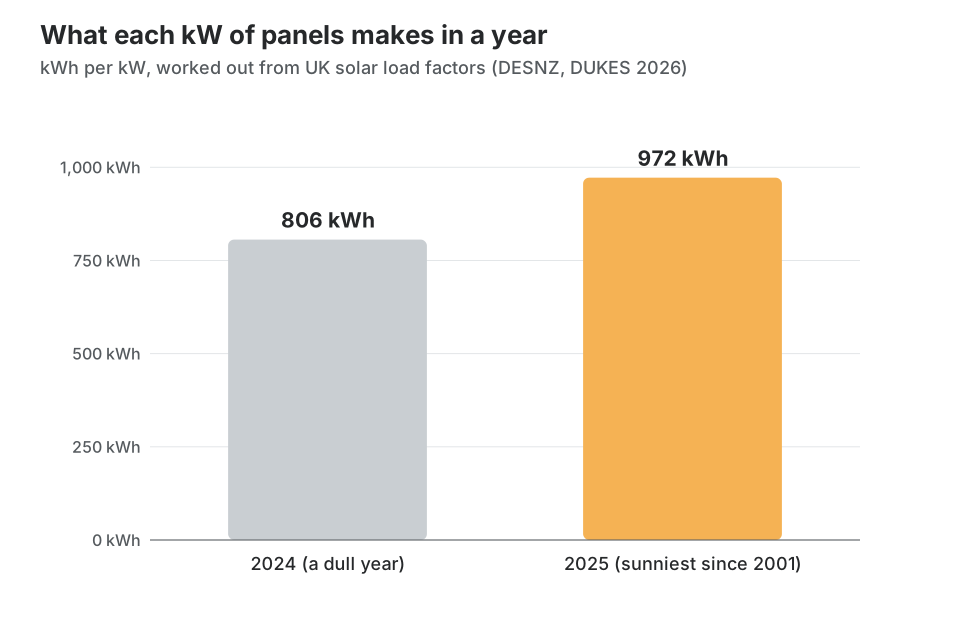
Size it to the power you use in daylight hours, not your whole bill. Each kW of panels makes roughly 800 to 970 kWh a year in the UK.
The figures come from DESNZ's solar load factors: 9.2% in 2024 and 11.1% in 2025, the sunniest year since its records began in 2001. Your roof's direction, tilt and shade change the figure, so ask for an estimate for your own roof space.
A simple way to find a starting size:
- Get your data. Ask your supplier for a year of half-hourly meter readings.
- Add up your daytime use. Count the kWh you use in daylight hours.
- Divide by about 890. That gives a starting size in kW for an average year.
- Check the space. In England, planning rules keep panels on non-domestic premises at least 1 m from the edge.
- Allow for change. Electric vans or new machinery add daytime use.
Certification and grid approval
Systems up to 50 kW
MCS's installation standard covers systems up to 50 kWp. Choose an MCS-certified installer, so you can be paid under the SEG (see our MCS certificate guide). Anything over 3.68 kW per phase comes under G99, says the Energy Networks Association, so you apply to the network operator before it's connected.
G99 has a fast track for small-scale generation. Every unit, batteries included, must connect through fully type-tested inverters, within a total of 32 A or 60 A per phase (about 41 kW on a three-phase supply). The planned switch-on date must then be 10 working days to three months after you apply.
Systems over 50 kW
A system this size is usually past the fast-track limits, so it needs a full G99 application to the network operator. How long consent takes varies with the operator and local grid capacity, so allow for it.
Is battery storage worth adding?
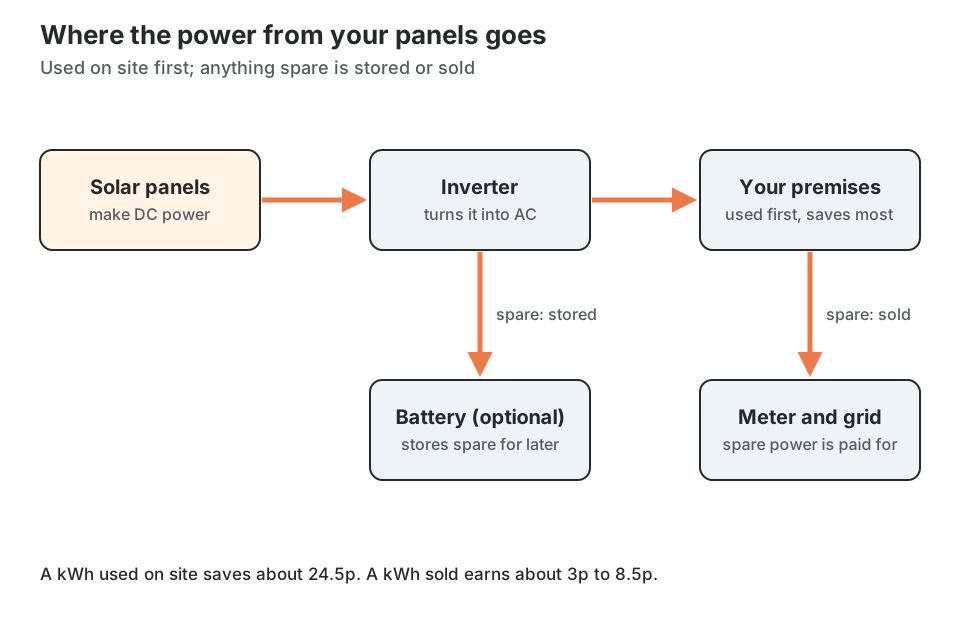
Only if you'd otherwise sell a lot of spare power cheaply. A battery stores midday surplus for later, so each stored kWh saves about 24.5p instead of earning 3p to 8.5p.
Panels make DC electricity, and an inverter turns it into the AC your site uses.
Battery storage tends to help when:
- you close before the evening, or open early, so midday power would otherwise be sold
- you're shut at weekends, when the panels still make power
- you're on a tariff with cheaper and dearer times of day
It adds little if you already use nearly all the power as it's made. Our solar battery cost page shows what home batteries cost per kWh.
Is your roof suitable for solar panels?
Most sound, unshaded commercial rooftop areas are suitable. Check the structure, the lease and the planning rules first.
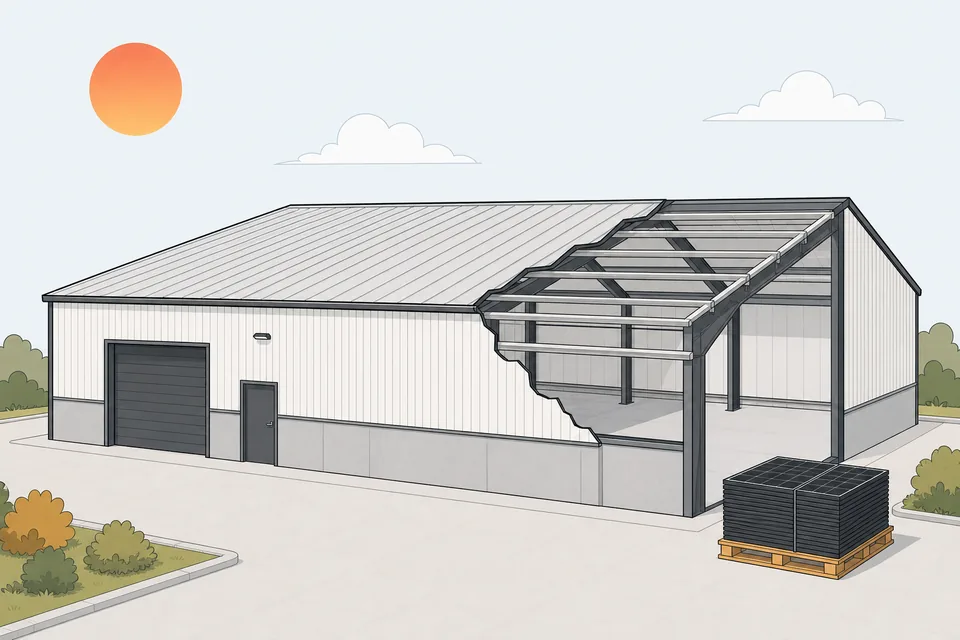
- Structure. MCS's standard says a competent person must check a pitched roof can take the extra load. For a ballasted system on a flat roof, a qualified structural engineer must confirm it can take the panels and ballast.
- Condition. Panels last around 30 years when looked after, says the Energy Saving Trust. If the roofing needs replacing soon, do that first.
- Direction and shade. Trees, taller blocks and rooftop plant cut output. Higher-efficiency panels fit more kW into the same space.
On planning, rooftop panels on non-domestic premises in England are usually permitted development. They can stand no more than 0.2 m proud of a pitched roof, or 1 m above a flat one.
Above 50 kW, the legal limit for microgeneration, they need the council's prior approval on design and appearance, especially glare. A listed property or scheduled monument needs consent instead. Our planning permission guide covers the rules for homes.
If you rent your premises
Many commercial properties are leased, so talk to your landlord first. The government's Solar Roadmap notes most commercial leases put repairing duties on tenants, and complex lease terms can hold back rooftop solar. Agree in writing who owns the panels, who maintains them and what happens when the lease ends.
For farms, our guide to agricultural solar panels covers land, grants and which sheds to use.
How a commercial solar installation works
A typical project has six steps. Network approval usually sets the pace of the process.
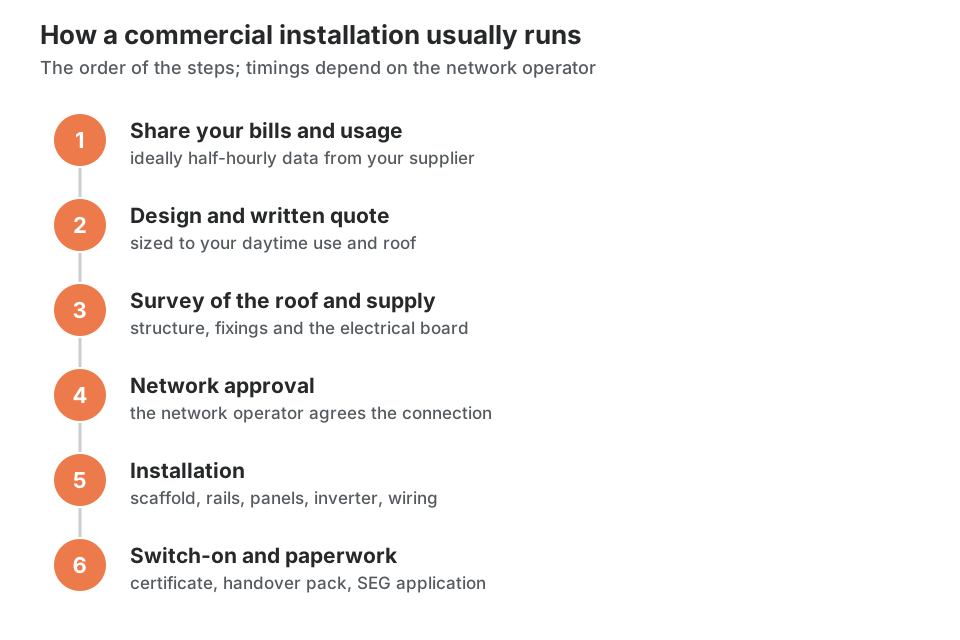
- Share your bills and usage. Half-hourly data shows when you use power.
- Design and written quote. Sized to your daytime use and space.
- Survey. The structure, fixings and electrical board are checked.
- Network approval. An application to your network operator under G99.
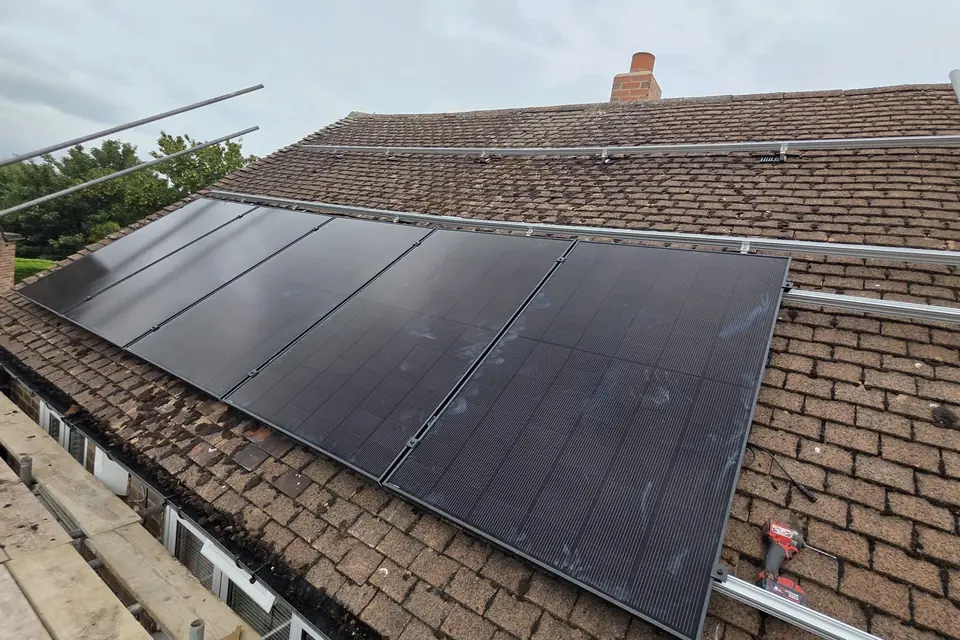
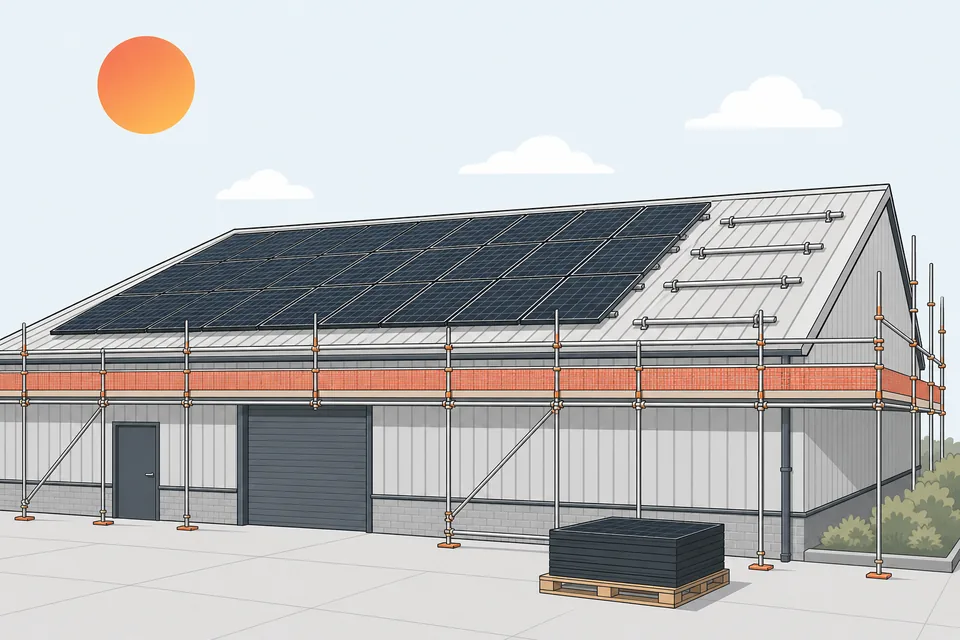
- Installation. Scaffold, rails, panels, inverter and wiring.
- Switch-on and paperwork. Commissioning, certificates, the handover pack and your SEG application.
There are no off-the-shelf solar solutions here. We fit bespoke commercial solar installations that are designed around when your site uses power, within 100 miles of Doncaster. We're MCS certified, and members of RECC and NAPIT. Ask for a free quote, or contact us with your questions.
Running costs, maintenance and energy monitoring
Running costs are low but not zero. Budget for these:
- An inverter replacement. The Energy Saving Trust says inverters typically need replacing every 10 to 15 years.
- Checks and cleaning. The Trust suggests checking panels every 12 to 18 months and cleaning them if there's visible dirt, with a full professional service every three to five years.
- Insurance. Tell your insurer before work starts, and check the panels are covered.
- Monitoring. An app or meter shows daily output, so you spot a fault quickly. Ask what aftercare and support come with the system.
Ask for the panels' product and performance warranties in writing with your quote. Our guide on how long solar panels last explains how slowly output falls.
In short: size commercial solar to the power you use in daylight. Our 30 kW example pays back in 6 to 8 years.
Questions people ask
How much does a 50 kW system cost?
About £62,800 before VAT, at the DESNZ median of £1,256 per kW for 10 to 50 kW systems in 2024/25. That's an example, not a quote. The building, access and grid connection all change the price.
What payback period should a firm expect?
In our worked example, 6 to 8 years for a VAT-registered firm, with 80% of the power used on site. If only half is used on site, it stretches to about 9.6 years.
Can a limited company claim the cost against tax?
Usually, yes. HMRC treats solar panels as special rate spending. A company can use the £1 million Annual Investment Allowance, or a 50% first-year allowance on new panels. Check with your accountant.
Do businesses pay VAT on solar panels?
Usually, at 20%. The 0% rate is only for homes and some charity property. If you're VAT registered, you can normally reclaim it.
Can the panels generate electricity for EV chargers?
Yes. Charging vans or cars in the day uses more of the power on site, where each kWh is worth about 24.5p rather than 3p to 8.5p sold.
Do we need planning permission?
Usually not for rooftop panels on non-domestic premises in England, within the permitted development limits. Above 50 kW you need the council's prior approval first. A listed property needs consent.
About this guide
Written by the SolarSave team in Retford: MCS certified installers, led by a founder in solar since 2010. We checked every figure against DESNZ, Ofgem, HMRC, the Valuation Office Agency, GOV.UK, legislation.gov.uk, MCS, the Energy Saving Trust and two suppliers' published rates on 16 November 2026. Prices, tax rules and rates for spare power change, so check them before you decide.
The 29 sources we checked
- DESNZ: Solar PV cost data (2025/26 edition), updated 28 May 2026, checked 16 November 2026
- pv magazine: UK small-scale solar costs tumble (DESNZ medians for 2024/25), June 2025, checked 16 November 2026
- pv magazine: UK hits 22.3 GW solar capacity as cost per kW falls (DESNZ data for 2025/26), 4 June 2026, checked 16 November 2026
- DESNZ (Arup): Renewable energy generation cost and technical assumptions 2024, onshore wind and solar PV, 14 July 2025, checked 16 November 2026
- DESNZ: Quarterly Energy Prices, September 2026 (non-domestic prices), 29 September 2026, checked 16 November 2026
- DESNZ: Digest of UK Energy Statistics 2026, chapter 6 (solar load factors), 2026, checked 16 November 2026
- DESNZ: Solar Roadmap, United Kingdom powered by solar, 30 June 2025, checked 16 November 2026
- GOV.UK: Hundreds more schools to save on bills as government solar drive slashes millions off energy costs, 16 July 2026, checked 16 November 2026
- Ofgem: Smart Export Guarantee, guidance for generators, December 2019, checked 16 November 2026
- Ofgem: Smart Export Guarantee, information for generators, checked 16 November 2026
- E.ON Next: Smart Export Guarantee tariffs (business and variable rates), checked 16 November 2026
- VoltX Power: SEG tariff, checked 16 November 2026
- HMRC Capital Allowances Manual: CA22335, solar panels are special rate, updated 8 July 2025, checked 16 November 2026
- GOV.UK: Work out capital allowances, rates and pools, updated 30 September 2026, checked 16 November 2026
- GOV.UK: Capital allowances, Annual Investment Allowance, checked 16 November 2026
- GOV.UK: Check if you can claim full expensing or 50% first-year allowances, updated 30 September 2026, checked 16 November 2026
- GOV.UK: Expenses if you're self-employed, office, property and equipment, checked 16 November 2026
- HMRC: VAT on energy-saving materials and heating equipment (Notice 708/6), last updated 31 January 2024, checked 16 November 2026
- GOV.UK: VAT rates, checked 16 November 2026
- GOV.UK: Reclaim VAT on business expenses, checked 16 November 2026
- HMRC: VAT on fuel and power (Notice 701/19), last updated 28 October 2026, checked 16 November 2026
- DESNZ (BEIS): Industrial price statistics, data sources and methodologies (prices exclude VAT), September 2017, checked 16 November 2026
- Valuation Office Agency: Rating Manual, valuation of plant and machinery (renewables exception), updated 21 September 2026, checked 16 November 2026
- legislation.gov.uk: Explanatory memorandum to S.I. 2022/405 (business rates exemption for onsite renewables), 2022, checked 16 November 2026
- Energy Networks Association: Connecting generation to the electricity networks, checked 16 November 2026
- MCS: MIS 3002 Solar PV installation standard, issue 1.0, checked 16 November 2026
- legislation.gov.uk: GPDO 2015, Part 14 Class J (solar on non-domestic premises), latest change 9 April 2026, checked 16 November 2026
- legislation.gov.uk: Energy Act 2004, section 82 (microgeneration: up to 50 kilowatts), checked 16 November 2026
- Energy Saving Trust: How to clean and maintain solar panels, updated 1 October 2026, checked 16 November 2026