

The short answer
Each unit the business uses itself
24.5p
saved, at the average business price for April to June 2026
A spare unit sold earns 6p to 8.5p on E.ON Next's export rates.
Grants for solar on farms in England
None open
on GOV.UK's funding list, updated 1 October 2026
The last one, worth £15,000 to £100,000, has closed.
UK land used by solar
0.1%
today, and up to 0.4% in future
From the government's Solar Roadmap. Barn roofs use none.
From DESNZ, GOV.UK, E.ON Next and the Solar Roadmap, checked 16 November 2026.
Are solar panels worth it for a farm?
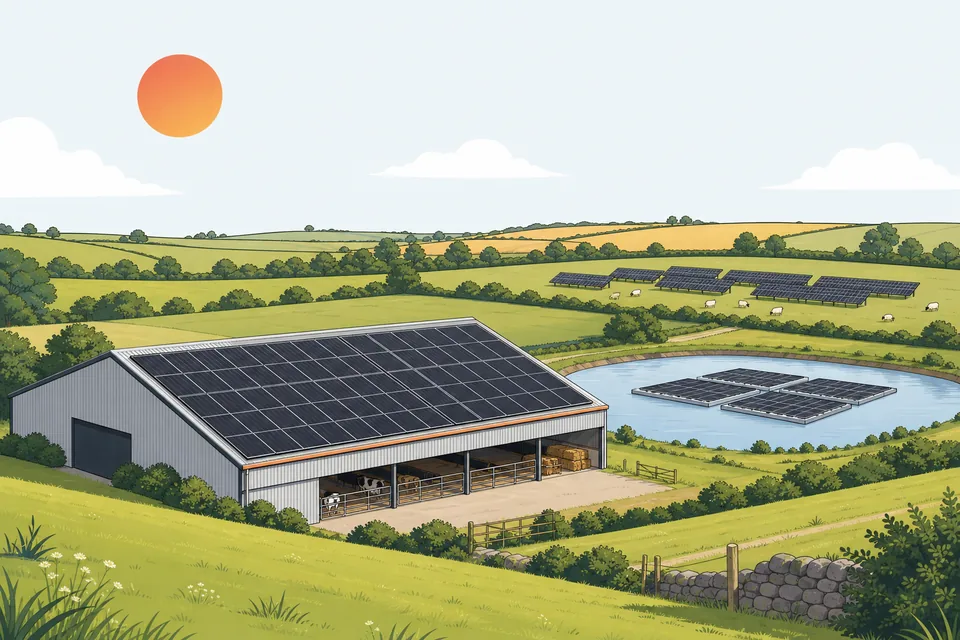
Usually, if the business uses most of the power while the sun is up. Agricultural PV means photovoltaic modules on barn roofs, on irrigation reservoirs or on land, making electricity for a farming business.
Three numbers decide it:
- Cost. A 10 to 50 kW system cost a median £1,256 per kW in 2024/25, on DESNZ figures reported by pv magazine. DESNZ's 2025/26 data put that median about 3% lower after inflation. DESNZ's release page doesn't say whether this includes VAT; the series did when it began in 2013. An example, not our price.
- Output. Each kW makes roughly 800 to 970 kWh a year in the UK, on DESNZ figures for 2024 and 2025.
- Use on site. Each unit (kWh) you use saves about 24.5p; one you sell earns far less.
Panels generate clean energy with no fuel to buy, so each unit used on site means reduced energy costs. That adds resilience when milk and crop prices swing.
For a 30 kW business example, see our commercial solar costs guide.
Matching output to the energy you use
Solar makes most in spring and summer, and only in daylight. In 2025, April to June gave 8.4 TWh of the UK's record 20.1 TWh of solar, about 42%. October to December gave just 2.1 TWh.
| Load | When it runs | Match |
|---|---|---|
| Cold stores and packhouses | All day, more in warm weather | Very good |
| Irrigation pumps | Dry, sunny spells | Very good |
| Milk cooling and vacuum pumps | After each milking | Good, except at dawn |
| Grain drying | Harvest, from late summer | Fair |
| Farmhouse and holiday lets | Mornings and evenings | Weak without a battery |
On dairy units, AHDB says milk cooling, water heating and vacuum pumping use over 80% of the energy. In one Welsh project, milk cooling alone took 38%. That makes the refrigeration of agricultural products a natural load.
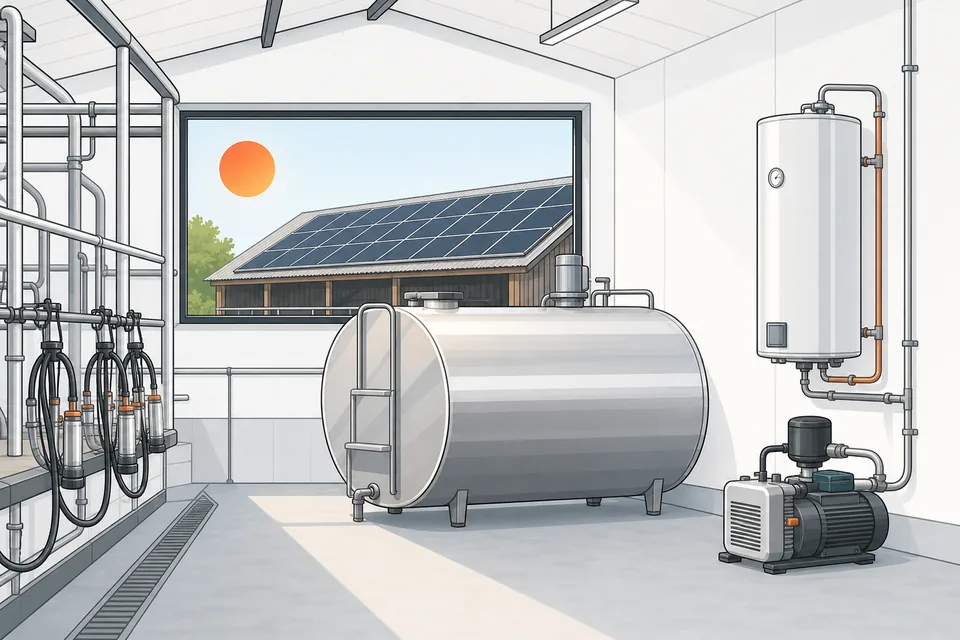
Solar irrigation suits too: pumps work hardest in dry, sunny spells, so daytime power can aid irrigation when crops need it most.
Working out how big to go
- Get your data. Ask your supplier for a year of half-hourly meter readings.
- Add up daytime use. Count the units you use in daylight.
- Divide by about 890. That's a starting size in kW, our midpoint of DESNZ's 806 and 972 kWh per kW.
- Check the summer, roof and grid. Big June surpluses suggest going smaller or adding storage.
A worked example
An example from official figures, not a quote. A holding uses 45,000 kWh a year in daylight across its dairy and workshop operations. That suggests about 50 kW, which at £1,256 per kW (the 2024/25 median) is £62,800.
We've assumed 80% is used on site at 24.51p and the rest sold at 6p. That saves about £9,260 a year, a payback of roughly 6.8 years. Sizing to a year's daytime use leaves summer surpluses, though. At 60% used on site, it's about £7,610 a year and 8.3 years. Both ignore tax relief, price changes and inverter replacement.
Want figures for your own holding?
Tell us about your buildings and power use. We'll send a written quote with the full price. No pressure to sign.
Or call 0333 577 6576, Monday to Friday, 9am to 5pm. We'll only use your details for your quote. Privacy policy
Which grants and schemes are open now?
None for solar in England on 16 November 2026, on GOV.UK's funding list for farmers (updated 1 October 2026).
| Scheme | Status | Covers PV? |
|---|---|---|
| Improving Farm Productivity, round 2 | Closed | Yes: £15,000 to £100,000 for rooftop or reservoir solar PV |
| Farming Equipment and Technology Fund 2026 | Closed 12 May 2026 | Not listed |
| Sustainable Farming Incentive (SFI26) | Closed 22 September 2026 | Not listed |
| Smart Export Guarantee | Open | Pays for spare power |
That grant covered panels, batteries, inverters, meters and grid connections, but not ground arrays.
Grant rounds have given farmers short windows: GOV.UK announced that round's online checker on 25 January 2024 and closed it on 21 March. Watch its funding page for a new one. For the farmhouse, see solar panel grants for homes.
Solar farming: land use and leases
Solar covers 0.1% of UK land today, and up to 0.4% may be needed, says the Solar Roadmap. Defra's Land Use Framework expects renewables to use about 2% of England's utilised agricultural area by 2035.
The Framework also aims to safeguard the best and most versatile land (grades 1, 2 and 3a), which developers must justify using.
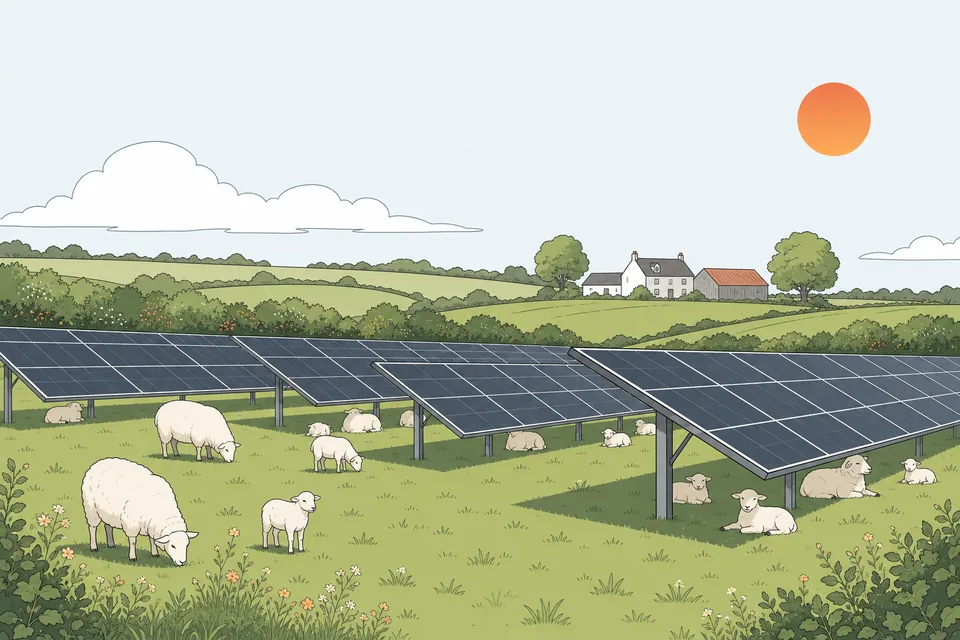
You can put your own ground-mounted array on a field, which usually needs planning permission. Or lease it to a developer, who builds a solar farm and pays rent. In the Solar Roadmap's case study, a Norfolk family let about 20 acres for a 3.6 MW site and graze 40 ewes on it.
A lease can provide farmers with a potentially increased income flow, one that doesn't track crop prices. But it commits the land for its whole term and can affect inheritance tax, so take legal and financial advice first.
Renting? Talk to your landlord. Tenant farmers manage a third of England's farmland, says Defra.
Agrivoltaics: advanced solar technologies on working farmland
Agrivoltaics means farming and generating electricity on the same land. Defra describes agrivoltaic systems as installing solar panels above crops, with grazing as another way to farm alongside solar.
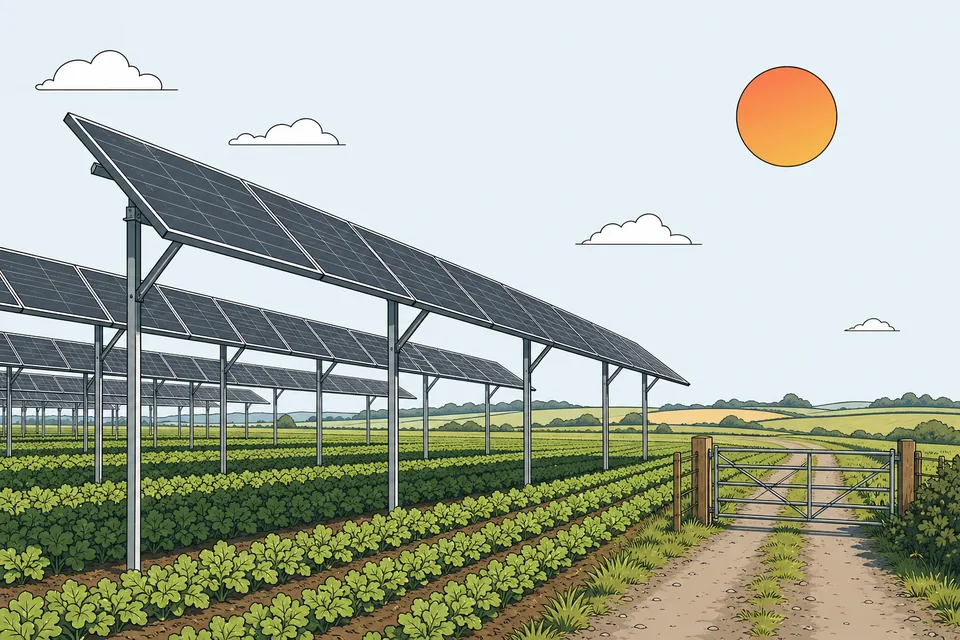
- Grazing. Many solar projects are designed for continued livestock grazing, says the Solar Roadmap.
- Raised arrays over crops. Mounting them high lets crops grow and machines pass underneath. Fraunhofer ISE says this can protect crops against hail, frost and drought damage in extreme weather conditions.
A 2025 University of Sheffield study found it could meet UK electricity demand more than four times over, with Lincolnshire among suitable areas. UK examples are still few, so treat raised arrays as specialist solutions, not a standard build.
Tax, VAT and business rates in agriculture
Capital allowances and VAT recovery can cut the real cost. Your own position decides the details, so check with HMRC or your accountant.
Capital allowances
HMRC treats all spending on solar panels as special rate spending. The Annual Investment Allowance (AIA) covers up to £1 million of spending a year (worked examples in our capital allowances guide).
Partnerships, sole traders and companies
- Sole traders can claim the AIA.
- Partnerships can claim it only if every partner is an individual.
- Companies paying Corporation Tax can also claim a 50% first-year allowance on new special rate equipment.
VAT. Agricultural buildings usually pay the standard 20%, which VAT-registered businesses can reclaim. The 0% rate covers residential accommodation, including self-catering holiday lets, until 31 March 2027, then 5%. So the farmhouse or a holiday cottage may qualify. See our VAT guide.
Business rates. Agricultural land and buildings are exempt in England. On other premises, such as a let workshop, onsite rooftop solar and battery storage are left out of rateable value until 31 March 2035.
Inheritance tax. Agricultural relief needs land occupied for agriculture, and HMRC restricts it where part of a property isn't. Land let for solar may lose it.
Do you need planning permission?
Not usually for a roof system on an agricultural building in England. A field array usually does.
- Roofs (Class J). Usually permitted development, unless the building is listed, sits in the grounds (curtilage) of a listed building or is on a scheduled monument. Our guide to solar on barns, sheds and stores has the limits.
- Over 50 kW. Above the legal limit for microgeneration, a roof system needs the council's prior approval.
- Land (Class K). One stand-alone array of up to 9 square metres in the grounds of a non-domestic building. Anything bigger needs a planning application.
The grants and planning rules here are England's; in Scotland, Wales or Northern Ireland, check your own government's. Our planning guide for homes covers the farmhouse.
Grid connection, selling spare power and storage
Over 3.68 kW per phase, your network operator must give permission before the system connects: see G98 vs G99, and our guide to solar on barns, sheds and stores for connecting a building.
Selling spare energy brings increased revenue under the Smart Export Guarantee, for systems up to 5 MW. Up to 50 kW, Ofgem says solar installations and their installer need MCS certification or an equivalent. From 50 kW to 5 MW, the installation must be suitably certified. Both need a half-hourly export meter. On 16 November 2026, E.ON Next paid businesses 8.5p a unit, fixed for 12 months.
Battery storage moves midday surplus into the evening, where each stored unit saves about 24.5p. It adds little if you use almost everything as it's made.
Barn roofs: a stable base for a solar project
For most farming businesses, a solar system on a sound barn roof is the simplest start. It uses no land and sits close to the loads, but check the structure first: our guide to solar panels on farm buildings covers that.
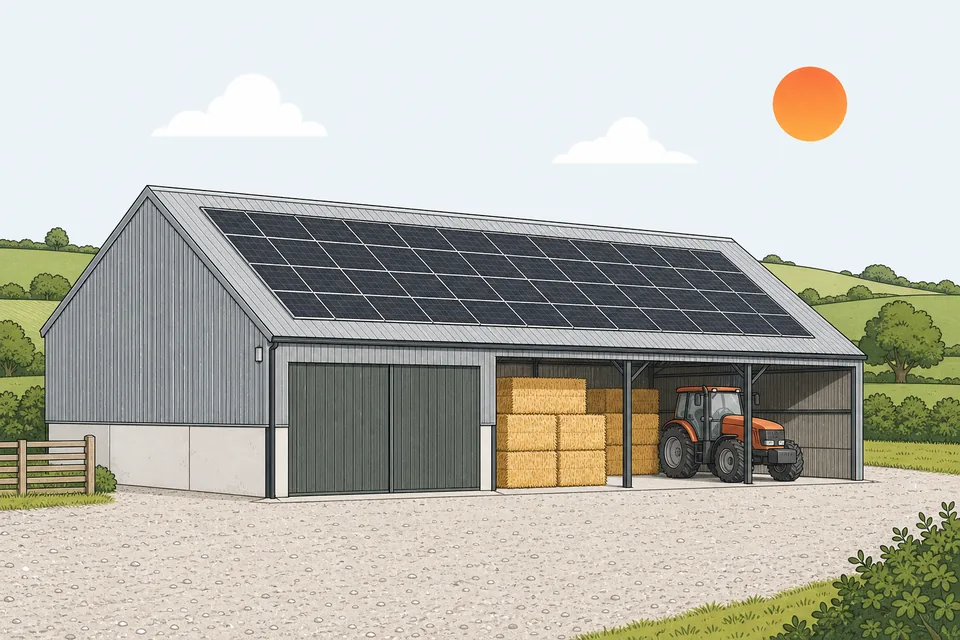
We fit panels on structurally sound agricultural buildings and business premises, within 100 miles of Doncaster. We design customised solar power systems around your buildings and power use. We're MCS certified, and members of RECC and NAPIT. Every installation starts with a free consultation: ask for a free quote or contact us.
Questions people ask
Can sheep graze under the panels?
Yes. The Solar Roadmap's Norfolk case study grazes 40 ewes and their lambs from April to October.
Do I need planning permission for PV in a field?
Usually yes, in England. Permitted development allows only one stand-alone array of up to 9 square metres in the grounds of a non-domestic building.
Will letting land for PV affect inheritance tax?
It can, because agricultural relief needs land occupied for agriculture. Take advice before you sign.
About this guide
Written by the SolarSave team in Retford: MCS certified installers, led by a founder in solar since 2010. We checked every figure and rule against GOV.UK, HMRC, Defra, DESNZ, Ofgem, legislation.gov.uk, AHDB, MCS, the Energy Networks Association, published research, an energy supplier's tariffs and trade press on 16 November 2026. Grants, tax rules and export rates change, so check them before you decide.
The 37 sources we checked
- GOV.UK: Funding for farmers, growers and land managers, updated 1 October 2026, checked 16 November 2026
- GOV.UK: Improving Farm Productivity grant round 2, applicant guidance (closed; online checker dates), updated 2 March 2026, checked 16 November 2026
- GOV.UK: Improving Farm Productivity grant round 2, who can apply and what the grant can pay for, updated 2 March 2026, checked 16 November 2026
- GOV.UK: Farming Equipment and Technology Fund (FETF) 2026, closed, 12 May 2026, checked 16 November 2026
- GOV.UK: SFI26 scheme rules and guidance, updated 23 September 2026, checked 16 November 2026
- DESNZ: Solar Roadmap, United Kingdom powered by solar, 30 June 2025, checked 16 November 2026
- Defra: The Land Use Framework for England, updated 6 May 2026, checked 16 November 2026
- GOV.UK: New plans to reshape how we protect and manage our land, 18 March 2026, checked 16 November 2026
- University of Sheffield: Solar technology could meet UK's electricity needs without sacrificing farmland, 26 February 2025, checked 16 November 2026
- Fraunhofer ISE: Dual yield on arable land, guideline for agrivoltaics published, 2021, checked 16 November 2026
- AHDB: Improving energy efficiency on dairy farms, checked 16 November 2026
- AHDB: Understand when and how you use energy, checked 16 November 2026
- DESNZ: Energy Trends March 2026 (solar generation in 2025), 2 April 2026, checked 16 November 2026
- DESNZ: Energy Trends June 2026 (record quarter for solar), 29 September 2026, checked 16 November 2026
- DESNZ: Digest of UK Energy Statistics 2026, chapter 6 (solar generation in 2025 and load factors), 2026, checked 16 November 2026
- DESNZ: Quarterly Energy Prices, September 2026 (non-domestic electricity prices), 29 September 2026, checked 16 November 2026
- pv magazine: UK small-scale solar costs tumble (DESNZ medians for 2024/25), June 2025, checked 16 November 2026
- DESNZ: Solar PV cost data (2025/26 edition, from the MCS Installation Database), updated 28 May 2026, checked 16 November 2026
- pv magazine: UK hits 22.3 GW solar capacity as cost per kW falls (DESNZ data for 2025/26), 4 June 2026, checked 16 November 2026
- DECC: Small scale solar PV cost data (how the series began, costs including VAT), December 2013, checked 16 November 2026
- E.ON Next: Smart Export Guarantee tariffs (business and variable rates), checked 16 November 2026
- Ofgem: Smart Export Guarantee, information for generators, checked 16 November 2026
- Ofgem: Smart Export Guarantee, guidance for generators, December 2019, checked 16 November 2026
- MCS: Notifying DNOs (G98 and G99), updated 14 July 2026, checked 16 November 2026
- Energy Networks Association: Connecting generation to the electricity networks, checked 16 November 2026
- HMRC Capital Allowances Manual: CA22335, solar panels are special rate, updated 8 July 2025, checked 16 November 2026
- GOV.UK: Capital allowances, Annual Investment Allowance, checked 16 November 2026
- GOV.UK: Check if you can claim full expensing or 50% first-year allowances, updated 30 September 2026, checked 16 November 2026
- HMRC: VAT on energy-saving materials and heating equipment (Notice 708/6), last updated 31 January 2024, checked 16 November 2026
- GOV.UK: VAT rates, checked 16 November 2026
- GOV.UK: Reclaim VAT on business expenses, checked 16 November 2026
- GOV.UK: Business rates relief, exempted buildings, checked 16 November 2026
- legislation.gov.uk: Explanatory memorandum to S.I. 2022/405 (business rates exemption for onsite renewables), 2022, checked 16 November 2026
- HMRC Inheritance Tax Manual: IHTM24060, agricultural purposes, updated 7 April 2026, checked 16 November 2026
- legislation.gov.uk: GPDO 2015, Part 14 Class J (solar on non-domestic premises), latest change 9 April 2026, checked 16 November 2026
- legislation.gov.uk: GPDO 2015, Part 14 Class K (stand-alone solar on non-domestic premises), latest change 21 December 2023, checked 16 November 2026
- legislation.gov.uk: Energy Act 2004, section 82 (microgeneration: up to 50 kilowatts), checked 16 November 2026