

In short
- Solar panels are special rate assets, not main pool, since April 2012.
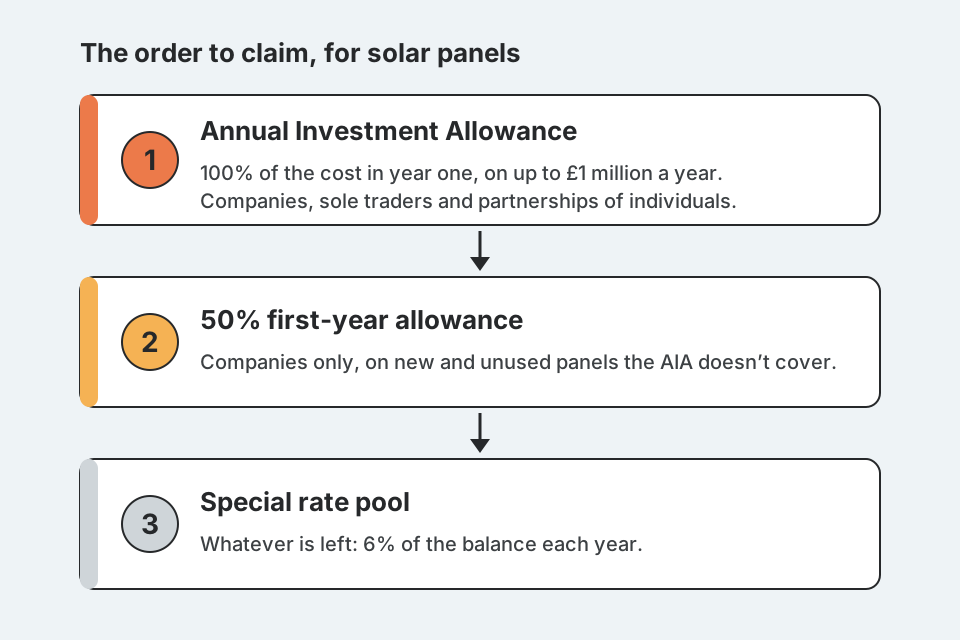
- The AIA gives 100% relief on up to £1 million of spending a year, for companies, sole traders and partnerships of individuals.
- Full expensing doesn't cover them. Companies can claim a 50% first-year allowance on new panels instead.
- Anything left goes into the special rate pool at 6% a year.
- Example: through the AIA, £10,000 of panels saves a company paying 25% Corporation Tax £2,500 in year one.
- Sole traders on the cash basis, and landlords of let homes, usually can't claim.
| Allowance | What it gives | Who can claim | Solar panels? |
|---|---|---|---|
| AIA | 100% in year one, on up to £1 million a year | Companies, sole traders and partnerships of individuals | Yes |
| 50% first-year allowance | 50% in year one; the rest at 6% a year | Companies only, on new and unused panels | Yes |
| Full expensing | 100% in year one, with no limit | Companies only | No: main rate assets only |
| Main rate first-year allowance | 40% in year one (50% from 1 January 2027, announced) | All businesses | No: main rate assets only |
| Writing-down allowance, special rate pool | 6% of the pool balance each year | Any business that can claim | Yes, for anything left over |
How capital allowances on solar panels work
Capital allowances are how the tax system provides tax incentives for businesses investing in equipment. They let you deduct some or all of the cost from your profits before tax. They aren't grants: nobody pays you money, you just pay less tax.
Solar panels count as plant and machinery, the tax name for equipment you keep and use in your business. Since April 2012, the tax rules have designated all capital spending on providing them as special rate expenditure (HMRC's manual, CA22335). They sit in the special rate pool with:
- integral features, such as electrical and lighting systems, heating, lifts and external solar shading
- long-life assets, with a useful life of at least 25 years
- thermal insulation added to a building
The pool sets how fast you get relief. The special rate pool gets a writing-down allowance of 6% a year; the main pool gets 14%, due to fall to 12% from April 2027 (announced in the Budget). That's why the first-year allowances below matter for solar PV.
Annual Investment Allowance: 100% relief in year one
The AIA lets you deduct the full cost in the year you buy, on up to £1 million of spending a year. Companies, sole traders and partnerships whose members are all individuals can claim it.
Companies under common control share one AIA. A shorter accounting period gets a smaller limit: 9 months gives £750,000.
Use the AIA on the panels first
If you buy other equipment in the same year, you choose where the AIA goes. HMRC's manual says businesses commonly set it against the spending that would otherwise get the lowest relief. Solar panels are in that group: without the AIA, they get only 6% a year.
Above £1 million: the 50% first-year allowance
Companies can claim a 50% first-year allowance (FYA) on special rate spending the AIA doesn't cover, if the panels are new and unused and bought on or after 1 April 2023. The other half goes into the pool at 6% a year from the next accounting period.
Some older guides say this 50% allowance ended on 31 March 2026. It didn't: in November 2023 the government announced it would remove that end date, and GOV.UK's guidance today gives none.
Why full expensing doesn't apply
Full expensing gives companies 100% relief, with no limit, on new main rate plant and machinery. Solar panels aren't main rate, so they get the 50% allowance instead.
What the October 2026 Budget changed
Nothing for solar panels. The Budget on 28 October 2026 announced two changes for main rate assets only:
- the main rate first-year allowance rises from 40% to 50% for spending from 1 January 2027
- the main writing-down allowance falls from 14% to 12% from April 2027
The Budget didn't change the 6% special rate, the £1 million AIA or full expensing. The two changes are announcements until Finance Bill 2026-27 becomes law. The old enhanced capital allowance scheme for energy-efficient technologies closed in April 2020, so ignore guides that still mention it.
Worked example: tax relief on £10,000 of panels
The relief is the amount you deduct times your tax rate. Here's what it's worth per £10,000 spent on a solar installation: an example to show the sums, not a SolarSave price.
| Who is claiming | Tax rate | Tax saved in year one |
|---|---|---|
| Company, main rate of Corporation Tax | 25% | £2,500 |
| Company, small profits rate | 19% | £1,900 |
| Sole trader, basic rate Income Tax | 20% | £2,000 |
| Sole trader, higher rate | 40% | £4,000 |
| Sole trader, additional rate | 45% | £4,500 |
Between £50,000 and £250,000 of profit, companies may get marginal relief, so ask your accountant what the deduction is worth to you. Sole traders may also save Class 4 National Insurance, charged on profits at 6% or 2% in 2026 to 2027. Scotland has its own Income Tax bands.
Here's how the relief adds up over time, at a 25% tax rate:
| Route | Year one | By year 5 | By year 10 |
|---|---|---|---|
| AIA, 100% at once | £2,500 | £2,500 | £2,500 |
| 50% allowance, then 6% a year | £1,250 | £1,524 | £1,784 |
| 6% a year only | £150 | £665 | £1,153 |
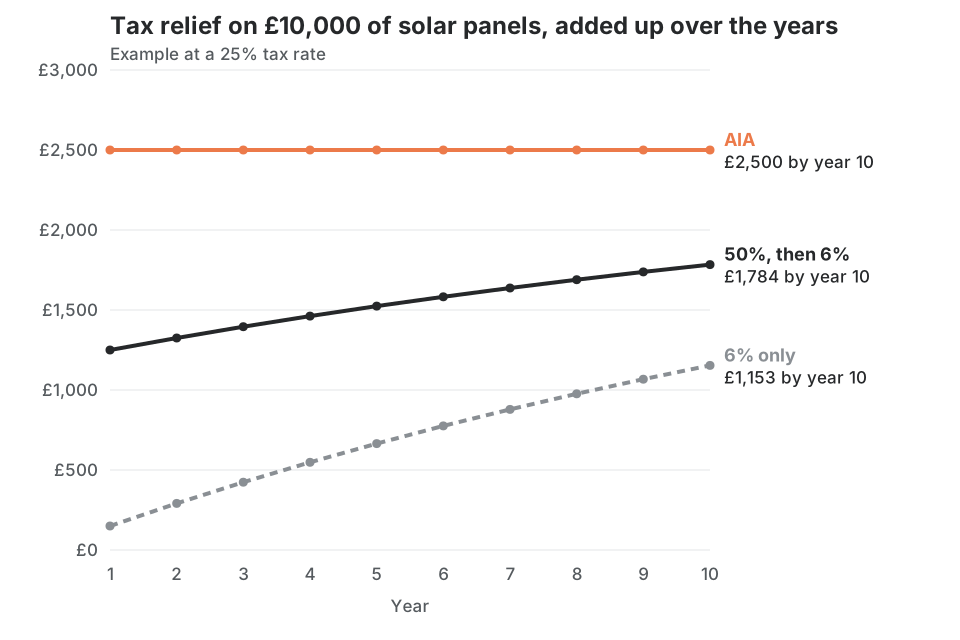
The slower routes take decades to catch up: by year 10, the 6%-only route has given less than half. The AIA gets you the relief years sooner, which helps cash flow. See commercial solar costs and payback for the full picture.
Planning solar for your business premises?
We design and fit solar panels for business premises as well as homes, within 100 miles of Doncaster. Free consultation and a written quote, with no pressure to sign.
Or call 0333 577 6576, Monday to Friday, 9am to 5pm. We'll only use your details for your quote. Privacy policy
Who can claim solar capital allowances?
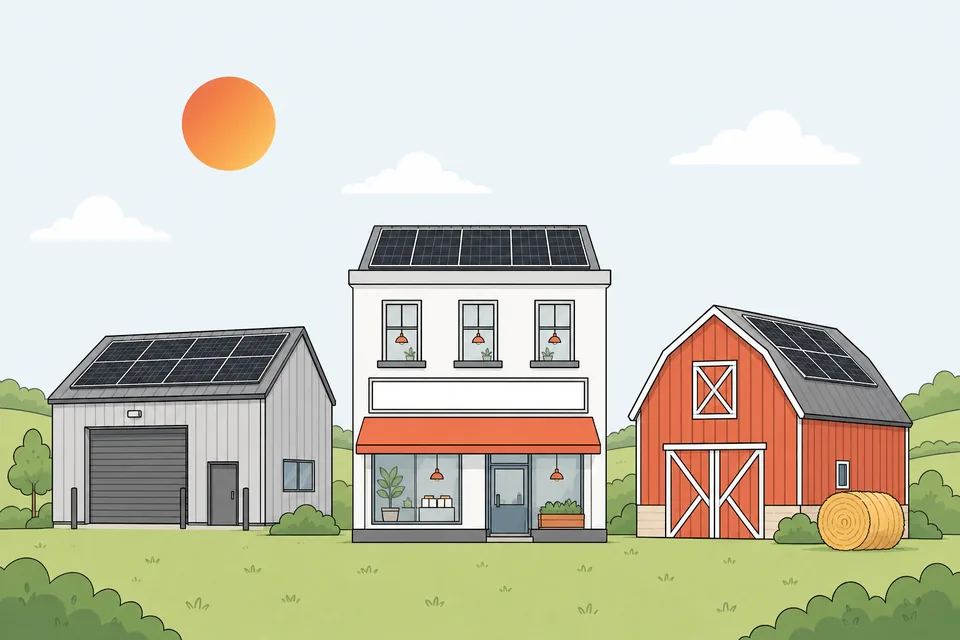
Any business that buys solar panels for use in its trade can usually claim. The main exceptions are sole traders on the cash basis and landlords of let homes.
| Who | What they can usually claim |
|---|---|
| Limited company | The AIA, then the 50% allowance on new panels, then 6% a year |
| Sole trader or partnership (accruals accounts) | The AIA, then 6% a year. No 50% allowance |
| Sole trader on the cash basis | No capital allowances. The cost may be an allowable expense instead |
| Landlord of a let home | Nothing for panels used in the home itself |
| Tenant who pays for panels on business premises | Yes, with a lease on the premises |
| Business with panels it doesn't own | Nothing: only the owner can claim |
Limited companies claim on the Company Tax Return, in the order above.
Sole traders and partnerships claim through Self Assessment. If the panels also serve your home, they go in a pool of their own, and your accountant will need the business share.
On the cash basis, the standard method for sole traders, you can't claim capital allowances except on cars. Capital spending is usually an allowable expense instead, but not for an asset that won't reach the end of its useful life, or lose 90% or more of its value, within 20 years.
The panels we fit carry a 25-year product warranty, so ask your accountant whether yours pass that test.
Landlords can't claim on equipment for use in a let dwelling-house, though equipment in the shared parts of a block of flats can qualify. If you rent business premises and pay for panels yourself, HMRC treats you as owning them once fitted, if you have an interest such as a lease.
Who owns the panels decides who claims. Hire purchase and long funding leases count as owning. If a provider owns the panels on your roof, for example under a lease or a power purchase agreement, you can't claim.
Farm businesses claim like any other trade: see agricultural solar panels.
What counts, when to buy, VAT and business rates
The panels and fitting them qualify, timing decides the year, and VAT and business rates follow their own rules.
Plant and machinery allowances: what counts and when
HMRC's term is qualifying expenditure: for solar, the cost of providing the panels, plus building alterations needed to fit them, but not repairs.
- Panels and fitting them: special rate.
- Roof alterations needed to install them: can qualify. Roof repairs don't.
- Battery storage: HMRC's guidance on solar panels doesn't mention batteries, so ask your accountant.
Ask for an invoice that lists each item separately.
Spending counts on the date the obligation to pay becomes unconditional, or on the due date if payment is due more than four months later. Check the dates with your accountant before your year end.
What to give your accountant
Before you claim, give your accountant what they need to learn your position:
- the itemised invoice, and the contract and payment dates
- whether the panels are new or second-hand
- who owns them: bought, hire purchase, lease or power purchase agreement
- the split between business and private use
- your other equipment spending this year, which shares the AIA
- whether you use the cash basis
Keep the handover pack we send after installation with your tax records.
VAT, business rates and export payments
The 0% VAT rate only applies to homes and charity buildings, until 31 March 2027, when it rises to 5%. Business installs pay the standard 20%.
If you're VAT registered, you can reclaim VAT on items you buy for use in your business, or the business share if they're also for personal use. There's more in our guide to VAT on solar panels.
In England, equipment in renewable energy installations that generates or stores power, including solar panels and their batteries, is left out of business rates valuations until 2035.
Exporting power? Under Ofgem's Smart Export Guarantee, some suppliers pay anyone with an eligible solar system up to 5MW for the electricity they export, businesses included.
Buying or selling premises with panels
Buying premises with panels fitted? Agree a value for the fixtures with the seller, or you can't claim. If you buy from a previous business owner, you can usually only claim for fixtures they claimed for. Second-hand panels can get the AIA, but not the 50% allowance.
Selling? What you get for the panels usually comes off your special rate pool, and anything above the pool balance is added to your profits as a balancing charge.
If you claimed the 50% allowance, half the sale value is a balancing charge instead, and the rest comes off the pool. A pool of £1,000 or less can be written off in one go.
The bottom line: if your business owns its panels and isn't on the cash basis, the AIA usually gives full relief in year one. Check the timing with your accountant.
Planning a commercial system? We're MCS certified and members of RECC and NAPIT. Ask for a free quote.
Questions people ask
Do solar panels qualify for full expensing?
No. Full expensing only covers main rate assets, and HMRC treats solar panels as special rate. A company can use the AIA first, then the 50% first-year allowance on new panels.
What is the writing-down allowance on solar panels?
Six per cent a year, on the remaining balance of the special rate pool, where solar panels go. The October 2026 Budget left it at 6%.
Do solar batteries qualify for capital allowances?
HMRC's guidance on solar panels doesn't mention batteries. Ask your accountant whether a battery qualifies, and which pool it goes in, before you claim.
About this guide
Written by the SolarSave team in Retford: MCS certified installers, led by a founder in solar since 2010. We checked every rule against GOV.UK, HMRC's own manuals and helpsheets, the Valuation Office Agency, Ofgem and the Budget documents of 28 October 2026 on 16 November 2026. Tax rules change at Budgets, so we update this page when they change. The worked examples are our own sums from the official rates.
The 29 sources we checked
- HMRC Capital Allowances Manual CA22335: solar panels, updated 8 July 2025, checked 16 November 2026
- GOV.UK: Work out your writing down allowances (rates and pools), checked 16 November 2026
- GOV.UK: Claim capital allowances, checked 16 November 2026
- GOV.UK: Capital allowances, what you can claim on, checked 16 November 2026
- GOV.UK: Annual investment allowance, checked 16 November 2026
- HMRC Capital Allowances Manual CA23084: allocating the AIA, updated 8 July 2025, checked 16 November 2026
- GOV.UK: Full expensing and the 50% first-year allowance, checked 16 November 2026
- GOV.UK: Check if you can claim full expensing or 50% first-year allowances, published 20 March 2024, checked 16 November 2026
- GOV.UK policy paper: Permanent full expensing for companies investing in plant and machinery, 22 November 2023
- GOV.UK policy paper: New first-year allowance and reducing the main rate writing-down allowance, 26 November 2025
- GOV.UK policy paper (Budget 2026): Reduce the main rate writing-down allowance and increase the main rate first-year allowance, 29 October 2026
- GOV.UK: Budget 2026, overview of tax legislation and rates, 28 October 2026, updated 5 November 2026, checked 16 November 2026
- GOV.UK policy paper: Ending enhanced capital allowances for energy and water efficient plant and machinery, 29 October 2018
- GOV.UK: Corporation Tax rates and allowances, checked 16 November 2026
- GOV.UK: Corporation Tax marginal relief, 5 January 2023, checked 16 November 2026
- GOV.UK: Income Tax rates and Personal Allowances, tax year 2026 to 2027, checked 16 November 2026
- GOV.UK: Self-employed National Insurance rates, tax year 2026 to 2027, checked 16 November 2026
- GOV.UK: Cash basis, checked 16 November 2026
- HMRC Business Income Manual BIM72035: cash basis, capital expenditure, updated 4 August 2026, checked 16 November 2026
- HMRC Capital Allowances Manual CA23060: plant and machinery in a dwelling-house, updated 8 July 2025, checked 16 November 2026
- HMRC Capital Allowances Manual CA26150: fixtures, person with an interest in land, updated 8 July 2025, checked 16 November 2026
- HMRC Capital Allowances Manual CA11800: when capital expenditure is incurred, updated 8 July 2025, checked 16 November 2026
- GOV.UK: Disposing of an asset if you claimed full expensing or 50% first-year allowance, published 20 March 2024, checked 16 November 2026
- HMRC HS252: Capital allowances and balancing charges (2026), updated 6 April 2026, checked 16 November 2026
- HMRC: VAT on energy-saving materials and heating equipment (Notice 708/6), checked 16 November 2026
- GOV.UK: VAT rates, checked 16 November 2026
- GOV.UK: Reclaim VAT on business expenses, checked 16 November 2026
- VOA Rating Manual: valuation of plant and machinery, updated 21 September 2026, checked 16 November 2026
- Ofgem: Smart Export Guarantee (SEG), checked 16 November 2026