

What you still pay, and what you save
The standing charge
About £200
a year, whatever you generate
54.83p a day on Ofgem's price cap for 1 October to 31 December 2026. Solar can't cut it.
Units you buy after dark and in winter
26.32p
a unit (kWh), on average
The cap's average rate, Direct Debit, same dates. This is the part solar shrinks.
What a unit you export earns
13p
the best rate open to anyone we found (variable)
From Fuse Energy. That's about half what a unit costs to buy.
Ofgem announces the cap for January to March 2027 on 25 November 2026. We'll update these figures then.
What do solar panels cut, and what don't they?
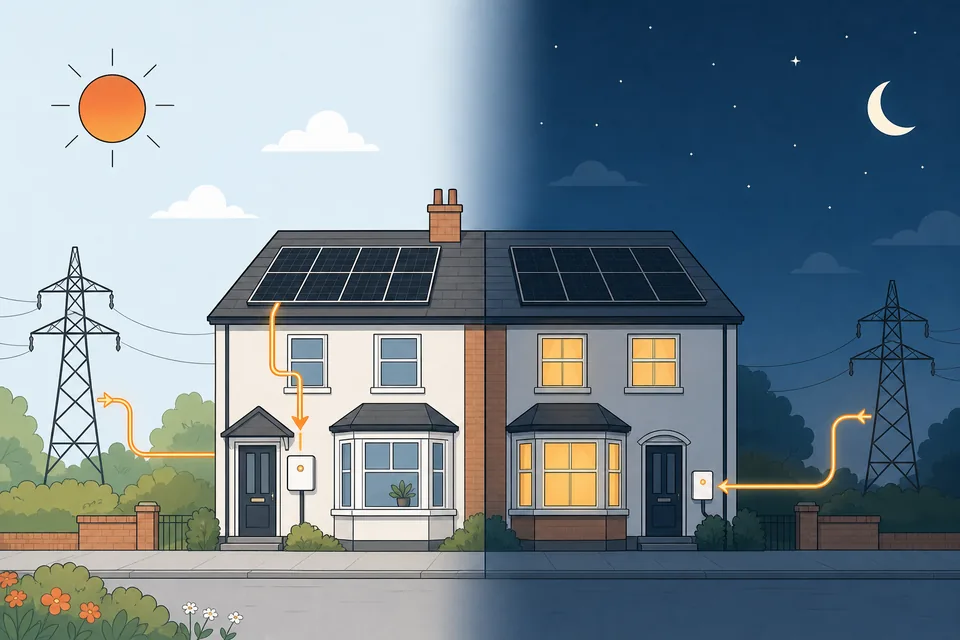
Solar cuts the units you buy in daylight, but not the standing charge or, without a battery, what you use after dark.
| Part of your bill | Does solar cut it? | Why |
|---|---|---|
| Standing charge | No | You pay it every day, even if you use no energy, Ofgem says. |
| Units used in daylight | Yes, mostly | Your home uses its own solar first and buys only the shortfall. |
| Units used after dark | Only with a battery | Solar panels don't actually generate free electricity at night. |
| Units used in winter | Partly | October to December makes about a third of what spring does. |
What you do make is clean, low-carbon solar energy. The Energy Saving Trust says a typical home setup could save around one tonne of carbon a year, depending on where you live.
Why is my electric bill so high with solar panels?
Usually one of seven things: three are normal, and four are problems you can get fixed.
1. It's winter
Short days cut output hard. In government figures, UK solar on the Feed-in Tariff had a load factor (its share of full output) of 4.7% from October to December 2024. That's about a third of its 13.6% from April to June.
See how solar copes in winter.
2. You use most of your energy after dark
Solar output peaks when the sun is strongest. If you're out all day, then cook, wash and watch TV in the evening, you export most of your solar, then usually buy power back for more than the export earned.
3. The standing charge hasn't changed
It's about £200 a year on the current cap. In a sunny month it can be most of your bill. That's normal, not a fault.
4. Your export isn't set up or isn't paid
Export payments don't start by themselves: GOV.UK says you apply directly to a Smart Export Guarantee (SEG) supplier to get paid. You need:
- an MCS certificate for your installation
- a smart meter that records half-hourly export readings
- an export reference number (an export MPAN), which your network operator creates
No export credits? Ask whether your export is registered, then compare the best SEG tariffs.
5. Your readings count export as import
Ofgem warned suppliers in 2014 that some digital meters at homes with solar systems were set up wrongly. They added exported units to the import reading, which can make a household pay for both. Ofgem said unsuitable meters should be exchanged.
6. Your bills are estimated
Smart meters usually send readings automatically. If there's a problem, your bills are estimated, Citizens Advice says. An estimate based on your pre-solar use can be far too high.
7. There's a fault
If your solar panels stop generating, you buy almost everything, and you may not notice for a long while. In a Which? survey of over 2,000 owners in April 2024, 68% had no technical issues. Inverter problems were the most common, at 15%.
Check the inverter for error codes and its live and total output, as Which? suggests. If something's wrong, contact your installer first, MCS says, and allow up to 14 days for a reply. If we fitted your system, that's us. See common solar panel problems.
Check your bill and solar production in 6 steps
You need your bills and your inverter app.
- Get 12 months of bills. Download them from your supplier's app or online account. Compare each month with the same month last year.
- Split the bill. Note the standing charge, units imported and any export credit.
- Check the readings are real. If any show "E" for estimated, send an actual reading.
- Check what you generate. Note your solar system's total for a year. Solar on the Feed-in Tariff had a median load factor of 9.2% in 2024/25: about 800 units a year for each kW installed (our sum).
- Check export is paid. No export credit usually means it isn't registered.
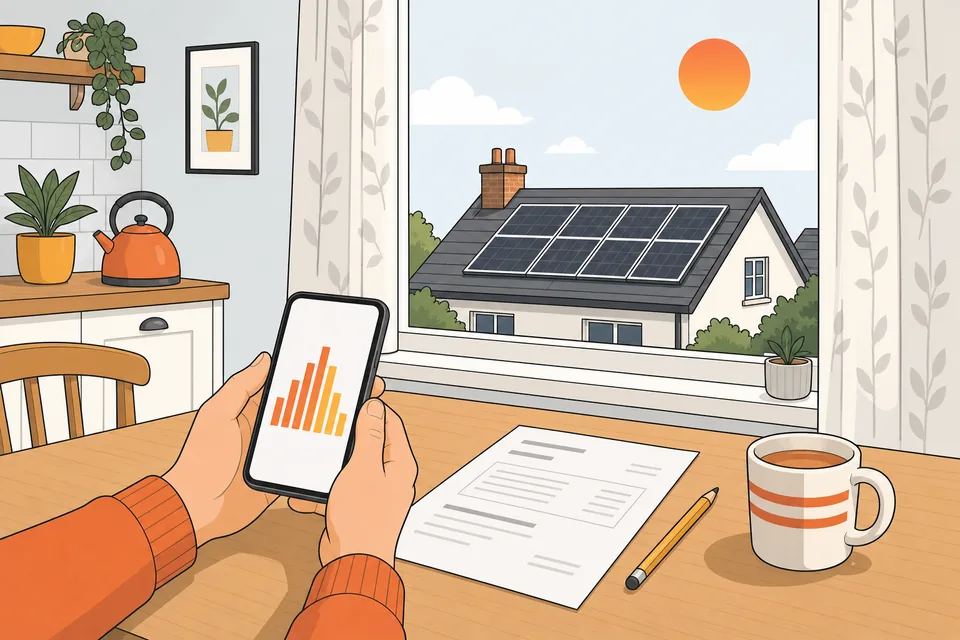
- Do the sunny-day test. At midday, with little switched on, check your inverter app shows it's generating. If it is and the import reading still climbs fast, tell your supplier. If it isn't, see reason 7.
Well below that benchmark in a sunny year? See how to test a solar panel. If your supplier won't fix a billing error, complain to it, then go to the Energy Ombudsman, Citizens Advice says. Your supplier usually can't charge for energy you used more than a year ago.
Does the UK use net metering?
No. Exported units don't cancel out imported ones. In Great Britain, where the SEG runs, they're counted and priced separately.
You pay your supplier's rate for every unit you import. For residential solar, the SEG pays a lower rate for each unit exported, and nothing for what you use yourself. Suppliers set that rate, though Ofgem says it must be above zero.
Do solar batteries lower the bill?
Yes, if most of your use comes in the evening. A battery stores spare daytime solar energy so you can use more of it outside daylight hours, Which? says. You export less and buy less.
One of our battery customers, who charges on a cheaper overnight rate, wrote: "we are now (hopefully) getting the full benefit of overnight cheap rate electricity powering batteries and day time the batteries powering the house" (Peter W., Google, November 2025).
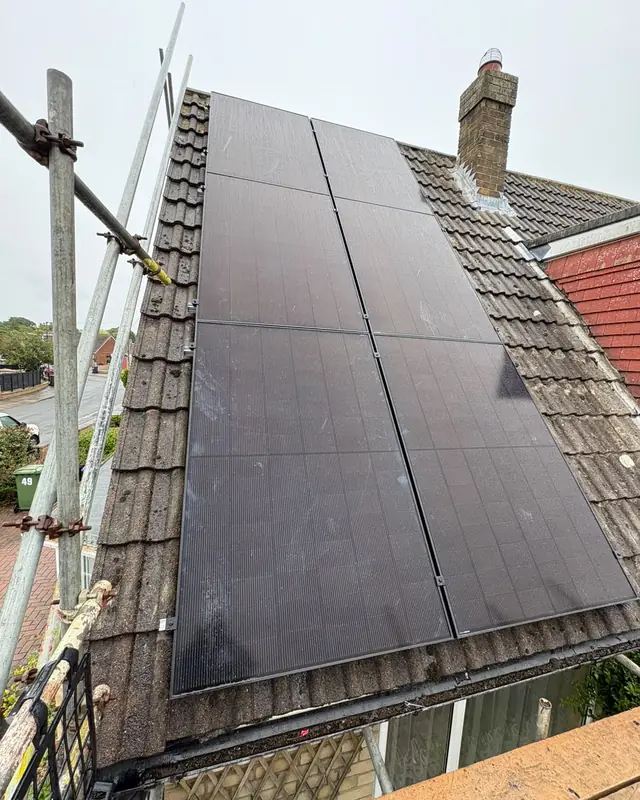
Our solar and battery systems are fully installed from £7,500 (10 panels, a Fox ESS battery and scaffolding to one side), including VAT, at 0% until 31 March 2027. Already have solar? See adding a battery to existing solar panels, or whether a battery is worth it.
Using most of your energy in the evening?
Tell us when you use energy and we'll show what a battery could cover. Free consultation, no pressure to sign.
Or call 0333 577 6576, Monday to Friday, 9am to 5pm. We'll only use your details for your quote. Privacy policy
How to cut your energy bills further
Homeowners save most by using more of their own solar power while it's light. Every unit you use yourself is one you don't buy at 26.32p.
- Run the washing machine, dishwasher and tumble dryer in daylight, on delay timers if you're out.
- On a tariff with cheaper off-peak rates, you could charge a battery cheaply and use the stored energy when electricity costs more, Which? says.
- Watch for new loads. An electric car, a heat pump or more people living at home raise your energy usage, much of it in winter or after dark.
Over a year, solar should cut your bill, not clear it. If yours hasn't fallen, run the six checks.
Questions people ask
Can panels clear electricity bills completely?
Rarely. You still pay the standing charge, about £200 a year on the current cap, and buy units in winter and after dark.
Do businesses still pay for power?
Yes. A business with solar still buys units its panels can't cover, such as after dark. Solar cuts its energy bills most if it does most of its work by day.
Why did my bill go up after installation?
Look for estimated readings first, then check your readings aren't counting export as import. Report either to your supplier. If your panels went in during autumn, shorter days and a new price cap can raise the bill too.
About this guide
Written by the SolarSave team in Retford: MCS certified installers, led by a founder in solar since 2010. We checked every figure against Ofgem, DESNZ, GOV.UK, HMRC, the Energy Saving Trust, Citizens Advice, Which?, MCS and suppliers' own pages on 16 November 2026. The price cap changes every three months: Ofgem announces the January to March 2027 cap on 25 November 2026, and we update this page when it does.
The 18 sources we checked
- Ofgem: Changes to the energy price cap between 1 October and 31 December 2026, 26 August 2026, checked 16 November 2026
- Ofgem: Energy price cap and standing charges explained, checked 16 November 2026
- DESNZ: Feed-in Tariff load factor analysis 2024/25 (Energy Trends special article), 18 December 2025, checked 16 November 2026
- GOV.UK: Smart Export Guarantee, updated 19 October 2026, checked 16 November 2026
- Energy Saving Trust: Smart Export Guarantee, updated 20 October 2026, checked 16 November 2026
- Ofgem: Smart Export Guarantee (SEG), checked 16 November 2026
- Ofgem: Smart Export Guarantee, generators, checked 16 November 2026
- Octopus Energy: How do I get an export MPAN?, checked 16 November 2026
- Fuse Energy: Smart Export Guarantee (Single Rate Variable Export, 13p), 23 July 2026, checked 16 November 2026
- Ofgem: Import supply meters affected by onsite generation (letter to suppliers), 14 February 2014, checked 16 November 2026
- Citizens Advice: If you think you've been charged too much for your energy, last reviewed 19 January 2024, checked 16 November 2026
- Citizens Advice: If you're having problems with your smart meter, checked 16 November 2026
- Which?: Solar panel problems and how to solve them, 26 March 2026, checked 16 November 2026
- Which?: The most common solar panel problems (survey of members, April 2024), 25 July 2024, checked 16 November 2026
- Which?: Solar panel battery storage, 30 October 2026, checked 16 November 2026
- MCS: What to do if things go wrong, updated 7 September 2026, checked 16 November 2026
- Energy Saving Trust: Solar panels (home solar content), updated 19 September 2024, checked 16 November 2026
- HMRC: VAT on energy-saving materials and heating equipment (VAT Notice 708/6), updated 31 January 2024, checked 16 November 2026